Few foods have accompanied humanity for as long as olive oil. Its history stretches back thousands of years and is deeply intertwined with the rise of Mediterranean civilizations — as food, but also as fuel for light, medicine, and an object of religious ritual.
The oldest proof: Tel Tsaf in the Jordan Valley
When people stopped merely gathering olives and started planting them can now be dated fairly precisely. A team from Tel Aviv University and the Hebrew University of Jerusalem analysed charcoal from the Chalcolithic settlement of Tel Tsaf in the middle Jordan Valley, inhabited between roughly 7,200 and 6,700 years ago. The charcoal came from olive trees — at a site where the wild olive does not grow naturally.
That is precisely where the proof lies: whoever burned olive wood there must have brought the trees in and cultivated them. In archaeobotany, a species found outside its natural range counts as indisputable evidence of domestication. The study, published in 2022 in "Scientific Reports", therefore dates olive domestication to around 7,000 years ago — the earliest known evidence for the domestication of any fruit tree. A few centuries later, by about 6,000 years ago, olive horticulture was well established in the southern Levant: olive stones, olive wood and stone crushing basins turn up at Chalcolithic sites in the Golan Heights and in Samaria.
Crete: the first large-scale oil economy
From the Levant, cultivation spread west. On Crete it became an economy for the first time: storing large quantities of grain, wine and olive oil was one of the main functions of the Minoan palaces. The West Magazines at Knossos were long corridors lined with pithoi, clay storage jars as tall as a person. Arthur Evans, the first excavator of Knossos, estimated the storage capacity there at more than 246,000 litres of olive oil — a figure to treat with the caution any century-old estimate deserves, but one that shows the order of magnitude.
And it really was about oil, as more than the jars attest. Clay tablets in Linear A and Linear B, the earliest written form of Greek, record olive oil stocks, allocations and deliveries. Crete is thus the oldest known place where olive oil was not only made but administered.
Greece: oil as a symbol of wealth and divinity
In ancient Greece, the olive tree was considered a sacred gift from the goddess Athena and was closely tied to prosperity, peace and culture. Olive oil served not only as a staple food, but also for body care, as fuel for oil lamps, and as a prize: winners of the ancient Olympic Games were crowned with olive branches, and athletes rubbed themselves with oil before competing. Valuable amphorae of olive oil were also awarded as prizes to winners of the Panathenaic Games.
Rome: trade good, mass commodity — and Spanish even then
The Romans perfected cultivation, pressing and trade across the entire Mediterranean. The scale of that trade can still be walked around in Rome today: Monte Testaccio, the mound in the Testaccio district, is made almost entirely of broken oil amphorae — by the excavators' estimates, the remains of some 25 million complete vessels.
What makes it interesting is where those amphorae came from. More than 80 per cent of them are vessels of the Dressel 20 type, and that type comes from Baetica, the Guadalquivir valley in what is now Andalusia. The oil with which the Roman annona supplied a city of a million people and the legions on the frontiers was therefore, in large part, Spanish oil. Spain's present dominance of the world market is in that sense not a new development but the resumption of a very old role.
Religious and ritual significance
In Judaism, Christianity and Islam, olive oil still holds a special place today. It was used to anoint kings and priests, burned in temple lamps, and in the Old Testament stands as a symbol of peace and abundance. This cultural and religious significance was a major driver behind the spread of olive cultivation across the entire Mediterranean over the centuries.
Historical uses beyond the kitchen
- Lighting: Until the invention of electric light, olive oil was for millennia the most important fuel for oil lamps around the Mediterranean.
- Body care: Greeks and Romans used olive oil for skin and hair care and in baths.
- Salves and ointments: for centuries oil was the carrier that made active and aromatic substances keepable and usable at all.
- Trade and economy: Olive oil was one of antiquity's most important trade goods and a measure of wealth for entire regions.
From press to centrifuge: the real break
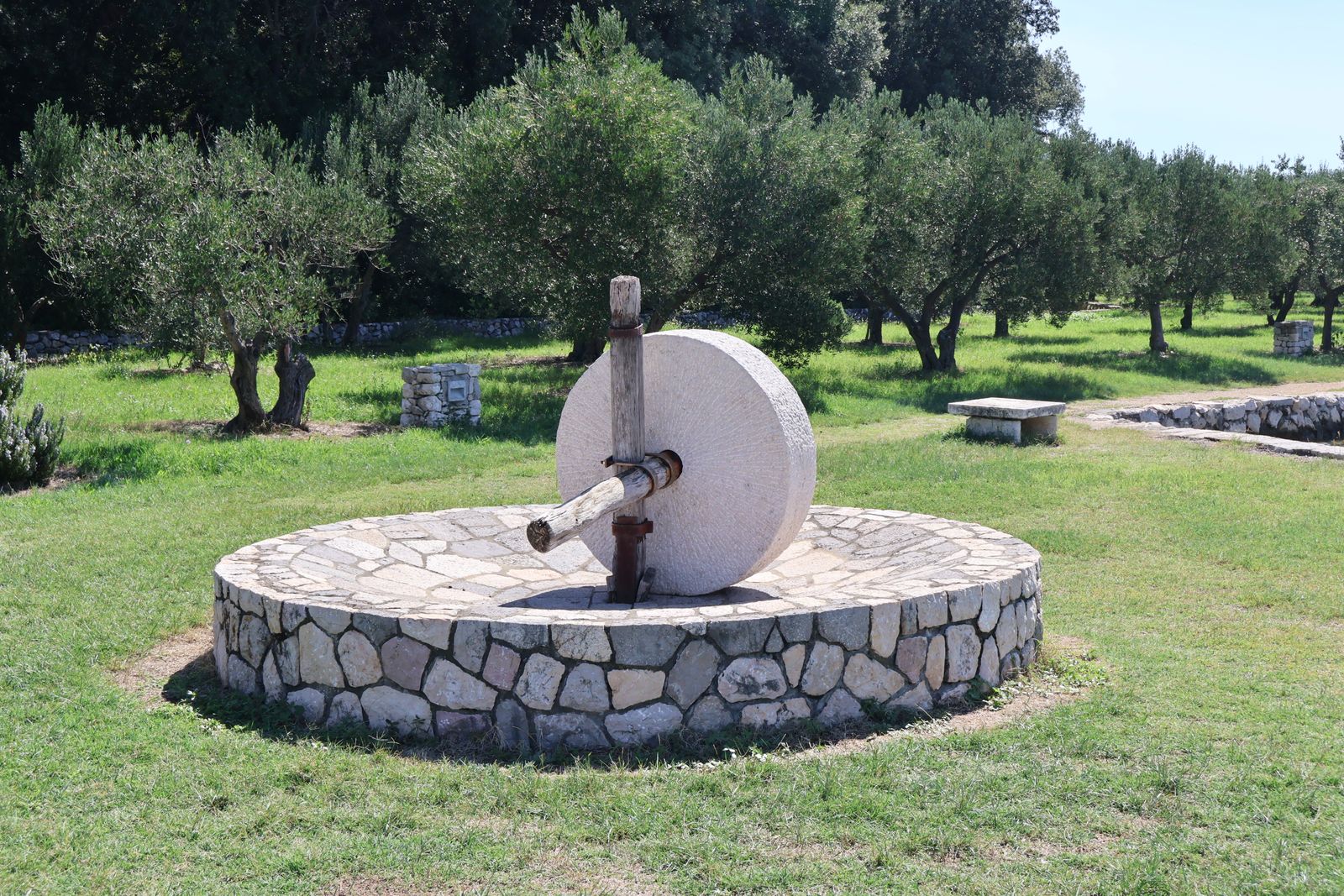
Well into the twentieth century, an ancient oil miller would have recognised a mill. The principle held for three thousand years: grind olives to a paste under a millstone, layer the paste onto mats, and squeeze those layers under a press. That process is where the term still printed on labels comes from — "first pressing", because there genuinely was a second one, in which hot water wrung a little more oil out of the residue.
The break came with the decanter centrifuge. A modern mill does not press at all: it grinds the olives to a paste, malaxes it, and separates the oil in a single pass in a centrifuge. There is no second pressing — and therefore no "first" pressing either. Swiss law draws that line explicitly: the Federal Department of Home Affairs ordinance on foodstuffs of plant origin (VLpH, SR 817.022.17) permits "first cold pressing" in Article 10, paragraph 3, only for oil from a first mechanical pressing in a traditional system using hydraulic presses, and "cold extraction" only for oil obtained by percolation or centrifugation — both below 27 °C.
So anyone reading "first cold pressing" on a bottle today is most likely holding an oil that was never pressed. Which terms on the Swiss shelf mean something and which merely sell nostalgia, we took apart in our piece on "first cold pressing" and unfiltered oil.
How the oil reached the Swiss table
For Switzerland this history is surprisingly young. Well into the twentieth century olive oil barely featured in everyday German-speaking Swiss cooking; demand arrived with Italian immigration from the 1950s onwards. In the early 1980s, according to the US Department of Agriculture series, Switzerland imported around 2,000 tonnes of olive oil a year; by the end of the 1990s it was around 8,000 tonnes.
From there the curve kept climbing steeply: 7,847 tonnes in 2000 according to the Federal Office for Customs and Border Security, and 19,090 tonnes in 2020 worth CHF 101.5 million — the point at which olive oil became, by value, Switzerland's most important imported vegetable oil. A product administered at Knossos and shipped in Roman amphorae thus needed until the 1990s to become unremarkable in a Swiss household. The full series is in our analysis of olive oil consumption in Switzerland from 2000 to 2025.
What has stayed the same
As the Roman Empire expanded, olive cultivation spread as far as Spain and North Africa, regions that today rank among the world's largest producers. Despite centrifuges, near-infrared analysis and harvesting machines, the core of the process is unchanged: the olive is broken up mechanically, and the oil is separated from water and pulp without solvents and without heat. Extra virgin olive oil is one of the very few industrially made foods whose method a Bronze Age farmer would understand in principle — which is also why harvest year and storage still tell you more about a bottle than any marketing term. For current per-litre prices on the Swiss shelf, see our price overview.
Olive oil is therefore not just a cooking oil, but a living piece of Mediterranean cultural history.
Frequently asked questions
How old is olive cultivation?
The earliest known evidence comes from Tel Tsaf in the middle Jordan Valley and is about 7,000 years old. Charcoal from olive trees at a site where the wild olive does not grow counts as proof of deliberate cultivation. It is the earliest known evidence for the domestication of any fruit tree.
Where was olive oil first produced on a large scale?
In Minoan Crete. The palaces served among other things as stores for grain, wine and oil; Arthur Evans estimated a capacity of more than 246,000 litres for the West Magazines at Knossos. Clay tablets in Linear A and Linear B record oil stocks and allocations.
Where did the Roman Empire's olive oil come from?
To a large extent from Spain. More than 80 per cent of the amphorae in Rome's Monte Testaccio mound are vessels of the Dressel 20 type from Baetica, today's Andalusia. The mound consists of the remains of an estimated 25 million amphorae.
Is olive oil still pressed today?
In the great majority of mills, no. They grind, malax and separate the oil in a decanter centrifuge — one pass, no pressing. That is why Swiss VLpH rules allow "first cold pressing" only for genuine hydraulic presses, while centrifuged oil is correctly called "cold extraction".
Sources
- Langgut D, Garfinkel Y: 7000-year-old evidence of fruit tree cultivation in the Jordan Valley, Israel. Scientific Reports 12, 7463 (2022)
- EurekAlert / Tel Aviv University: Olive trees were first domesticated 7,000 years ago (2022)
- ScienceDaily: Olive trees were first domesticated 7,000 years ago, study finds
- Current World Archaeology: Olives – oiling the wheels of civilisation
- Ashmolean Museum, University of Oxford: Dining with the Minoans
- Monte Testaccio – overview of size, amphora types and the Dressel 20 share
- CEIPAC, Universitat de Barcelona: The olive oil trade between Baetica and Rome (Greece & Rome XXXIX/2, 1992)
- Fedlex: Ordinance of the FDHA on foodstuffs of plant origin, fungi and edible salt (VLpH), SR 817.022.17 – Art. 10 para. 3