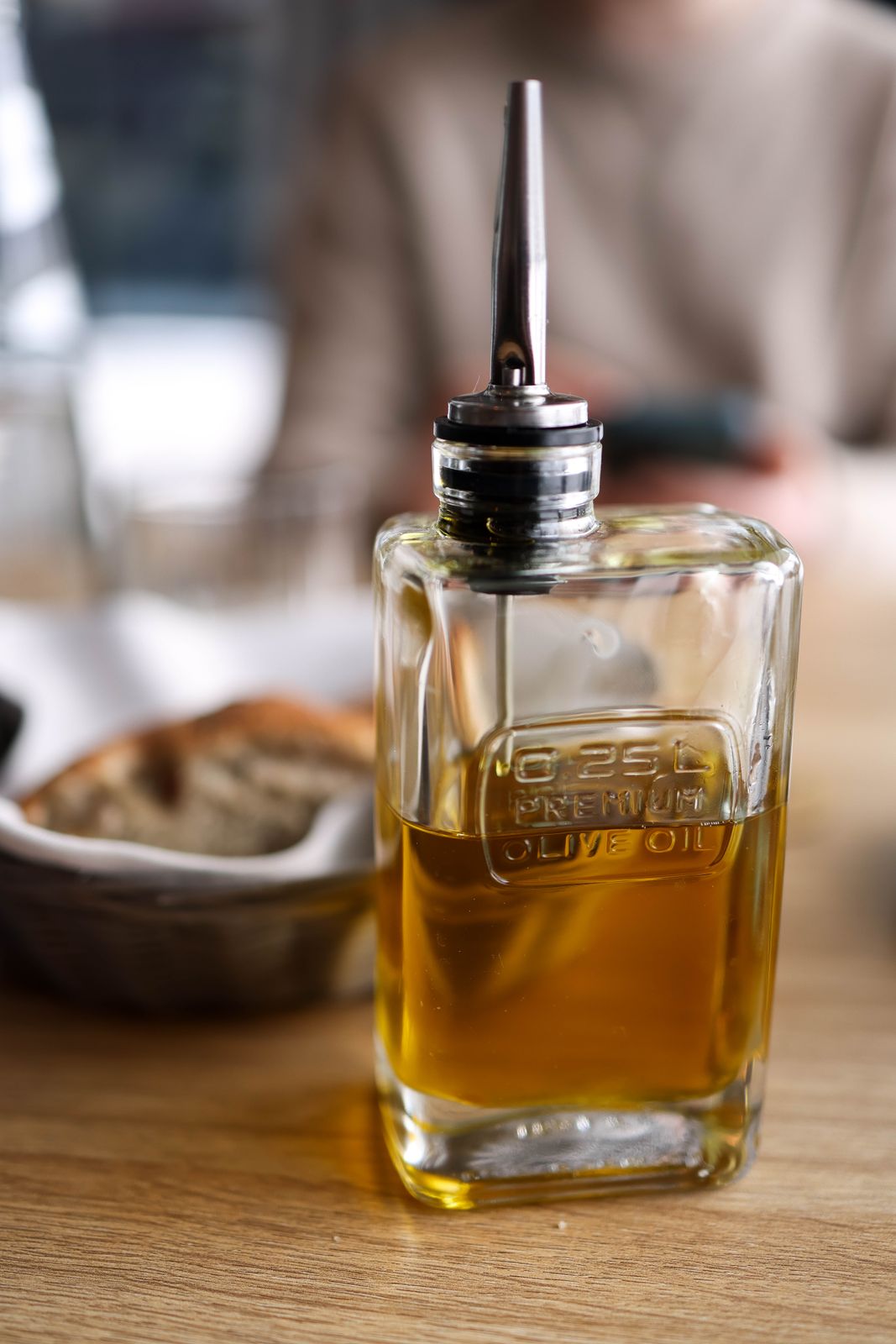
The question sounds like a magazine feature: which olive oil do Switzerland's wealthiest households buy? We researched it and have to hand it back. On olive oil, there is no published data on the buying behaviour of high-net-worth households in Switzerland – no survey, no retail statistics, no study. Everything in circulation on the subject is guesswork, and we are not going to write it down.
What does exist is the shelf. The premium segment for extra virgin olive oil is real in Switzerland, it is documented, and it can be worked out franc by franc. This article looks at what is actually on it, at what "first cold pressing", "non filtrato", "novello" and "prima spremitura" mean legally, and at what the Swiss consumer tests say about whether the markup buys quality or a story.
Where the premium segment sits in Switzerland
The expensive bottles are not in the supermarket. They are in the food halls of the department stores and in specialist shops. Globus stocks Château d'Estoublon from Provence and Ardoino from Liguria in its Delicatessa range; Manor Food carries its own organic oils and Italian brands. One name has dropped out: Jelmoli closed in February 2025 after its owner, Swiss Prime Site, failed to find anyone to take the department store on. Manor has held a long lease on three floors of the same building since July 2024 and runs its Zurich flagship store there.
Then there is the specialist trade: Acetolio in Aarau and Lenzburg, the evoo ag online shop, or "Oliven & Öl" on Hottingerplatz in Zurich. These shops sell what the supermarket does not: oils with a harvest date, a single variety and a producer you can look up. If a trip to the shop is not an option: which Swiss shops deliver olive oil, and what they charge for it, is in our overview of buying olive oil online.
The price range is well documented, because the consumer magazines print it every time. In July 2025 the Fédération romande des consommateurs compared ten oils between CHF 7.95 and 58 per litre; in September 2025 Kassensturz and K-Tipp tested thirteen between CHF 7.95 and 40. That is not the ceiling: in 2016 the Castelines sold at Mövenpick cost CHF 73.80 per litre, and in 2010 A Bon Entendeur tested a Cartoceto DOP at CHF 72. Switzerland's premium segment therefore runs roughly from CHF 25 to 75 per litre. What lies above that we checked at the source in The world's most expensive olive oils.
Taking the markup apart
Part of the markup has nothing to do with the oil. In September 2026 one Sicilian oil in Acetolio's range cost CHF 21.50 in a 500 ml bottle, CHF 89.50 in a 3-litre tin and CHF 126.00 in a 5-litre tin. By our arithmetic that is CHF 43.00, CHF 29.83 and CHF 25.20 per litre – the same oil, a spread of more than 40 per cent, purely down to glass, label and fill size. How the same effect plays out in the supermarket is calculated in 500 ml, 1 litre or a bulk tin.
Another part is real. Green, early-picked olives yield less oil per kilo of fruit, the volume from the first days of harvest is limited, and strict selection means throwing oil away. We unpick what is substance and what is marketing in our piece on Picual from the early harvest.
"First cold pressing": the phrase modern mills may not use
This is where it gets concrete. The Swiss federal ordinance on foods of plant origin, mushrooms and table salt (SR 817.022.17) regulates two terms separately in Article 10, paragraph 3, and the wording matches EU law exactly:
- "First cold pressing" may appear only on extra virgin or virgin olive oil obtained below 27 °C from a first mechanical pressing of the olive paste by a traditional extraction system using hydraulic presses.
- "Cold extraction" may appear only when the oil was obtained below 27 °C by percolation or centrifugation of the olive paste.
The point is the machinery. A modern mill does not press. It grinds the olives into a paste, malaxes it and separates the oil in a centrifuge, in a single pass. There is no second pressing, so there is no "first" pressing either. The legally correct term for that oil is cold extraction. In the EU the same wording stood in Article 5 of Implementing Regulation (EU) No 29/2012 and carries over into Delegated Regulation (EU) 2022/2104, which entered into force on 24 November 2022 and repealed the older texts.
This does not make every bottle saying "first cold pressing" a deception – traditional mills with presses still exist. It makes the phrase a statement about process, not a quality mark.
"Non filtrato": more polyphenols, a shorter window
Unfiltered oil is cloudy because fruit particles and water stay in suspension. The Swiss ordinance expressly permits washing, decanting, centrifugation and filtration for cleaning, so filtered or not is a producer's choice, not a grade.
What filtration does to the oil was measured by Zullo, Venditti and Ciafardini in Foods (2021). Cellulose filtration brought water content down to 0.06 per cent, against 0.16 to 0.38 per cent with cotton filters, but cut polar phenols by 35 to 42 per cent and antioxidant activity by 42 to 46 per cent. Cotton filters cost only 7 to 13 per cent of the phenols. The trade-off: yeasts were still alive in unfiltered and cotton-filtered oil after a month of storage, but not after cellulose filtration, because the water they needed had gone.
That is the whole bargain: more polyphenols against more water and living micro-organisms, which can produce defects a panel will call "fusty" or "muddy". A literature review in Foods (2023) concludes that the findings are contradictory and that "to filter or not" cannot be answered in general. One practical rule survives: use an unfiltered oil quickly and keep it dark and cool, as set out in how to store olive oil.
"Novello" and "prima spremitura": what is not regulated
"Novello" has no legal basis. The term does not appear in the Swiss ordinance, and in Italy, where it comes from, it is not a protected category either – unlike in wine. The Apulian producer Olio Intini says so in as many words on its own site. What it describes is the fresh oil of the current harvest, usually from late October, often unfiltered. What the ordinance does regulate is the vintage: a harvest year may be stated only if 100 per cent of the contents come from that harvest (Article 12, paragraph 4). That single line tells you more than any Italian word on the front label.
"Prima spremitura" without the words "a freddo" is not a defined term either, so the general rule applies. Under Article 18 of the Swiss Foodstuffs Act, all information about food must correspond to the facts, and presentation, labelling and advertising must not deceive consumers. Advertising "first pressing" for an oil that was never pressed sits on thin ice.
What else the label has to show – and what is usually missing
Two further rules make the back label worth reading. An acidity figure may be stated only if the peroxide value, wax content and ultraviolet absorbance appear alongside it, in the same type size and the same field of vision (Article 12, paragraph 6). And taste or smell may only be described using terms that are based on a panel's sensory assessment (Article 12, paragraph 5).
In practice, the simplest things are missing. In 2025 the FRC found that four of the ten oils it examined gave "Europe" as their only origin, that hardly any named a harvest date and that only two named the producer. In the 2022 inspection campaign run by fifteen cantons, 47 per cent of the 96 oils tested had labelling defects. This is exactly where paying more can be made to pay off: harvest date, a specific place, the variety, the producer. A good oil can supply all four; an anonymous one cannot.
Does the markup buy quality?
The Swiss tests give no comfortable answer. Two findings argue against price: in 2016 Kassensturz failed two expensive bottles alongside the cheap ones – Castelines from Mövenpick at CHF 73.80 per litre and Ardonio from Globus at CHF 39.80. In 2020 Globus's own Delikatessa scored only "satisfactory", while Lidl's Primadonna at CHF 9.40 per litre took "good" and the value-for-money award.
In favour of price: the 2020 winner was Oro Bailén from Manor at CHF 39.80 per litre, and in 2010 the most expensive oil in the field, a Cartoceto DOP, was also the best. The most telling year is 2025. Of thirteen oils between CHF 7.95 and 40 per litre, two were rated "very good": Manor's organic oil at CHF 21.50 and Coop's Greek Iliada at CHF 21.90. The worst-rated oil was the cheapest.
Manor Bio Extra virgin olive oil, 1 l
Italy · Organic
CHF 21.501 L · CHF 21.50 per litre
Kassensturz / K-Tipp 2025: very good Check priceThe pattern across fifteen years of Swiss testing is awkward for both camps. Risk is highest at the very bottom, but going from about CHF 20 to about CHF 70 per litre buys no measurably better sensory score. It buys variety, origin, freshness and a story – things you may well want, but that no panel rewards. Every ranking in detail is collected in our Swiss olive oil test 2026, and if you want to know what the oils on the shelf cost in the first place, the price per litre is on our overview of Swiss olive oil prices.
Frequently asked questions
Is "first cold pressing" allowed on olive oil?
Yes, but only for oil from a first mechanical pressing of the olive paste below 27 °C in a traditional system using hydraulic presses (Article 10, paragraph 3 of the Swiss ordinance; Article 5 of EU Regulation 29/2012). Mills that centrifuge may only say "cold extraction".
Is unfiltered olive oil better?
It contains more polyphenols, but also more water and live yeasts. Cellulose filtration was measured to cut polar phenols by 35 to 42 per cent, while stopping the yeasts from surviving. Unfiltered oil is more fragile and should be used up faster.
What does "novello" on a bottle mean?
Legally, nothing. The term is not a protected category in Swiss law or in Italy. The only reliable indication is the harvest year, which may be stated only when the whole contents come from that harvest.
How much does good olive oil cost in Switzerland?
The two winners of the 2025 Kassensturz and K-Tipp test cost CHF 21.50 and CHF 21.90 per litre. Judging by the prices quoted in the tests, the premium segment in food halls and specialist shops runs roughly from CHF 25 to 75 per litre.
Which oil do wealthy Swiss households buy?
Nobody has published data on that. There is no survey and no retail statistic that breaks olive oil purchases down by wealth, so any specific claim about it would be invented.
Sources
- Fedlex: Swiss ordinance on foods of plant origin, mushrooms and table salt (VLpH/ODAlOV), SR 817.022.17 – Art. 10 and 12
- Fedlex: Swiss Foodstuffs Act (LMG), SR 817.0 – Art. 18 on protection against deception
- Implementing Regulation (EU) No 29/2012, Article 5 – optional indications for olive oil
- EUR-Lex: Commission Delegated Regulation (EU) 2022/2104 on marketing standards for olive oil (2022)
- Zullo BA, Venditti G, Ciafardini G: Effects of the Filtration on the Biotic Fraction of Extra Virgin Olive Oil. Foods 2021;10(8):1677
- Frangipane MT et al.: Effects of Filtration Processes on the Quality of Extra-Virgin Olive Oil – Literature Update. Foods 2023;12(15):2918
- SRF Kassensturz: olive oil test – "extra vergine" or not (02.09.2025)
- SRF Kassensturz: the great "extra vergine" swindle (03.05.2016)
- SRF Kassensturz: many "extra vergine" oils are not extra at all (26.05.2020)
- FRC: comparison of olive oils (01.07.2025)
- Canton of Zurich: one in ten "extra vergine" olive oils shows sensory defects (13.04.2022)
- 20 Minuten: Jelmoli closes for good in February 2025
- Globus: olive oil in the Delicatessa range (accessed 09.2026)
- Acetolio: buying olive oil online (accessed 09.2026)
- evoo ag: Swiss centre of competence for olive oil (accessed 09.2026)
- Oliven & Öl, Hottingerplatz Zurich (accessed 09.2026)
- Olio Intini: "olio novello" does not exist – here is why