Anyone reading a Swiss olive oil test table runs into three kinds of verdict that are almost never explained: marks from "very good" to "insufficient", scores out of 10, and sentences like "only virgin". These are not three ways of saying the same thing. They are three different measurements, and only one of them is law.
This article explains how a tasting panel turns noses into a number, which number decides the grade on the bottle, and how to read the results of Kassensturz, K-Tipp, Saldo, FRC and ACSI once you know. What the individual defect notes actually smell like has an article of its own – this one is about the scoring.
Three verdicts, three different claims
Before you read a single mark, you need to know who awarded it and what it hangs on.
| Verdict | Who awards it | What it means |
|---|---|---|
| "extra virgin", "virgin", lampante oil | an approved panel of tasters under EU law | the grade – legally binding, it decides the sales description on the bottle |
| "very good", "good", "satisfactory", "insufficient" | the test magazine | the overall mark of the test, by the editors' own criteria. No legal effect |
| points from 0 to 10 | the panel, on top of the legal assessment | how good a defect-free oil is within its grade |
How far apart the three can sit is clear from the joint test by Kassensturz and K-Tipp of 2 September 2025. Denner's Ybarra was still legally "extra virgin" – and came out of the field worst all the same; according to SRF the panel held that it was not "clean and pure". For Lidl's Primadonna Bio the finding was harder: a majority of the panel registered a defect, and the oil was downgraded to "virgin". That concerns the declaration on the bottle, not the sympathies of a jury.
How a panel turns noses into one number
Sensory assessment is not a matter of taste but a standardised measurement. Implementing Regulation (EU) 2022/2105 points for it to the method of the International Olive Council, COI/T.20/Doc. No 15. The procedure is the same in Wädenswil as in Jaén:
- The group. The assessment is not made by one person but by a panel of 8 to 12 trained tasters, plus a few reserve tasters. It is led by a panel leader with recognised training.
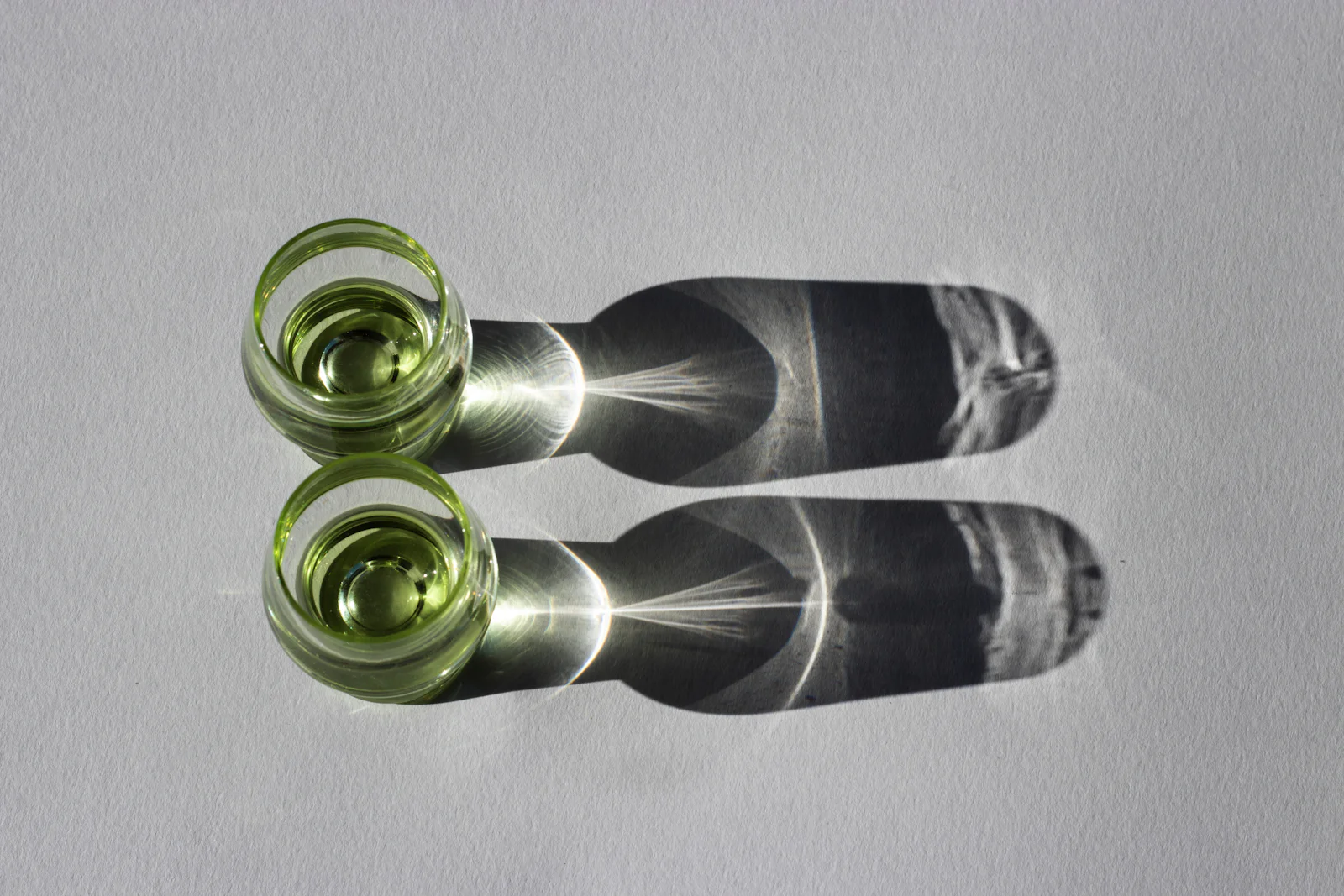
- The conditions. Blind, in standardised blue glasses so that colour cannot influence anyone, covered and brought to 28 degrees, the temperature at which the aroma compounds come through most clearly.
- The profile sheet. Each taster marks on a scale how strongly they perceive the three positive attributes – fruity, bitter, pungent – and how strongly each defect note: rancid, fusty/muddy sediment, musty-humid-earthy, winey-vinegary and several more.
- The calculation. The panel leader does not work out the average but the median of each attribute. A single taster who smells something nine others do not can therefore neither save a bottle nor sink it.
Out of all of that, only one figure counts for the grading: the median of the defects, defined as the median of the defect perceived at the greatest intensity. Not the sum of all defects – an oil with one clear off-note falls even when it is otherwise clean.
For the result to hold at all, the group has to agree. The method requires, for the attribute that classifies the oil – the strongest defect and the fruitiness – a robust coefficient of variation of no more than 20 per cent. If the scores scatter more widely, the panel leader has the sample tasted again in a further session. In practice that means, as SRF put it after the 2020 test: an oil is downgraded only once half the panel finds the same type of defect at a clear intensity.
Why the grade falls when the lab results are clean
The limits are set out in Annex I of Delegated Regulation (EU) 2022/2104. They are short:
- Extra virgin olive oil: median of the defects = 0, median of the fruitiness greater than 0. No perceptible defect and, at the same time, a positive fruitiness.
- Virgin olive oil: median of the defects up to 3.5.
- Lampante oil: median of the defects above 3.5. It may not stand on the shelf as an edible oil at all.
This hurdle is entirely independent of the chemical one. Free acidity, the peroxide value and the UV figures can all sit inside the limits and the oil can still lose its grade – because a nose finds a defect for which there is no laboratory value. What the chemistry measures and what it does not is in Acidity: what 0.8 percent on the label means.
The Swiss evidence is the comparison published by the Fédération romande des consommateurs on 1 July 2025: ten supermarket oils, tasted blind, plus laboratory work and a label check. Two of the cheapest bottles were downgraded to "virgin" over sensory defects although the chemistry turned up nothing – Coop's Prix Garantie and Aldi Suisse's Bellasan. ACSI, the consumer organisation of Italian-speaking Switzerland, took the investigation up in July 2025 under the title "Oli d'oliva non proprio speciali" and noted that the defects have no consequences for health; according to ACSI, Aldi passed the result on to its supplier. According to K-Tipp of 6 May 2026, Prix Garantie is still declared "extra vergine".
Prix Garantie Extra virgin olive oil, 1 l
EU, bottled in Italy
CHF 7.951 L · CHF 7.95 per litre
FRC 2025: only “virgin” (downgraded) Check priceBellasan Extra virgin olive oil, 1 l
EU blend
CHF 7.951 L · CHF 7.95 per litre
FRC 2025: only “virgin” (downgraded) Check priceThat is the most useful practical lesson of these tests: "the chemistry was fine" is not a rebuttal of a downgrade, it is a different subject.
"Fruity", "bitter", "pungent": three regulated words
The medians from the profile sheet do not vanish into the test report. Annex II of the same Regulation 2022/2104 governs when these attributes may appear on a label, and ties them to thresholds. Note that the words in the regulation are not the ones most bottles use:
- robust, when the median of the attribute is above 6.0;
- medium, when it is above 3.0 and no more than 6.0;
- delicate, when it is 3.0 or lower.
Two overall terms go with them: an oil may be called balanced when the medians for bitter and pungent are no more than 2.0 points above the fruitiness median, and sweet oil when both medians are 2.0 or lower. These claims may be used only for extra virgin olive oil and virgin olive oil, and only with a certificate from the panel leader.
For shopping that means: "medium fruity" is a measured statement with a panel behind it. "Especially aromatic" or "fine in flavour" is not – wording like that appears in no regulation.
The Wädenswil panel behind the Swiss tests
The panel whose verdicts you read in Swiss tests is the Swiss Olive Oil Panel (SOP) of the ZHAW in Wädenswil. It is run, trained and supervised by the university's Food Sensory research group; the ZHAW states more than 30 tasters, trained according to the guidelines of the International Olive Council and the EU.
It tasted the Kassensturz tests of 2016 and 2020 as well as the joint test by Kassensturz and K-Tipp of 2 September 2025, in which each of the 13 oils was assessed by eleven panellists. And it judges the oils of the Olive Oil Award – Zurich: in 2026 there were 98 extra virgin olive oils from ten countries and regions of origin, of which five took gold, 27 silver and 24 bronze.
That is where the score in the test tables comes from. Alongside the legal assessment, the SOP uses a harmony rating of its own on a scale from 0 to 10: it judges the interplay of fruitiness, bitterness and pungency, plus cleanness and aromatic complexity. In 2025 the two best-rated oils reached 7 out of 10 points (Manor Bio) and 6.6 points (Coop's Iliada), according to SRF. These points do not say whether an oil keeps its grade – that is decided by the median of the defects alone – but how good it is within its grade.
Why two panels judge the same oil differently
In 2025 that is exactly what happened: after the downgrade of the Primadonna Bio, Lidl had the same batch assessed by a German panel, which found nothing to object to, according to SRF; the importer of the Ybarra pointed to variation between panels. The law has a procedure for this.
If a panel of tasters does not confirm the grade, the authorities request without delay, at the request of the party concerned, two counter-analyses by other approved panels, at least one of which must come from the producing member state. In Switzerland the Cantonal Laboratory of Zurich has taken this route: in 2023 and in 2024 it downgraded three oils out of twelve on sensory grounds each year, and two arbitration analyses confirmed the finding.
What follows for you as a buyer: a downgrade is a solid finding about that batch, not a verdict on the brand for years to come. And the objection "another panel found nothing" is not an acquittal – it is precisely why the regulation provides for two counter-analyses and not one.
How to read a Swiss test table
- Look first at what was tested. Kassensturz and K-Tipp taste; the FRC tastes, analyses and checks the label; Saldo had sixteen oils examined in 2026 for residues in the laboratory only – no nose comes into it there. A good laboratory result is not a good sensory result.
- Take "only virgin" more seriously than "insufficient". The first is a statement about the declaration, the second a mark from the editors.
- Read scores as a ranking, not as a test. 6.6 out of 10 means: free of defects and good in comparison, not "barely passed".
- Check the date. Sensory work describes the bottling that was assessed; a finding from 2020 says little about today's bottle.
- Do not expect complete rankings. The individual marks from K-Tipp, Saldo, Bon à Savoir and the FRC sit behind a paywall; usually only the extremes are freely available.
- Smell for yourself. Your nose does not replace a panel, but it does catch a clear defect.
Every Swiss test from 2010 to 2026, with winners, downgrades and source, is in Olive Oil Tests in Switzerland 2026. What the tested bottles cost on the shelf today, with litre price and survey date, is on the page Olive oil prices in Switzerland.
Frequently asked questions
What does "insufficient" mean in an olive oil test?
It is the overall mark of the test magazine, not a grade. An oil can be legally faultless "extra virgin" and still finish "insufficient". That is what happened to Denner's Ybarra at Kassensturz and K-Tipp on 2 September 2025: the grade held, the assessment was the worst in the field.
Why is an oil downgraded to "virgin" when the laboratory found nothing?
Because the sensory assessment is a separate requirement, independent of the chemistry. For extra virgin olive oil, Annex I of Regulation (EU) 2022/2104 requires a median of the defects of 0; a defect such as rancid or fusty is caught only by the panel, by no laboratory value. That is exactly how the FRC justified the 2025 downgrade of Prix Garantie (Coop) and Bellasan (Aldi).
How many tasters does a panel need – and is my own nose enough?
The grading is carried out by an approved panel of 8 to 12 trained tasters, whose individual scores the panel leader condenses into a median; if they scatter too widely, the sample is tasted again. Your nose does not replace that, but it is enough to spot a clear defect and to decide whether you buy the bottle again.
What does "robust fruity" mean on a label?
It is a regulated claim: under Annex II of Regulation (EU) 2022/2104, "robust" may be used only when the median of the attribute is above 6.0, "medium" between above 3.0 and 6.0, "delicate" at 3.0 or lower – and only with a certificate from the panel leader. Free marketing wording such as "especially aromatic" is tied to no threshold at all.
Are bitter and pungent bad marks?
No. On the profile sheet, bitter and pungent are positive attributes, together with fruity. The defect notes are others: rancid, fusty/muddy sediment, musty-humid-earthy, winey-vinegary and several more. An oil that scratches the throat is therefore not scored any lower.
Sources
- Delegated Regulation (EU) 2022/2104 on the marketing standards for olive oil, consolidated version: Annex I (median of the defects) and Annex II (optional terminology for labelling)
- Implementing Regulation (EU) 2022/2105 laying down rules on conformity checks, approved panels of tasters and counter-analyses
- International Olive Council: COI/T.20/Doc. No 15, method for the organoleptic assessment of virgin olive oil (PDF)
- ZHAW Wädenswil: sensory assessment and the Swiss Olive Oil Panel
- ZHAW: 25 years of the Olive Oil Award – Zurich, the best olive oils of 2026
- SRF Kassensturz: Olivenöl «Extra vergine» im Test: Zwei mit Note «sehr gut» (2 Sep 2025)
- SRF Kassensturz: Viele «Extra vergine»-Olivenöle sind gar nicht extra (26 May 2020)
- FRC: Le comparatif des huiles d'olive (1 Jul 2025)
- ACSI, La borsa della spesa: Oli d'oliva non proprio speciali (July 2025, PDF)
- K-Tipp 09/2026: Olivenöl: Bessere Qualität «herausfordernd» (6 May 2026)
- Saldo 07/2026: olive oils tested, laboratory for residues (15 Apr 2026, paywalled)
- Canton of Zurich: Olivenöl «extra vergine» geschmacklich nicht immer extra (31 Jan 2025)
- Federal Department of Home Affairs ordinance on foodstuffs of plant origin, mushrooms and table salt (VLpH), SR 817.022.17