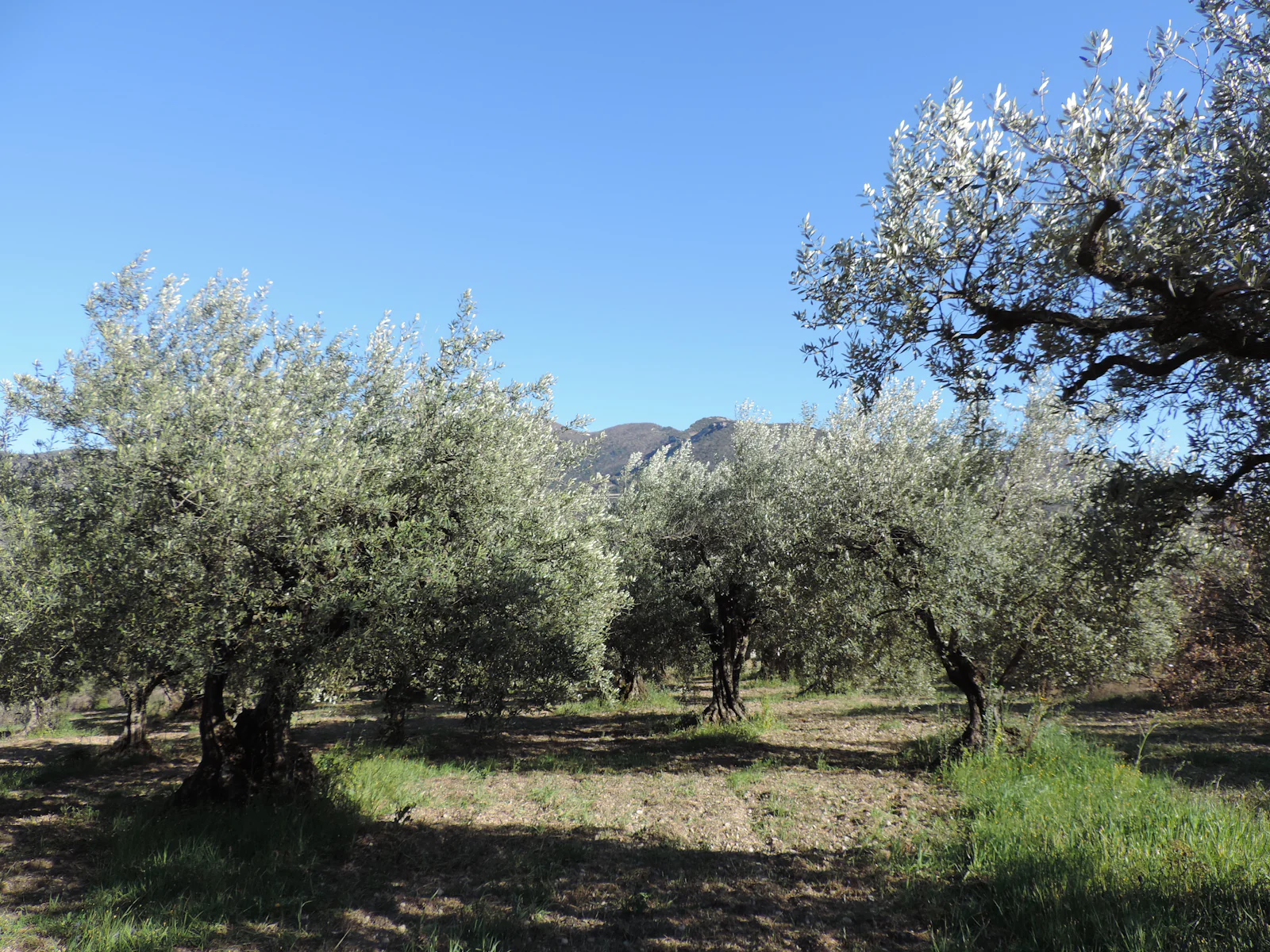
Walk the slopes above Lake Lugano in Ticino in October and you will see them: nets under gnarled trees, ladders, crates of small fruit with a violet sheen. Olive oil from Swiss olives does exist. It is simply so rare that most people in the country have never held a bottle of it. A good year's harvest fills a few thousand bottles, a bad one a few hundred.
Our editorial team has gathered what can be documented about the production: where the trees stand, who mills, how recent harvests turned out, what a bottle costs and where to get one. Plus the new movement in Vaud and Valais, where a national producers' association has existed since 2025. The longer cultural history of the olive tree south of the Alps we summarise only briefly; what the oil is actually used for in Swiss kitchens is in our Swiss recipes with olive oil.
Ticino: trees, sites and varieties
The olive tree is no newcomer to Ticino. The late-antique poet Claudian already wrote of the "litus oliva Larius", the olive-clad shore of Lake Como. A deed of 769 from Campione mentions olives, and Ekkehard IV of St Gallen referred to olives from the area around the year 1000. Hard frost winters in 1494, 1600 and 1709 damaged the stands, and mulberry trees later displaced the olives. In the 19th century the little oil produced burned mainly in church lamps, and by the middle of the 20th century only Gandria was still pressing small quantities.
The revival began in the late 1980s in Coldrerio with Bernardino Caverzasio and Claudio Tamborini. In 1993, 380 trees were planted there, and the inventory of Switzerland's culinary heritage dates the first production to 1994. swissinfo, by contrast, wrote in 2001 that Tamborini had already made oil in 1992. The sources contradict each other here, and we leave it at that.
How many trees there are
The stands are surveyed regularly. The 2021 count arrived at 7,652 olive trees: 5,465 in the Sottoceneri and 2,187 in the Sopraceneri, a figure that includes 140 trees in the Grisons Misox (Mesolcina). The largest sites were Gudo with 592 trees, Coldrerio with 554, Mendrisio with 328, Rancate with 298 and Gandria with 286. The lowest tree stood on the Brissago Islands at 193.5 metres, the highest in Mairengo at 907 metres.
A fresh count was made in June 2024. The Corriere del Ticino reported 9,050 trees for Ticino and the Misox, around 70 per cent of them in the Sottoceneri. The largest contiguous grove, with some 400 trees, lies in Gudo, and the highest site is in Campello at around 900 metres. In October 2025 the Research Institute of Organic Agriculture (FiBL) rounded this to roughly 10,000 trees in Ticino and around 15,000 across Switzerland, including some 5,000 in the French-speaking part.
Which varieties grow
The Ticino range is Tuscan and Lombard in character. Leccino, Frantoio and Pendolino form the base, alongside Maurino, Bianchera and Moraiolo, plus Ascolana as a table olive. According to swissinfo some 20 varieties are grown, seven or eight of them commonly. Anyone wanting to compare the profiles of these varieties will find them in our guide to olive varieties in Europe. Leccino is generally considered comparatively robust, Pendolino is often planted as a pollinator, and Frantoio stands for green, peppery oils.
Grisons on the margin
Outside Ticino, the Grisons also has a few olives. Besides the 140 trees in the Misox, the culinary heritage inventory mentions a farm in Brusio in the Val Poschiavo which obtained 13 litres of oil from 75 trees in 2020. That is household supply, not a market.
Who makes oil in Ticino
The number of brands you can actually buy is small. Most trees belong to private individuals, municipalities or small operations that have their olives milled collectively. Some producers do bottle under their own name. The following prices come from the inventory of Switzerland's culinary heritage and were recorded between December 2020 and July 2021; current prices may differ.
| Oil | Producer and origin | Notable for | Price (2020/21) |
|---|---|---|---|
| L'Or da Gandria | Viva Gandria, Gandria | Oil from the historic olive village on Lake Lugano | CHF 16 / 25 cl, CHF 30 / 50 cl |
| Olio del Ceresio | Claudio Tamborini, around 400 trees in Castelrotto, Lamone and Comano | According to swissinfo (2023) a blend of 65 per cent Ticino and 35 per cent Italian olives | CHF 29 / 50 cl |
| Mostolio | Delea | Ticino olives | CHF 39 / 50 cl |
| Olio dell'Amorosa | Delea, Fattoria l'Amorosa in Gudo-Sementina, around 500 trees since 2000 | 100 per cent Ticino olives | CHF 44 / 50 cl |
| Colle degli Ulivi | Azienda Agricola San Martino, Rancate | Estate in Rancate in the Mendrisiotto | no figure found |
By our calculation these prices correspond to roughly CHF 58 to 88 per litre. In Delea's online shop, Olio Amorosa was listed from CHF 22.00 at the time of our research, offered in 25 and 50 cl bottles. Delea states that the olives are hand-picked in October and November and cold-pressed within hours.
Alongside these, the Amici dell'Olivo bottle a blended oil of their own, made from their members' olives. The association was founded in 2001 and is chaired by Claudio Premoli; among other things it organises a collective harvest. For many smallholders it is the only way to make oil at all out of twenty or thirty kilos of olives.
The mills: the real bottleneck
An olive has to be pressed shortly after picking or the quality suffers. Anyone who knows the criteria for "extra virgin" knows how quickly fermentation and oxidation can throw an oil out of that category; we explain the basics in What Is Extra Virgin Olive Oil? This is exactly where Ticino is weak: there are only a few mills, and every one of them is small.
| Mill | Operator | Key figures |
|---|---|---|
| Sonvico (around 620 m above sea level) | Ennio Bianchi, 2011 to 2024 | First pressing 2011: around 1,300 kg of olives, some 140 litres of oil. 2024: around 6,300 kg of olives, 520 litres. Closed on 31 December 2024. |
| Losone | Angelo Delea winery | Mill bought in Tuscany in 2018; first pressing 1,300 kg of olives, some 140 litres. |
| Frantoio Atena, Mezzana | Associazione Frantoio Atena (chair Claudio Premoli), on the estate of the cantonal agricultural college | Inaugurated on 11 November 2024; capacity around 10 tonnes of olives per season; minimum 100 kg per producer; cost CHF 70,000, some 35,000 of it from the regional development agency. |
Atena's 100-kilo minimum shows the smallholders' problem. Anyone with only a few trees has to team up with neighbours or hand their olives to the Amici dell'Olivo collective pressing. With Sonvico closing at the end of 2024, only Atena and one private mill were operating in the 2025 season, according to RSI.
Harvests 2020 to 2025: a record and a black year
Volumes in Ticino swing enormously. Olive trees bear in alternation anyway, a year of heavy fruit often followed by a weak one. Weather and pests come on top. The figures from the Amici dell'Olivo, published by RSI in December 2025, show the spread.
| Year | Olives | Oil | Note |
|---|---|---|---|
| 2020 | around 20,000 kg | 1,830 kg (some 2,000 litres) | Record year |
| 2023 | 120 kg (collective harvest only) | no total found | Heavy infestation by the olive fruit fly |
| 2024 | around 11,700 kg | around 800 kg | Good bearing year, barely any flies |
| 2025 | around 1,600 kg | just over 120 kg | Down 92 per cent against 2020 |
By our calculation the oil yield in 2020 was a good 9 per cent of the olive weight, and just under 7 per cent in 2024. For 2023 only the volume of the Amici dell'Olivo collective harvest is documented, not a cantonal total. RSI named the weather and the olive fruit fly as the reasons for the 2025 collapse. In September 2024 the Corriere del Ticino had still reported an "anno di carica", a bearing year without flies; a year later little of that was left.
Vaud, Valais and Geneva: the Romandie gets going
The greater momentum now lies north of the Alps. On 18 September 2025 the Association suisse des producteurs d'olives (ASPO) was founded in Luins on Lake Geneva, with its seat in Bonvillars on Lake Neuchâtel. The president is Frank Siffert of the La Sauvageraie estate in Bonvillars, the vice-president the nurseryman Urbain Girod. Terre&Nature put membership at around 50, while FiBL spoke of some 30 producers. According to its own website the association intends to produce and market olive oil and table olives; a mill of its own is a long-term goal.
Plantings in figures
- 32 operations in the Romandie had planted olives by the winter of 2025 or intended to (Terre&Nature).
- The Girod nursery offered 13,000 trees for sale in autumn 2025.
- Three producers in Roche VD are planning 4,000 trees; in Bex, Anne Bielman has 100 trees.
- ASPO expects a further 13,000 to 15,000 trees in 2026, mainly from a group of farmers in the Chablais.
- In July 2025 swissinfo expected around 20,000 trees nationwide by the end of 2026.
Frank Siffert planted around 60 trees of about ten varieties in Bonvillars in 2019, supported by BioVaud, as RTN reported in 2024. In Valais the Association oléicole de Fully runs a "Pressoir Oléicole" at Route du Chavalard 45 and sells trees for the 2027 planting season: CHF 35 for two-year, CHF 55 for three-year and CHF 75 for four-year plants. FiBL also mentions an olive site in Branson at around 700 metres. In Geneva a small olive operation has existed in Satigny since 2019, which according to Wikipedia was probably the first north of the Alps.
Whether the trees survive frost is an open question. FiBL is working with the French institute INRAE to study trees planted before 2012 that survived the hard winter of that year, in order to identify cold-resistant planting material. How much oil the Romandie actually produces today, and where most of it is pressed, we found quantified in no source.
Why Swiss olive oil is expensive and scarce
A price of CHF 58 to 88 per litre looks high set against the supermarket shelf. There are comprehensible reasons for it.
- Volume: even the record year 2020 produced around 2,000 litres. Switzerland imports roughly 16,000 to 19,000 tonnes of olive oil a year. By our calculation the Swiss share therefore came to about one hundredth of a per cent. More on the demand side is in our analysis of olive oil consumption in Switzerland from 2000 to 2025.
- Olive fruit fly: the larvae eat the flesh; infested olives give less and poorer oil. 2023 and 2025 show how hard an infestation pushes the harvest down.
- Frost: the history of Ticino's olives is a history of frost winters. That applies all the more in the Romandie, which is why frost-hardy trees are being sought there.
- Small mills: a plant like Atena processes around 10 tonnes a season. That covers the present stand but permits no industrial costs.
- Manual work: steep slopes, small parcels, harvesting by hand. The machines that run in Andalusia have no place here.
Anyone buying Swiss olive oil is therefore paying for a labour of love with genuine effort behind it, not for a notably higher quality than good oils from Italy or Spain. Whether an oil is good is answered by taste, not by a passport.
What the label says and what it does not
There is no protected designation of origin (AOP/PDO) for Swiss olive oil. We found no organically certified Swiss olive oil in the course of our research. That does not mean nobody works organically, only that we found no correspondingly certified oil on sale.
The Swiss cross is a touchier question. According to the Federal Office for Agriculture, the Swissness rules for foodstuffs require in principle at least 80 per cent Swiss raw materials by weight and the essential processing to take place domestically. Raw materials with a self-sufficiency rate below 20 per cent are excluded from that calculation, and the relevant ordinance lists olives with a self-sufficiency rate of less than 5 per cent. What this means concretely for an individual label is a legal detail we do not judge here. For buyers something else counts: reputable producers state where their olives come from.
Our advice on reading the label:
- Look at the origin of the olives, not only the place of bottling. The Olio del Ceresio example shows that Ticino oils can also be blends with Italian olives.
- Check the harvest year. With volumes this small the latest vintage is almost always the one on sale; older bottles should be cheaper.
- Prefer small bottles. 25 cl is used up faster and the oil stays fresher. Tips on this in How to Store Olive Oil.
Where to buy and taste Swiss olive oil
We found no major retailer that carries Swiss olive oil as a regular line. The route almost always leads directly to the producers.
- Delea: Olio Amorosa is available in the winery's online shop while stocks last.
- Producers direct: Viva Gandria for L'Or da Gandria, Claudio Tamborini for Olio del Ceresio, Azienda Agricola San Martino in Rancate. It is worth enquiring shortly after pressing in late autumn.
- Amici dell'Olivo: the association bottles a blended oil from its members' olives and gives information through its website. Anyone who owns trees will also find the collective harvest there.
- Sentiero dell'olivo: the olive trail between Castagnola and Gandria, opened in 1995, runs along the lakeshore past old and young olive trees. In October and November you will often see harvest nets.
- Romandie: in Fully and Bonvillars the oil is barely on sale yet. The ASPO website and the Association oléicole de Fully are the best places to follow developments.
The best time to visit is the harvest from mid-October to the end of November. The oil is then fresh, green and often still slightly cloudy, and the producers have stock.
Frequently asked questions
Is there really olive oil from Switzerland?
Yes. Ticino has been pressing oil again since the 1990s, up to around 2,000 litres in good years. Vaud and Valais have young plantings whose oil volumes are not yet quantified.
How much does Swiss olive oil cost?
The prices recorded in the culinary heritage inventory lay between CHF 16 for 25 cl and CHF 44 for 50 cl in 2020/21. By our calculation that is roughly CHF 58 to 88 per litre.
Which olive varieties grow in Ticino?
Mainly Leccino, Frantoio and Pendolino, plus Maurino, Bianchera, Moraiolo and the table olive Ascolana. Around 20 varieties are grown in total.
Why was the 2025 harvest so small?
According to RSI, weather and the olive fruit fly caused a collapse to around 1,600 kg of olives and just over 120 kg of oil, 92 per cent less than in the record year 2020.
Does Swiss olive oil have a protected designation of origin?
No. No AOP or PDO for Swiss olive oil exists. What matters instead is the producers' statement of where the olives come from.
When is it worth visiting Ticino?
From mid-October to the end of November, when picking and pressing happen. The Sentiero dell'olivo between Castagnola and Gandria is walkable all year.
Sources
- Patrimoine culinaire suisse: Olio d'oliva ticinese (o. J.)
- swissinfo.ch: In Ticino rinasce la produzione dell'olio d'oliva (6.5.2001)
- swissinfo.ch: Au Tessin, la Suisse se redécouvre en terre d'oliviers (25.2.2023)
- laRegione: Associazione Amici dell'Olivo, 20 anni (19.10.2021)
- Corriere del Ticino: Si avvicina il raccolto delle olive: è un anno di carica e senza mosche (27.9.2024)
- Corriere del Ticino: Ticino terra di olivi, la dea greca tende la mano (2024)
- Ticinonews: Il futuro dell'olio extravergine d'oliva ticinese passa dal Frantoio Atena (12.11.2024)
- RSI: Un anno nero per gli olivi ticinesi (10.12.2025)
- Associazione Amici dell'Olivo: Frantoio di Sonvico (o. J.)
- Associazione Amici dell'Olivo: Frantoio di Losone (o. J.)
- Associazione Amici dell'Olivo: Raccolta collettiva 2024 (o. J.)
- Delea: Olio Amorosa Extra Vergine d'Oliva (o. J.)
- Bioactualités (FiBL): Avec son association de producteurs, l'olive prend racine en Suisse (10.10.2025)
- Terre&Nature: Oléiculteurs associés: dans notre pays, la culture d'olives sera collective (19.9.2025)
- ASPO Suisse: Association suisse des producteurs d'olives (o. J.)
- swissinfo.ch: Swiss olive cultivation to get a boost thanks to warm weather (15.7.2025)
- RTN: Et pourquoi pas de l'huile d'olive indigène? (16.10.2024)
- Association oléicole de Fully: Olive Valais (o. J.)
- Wikipedia: Olive production in Switzerland (o. J.)
- Office fédéral de l'agriculture (OFAG/BLW): Swissness pour les denrées alimentaires (o. J.)