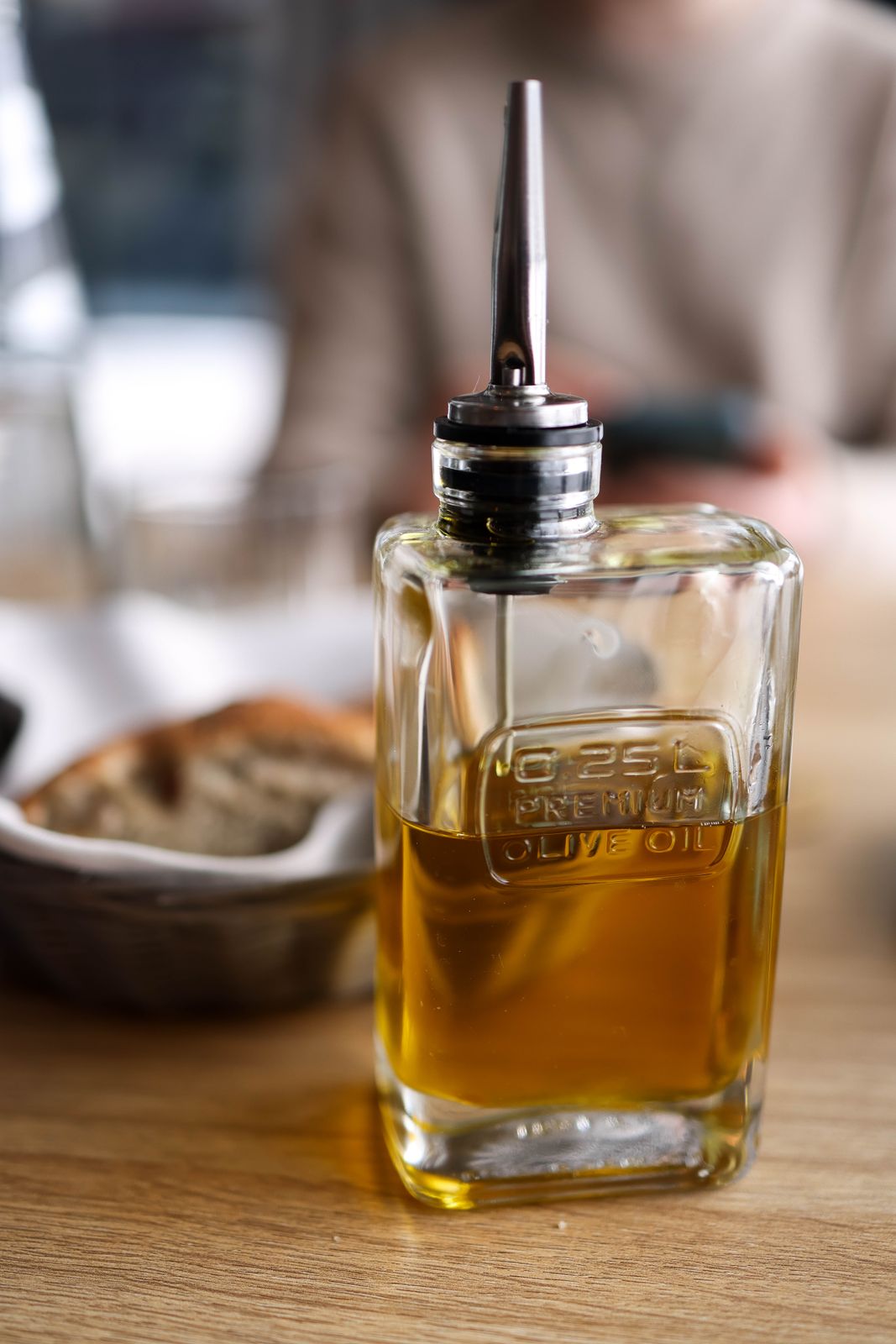
Lidl Switzerland runs almost its whole olive oil range under a single name: Primadonna. Three bottles of that own brand sit permanently on the shelf – a Spanish litre bottle at the lowest litre price in the country, a 750 ml bottle filled with an EU blend, and an organic oil in the same size. Around them stand smaller single-origin bottles and a couple of branded oils. Anyone searching for «Lidl olive oil» is in practice choosing between those three Primadonna.
And those three carry a test file that is unusually thick for a discount chain – and unusually uncomfortable. One of the bottles lost the grade it is sold under in the strictest tasting in the country; two were marked below «good» in a large comparison published at the end of January 2026. This page takes each bottle on its own and says which test named it and what it is good for. Franc amounts appear only in the product cards, each with its survey date. The comparison with the other discounter is in the Aldi range, the chronology of every Swiss test is in olive oil tests in Switzerland 2026, and the shelf prices of all the chains side by side are in our price overview.
The Lidl range at a glance
The first three rows are sorted by ascending litre price, as surveyed on 30 September 2026. «Test verdict» here means a verdict from a test that named this exact bottle – not one about the Primadonna brand in general, and not one about a product of the same name sold abroad.
| Bottle | Declaration and origin | Test verdict | What for |
|---|---|---|---|
| Primadonna Spanish extra virgin olive oil, 1 l | extra virgin; Spain | none | Frying, baking, large quantities |
| Primadonna extra virgin olive oil, 750 ml | extra virgin; blend of olive oils from the EU | «adequate» (Stiftung Warentest, January 2026) | Everyday cooking, warm |
| Primadonna organic extra virgin olive oil, 750 ml | extra virgin, organic; origin only on the pack | no mark, only «vergine» (Kassensturz/K-Tipp, 2.9.2025); «satisfactory» (Stiftung Warentest, January 2026) | Warm cooking; for salad there is better |
| Primadonna Italian olive oil, 500 ml | Italy; small bottle | none for this batch | Not judged here |
| Primadonna Greek olive oil, 500 ml | Greece; small bottle | none | Not judged here |
| Organic Terra di Bari 500 ml, unfiltered oil 750 ml, Sabo from Tunisia 1 l, Monini 1 l | secondary range and branded oil | none | Not judged here |
The lower rows deliberately stay without a verdict: too small for a sensible litre price, secondary range, or in no Swiss sample at all. Of the three permanent bottles two carry a verdict – and both are weaker than what the same tests gave other chains.
The Spanish litre bottle: at the price floor, with no Swiss verdict
The Spanish Primadonna in the litre bottle is the bottle many people buy olive oil at Lidl for in the first place. It sits at the lowest litre price in the country, and that price is not a Lidl advantage: according to K-Tipp, Aldi, Coop, Lidl and Migros sell their cheapest olive oil at exactly the same price. The difference is on the label. Lidl declares the Primadonna as «nativ extra», which corresponds to «extra vergine»; Aldi declares its Bellasan the same way, Coop its Prix Garantie likewise as «extra vergine» – only Migros downgraded its own M-Budget oil to «vergine», because reliably guaranteeing the higher standard is «challenging».
Of four equally priced bottles, exactly one is labelled as the second grade, and it is not the one from Lidl. A Swiss tasting verdict for this Spanish bottle does not exist – neither a good one nor a bad one. That is not an acquittal but a gap: tastings come along every few years and take a handful of best-sellers. Anyone buying here buys at the price floor and without a test finding, and is better off using the bottle the way you would use any untested cheap bottle: in the pan, on the baking tray, in the braising pot.
Primadonna Spanish extra virgin olive oil, 1 l
Spain
CHF 7.951 L · CHF 7.95 per litre
Check priceThe 750 ml bottle: «adequate» in the biggest comparison
The EU blend in the 750 ml bottle is the middle one of the three and the one with the weakest mark of all. Stiftung Warentest examined 25 oils of the «nativ extra» grade and published the results at the end of January 2026; only four of them were given the verdict «good». The Beobachter picked out of that test the five oils that are also sold in Switzerland and added franc prices to them. Two of those five are the Primadonna bottles from Lidl: the conventional Primadonna came out «adequate», the organic oil «satisfactory». The best oil in the whole field was an organic olive oil from Alnatura, available in Switzerland at Migros.
Two caveats belong with that. First, Stiftung Warentest tests the German market; that the German and the Swiss bottle come from the same filling is not documented, even though the Beobachter explicitly describes these five oils as available here. Second, Lidl disputes the results and states that its own tests found the oil in good condition. Worse than Lidl did a Greek oil that sits on the shelf at Denner: «poor», because of a heavy load of plasticisers. Denner writes that the affected batches never reached Switzerland.

Primadonna Extra virgin olive oil, 750 ml
EU
CHF 8.950.75 L · CHF 11.93 per litre
Stiftung Warentest 2026: adequate Check priceThe organic Primadonna: the bottle that lost its grade
This is where the actual Swiss finding lies – and it does not hit the cheapest but the most expensive of the three bottles. On 2 September 2025, «Kassensturz» and K-Tipp had thirteen of the best-selling «extra vergine» oils tasted by the Swiss Olive Oil Panel of the ZHAW in Wädenswil, the only panel in Switzerland accredited for olive oil; eleven panellists judged each oil blind. Two oils were given «very good» – Iliada from Coop and the organic oil from Manor – eight «good», one «sufficient», and the Ybarra from Denner was classed as «insufficient».
The «organic extra virgin olive oil» from Primadonna was given no mark at all. The expert Maria Bitonti described it as «stichig, schlammig» – fusty and muddy; a majority of the panel shared that judgement. The oil therefore did not meet the legal requirements for «extra vergine» and was merely «vergine». Of thirteen bottles exactly one missed the grade it is sold under, and it was the one from Lidl.
Lidl did not let that stand. The chain stated that an accredited German testing body had examined the same product from the same batch and found it compliant, and that it could not account for the divergent assessment of the Swiss panel. It is the same figure as with Coop in the French-speaking Swiss comparison of the same year: the in-house panel says passed, the external one says downgraded. Both accounts are documented; neither overturns the verdict of the testers.
Primadonna Organic extra virgin olive oil, 750 ml
Origin on the label · Organic
CHF 9.950.75 L · CHF 13.27 per litre
Stiftung Warentest 2026: satisfactory Check priceWhat «fusty, muddy» means – and what it does not
«Stichig» and «schlammig», fusty and muddy, are fault notes from the vocabulary of sensory testing. They arise when olives are stored too long and too warm before pressing, or when the finished oil sits too long on its sediment. In the highest grade such notes are not permitted; in the second grade, «vergine», they are. What those notes taste like and how to spot them at home is in how to tell if olive oil is rancid.
What a downgrade like this is not: a fraud finding or a health finding. What was faulted was the taste, not the safety, and «vergine» is a legal, marketable grade. Anyone who hears a scandal here is hearing something these tests do not say. What they do say is narrower and still unpleasant at the till: you bought the second grade at the price of the first – and with the organic Primadonna at the highest litre price of the three Lidl bottles.
From that follows an uncomfortable reversal of the usual rule. Normally the advice runs: the better bottle for the salad, the cheap one for the pan. On the Lidl shelf the better bottle is precisely the one with the worst Swiss panel verdict.
What the panel has said over the years
Primadonna is no newcomer to these tests, and the picture is not uniform. In an earlier tasting by «Kassensturz» and Saldo, in which sixteen of the best-selling «extra vergine» oils were examined by the ZHAW panel, the jury rated an Italian Primadonna «good» on taste and singled it out as the best value for money in the field; the overall winner then was a Spanish oil from the Manor shelf. Between that verdict and the one of 2025 lie several years, a different panel protocol and – decisively – a different bottle: the Italian oil, not the organic oil and not the EU blend.
That is exactly where the lesson of this range hangs. An olive oil verdict applies to one batch, one panel and one protocol, never to a brand name. «Primadonna» is not an oil but a label over at least five different bottles from different countries. Anyone who reads that Primadonna has been tested has to ask first: which one?
The same holds in reverse: a «Saldo» test of 2026 concluded that the cheapest own brands of the big retailers came out better than branded products such as Bertolli and Monini – and Monini stands on the same Lidl shelf as the most expensive oil there. In this category, expensive and branded does not automatically mean better.
Lidl against Aldi: the comparison that decides
For most readers that is the real question, because the two discounters are often within the same shopping radius. Three documented points:
- At the price floor there is nothing to win. According to K-Tipp, Aldi, Coop, Lidl and Migros sell their cheapest olive oil at exactly the same price. Anyone switching chains because of the olive oil saves nothing.
- The downgrades sit on different shelf levels. In the 2025 comparison by the French-speaking Swiss FRC, two of ten supermarket oils were downgraded – Coop's Prix Garantie and Aldi's Bellasan, that is, the cheap bottles. Lidl does not appear in either of those two downgrades. In the tasting by «Kassensturz» and K-Tipp of September 2025 it was the other way round: there it hit Lidl, and on the organic level.
- That changes the order in which you shop. At Aldi the budget bottle carries the panel blemish, at Lidl the organic oil. Which verdict the Aldi organic oil carries, and how the levels stand against each other there, is broken down bottle by bottle in the Aldi range linked at the top.
Both are single samples; neither chain has thereby proved or disproved a quality problem. For a buying decision, though, a panel verdict on a specific bottle is always worth more than a chain's reputation.
What this means for your shopping
- Frying, baking, large quantities: the Spanish litre bottle. It sits at the lowest litre price in the country, names a country of origin and carries no negative Swiss finding – but no positive one either.
- Everyday cooking, warm: the 750 ml EU blend, in the knowledge that it was given only «adequate» in the biggest comparison of the year.
- Organic as the criterion: the organic Primadonna is the most expensive of the three and the one with the heaviest Swiss finding. If organic is the criterion, it is worth looking beyond the chain.
- Salad, bread, vegetables at the end: for that the permanent Lidl range currently has no positively tasted bottle. Here a trip to another chain is the only answer that can be supported by a Swiss verdict.
Frequently asked questions
Which olive oil should I buy at Lidl?
For hot cooking and large quantities the Spanish litre bottle: the lowest litre price in the country, a declared country of origin, no negative Swiss finding. For warm everyday cooking the 750 ml EU blend, which was given «adequate» by Stiftung Warentest. For raw use on salad and bread, the permanent Lidl range currently has no bottle with a positive Swiss tasting verdict.
Is Lidl's Primadonna really «extra virgin»?
That depends on which bottle is meant. The organic Primadonna was given no mark in the tasting by «Kassensturz» and K-Tipp of 2 September 2025, because the panel judged it «stichig, schlammig» – fusty and muddy – and therefore merely «vergine»; of thirteen oils only this one missed the legal requirements. The conventional 750 ml bottle and the Spanish litre bottle were not downgraded in that test. All three continue to be sold as «extra vergine» or «nativ extra».
Why did Primadonna get «good» earlier and no mark in 2025?
Because they are different bottles and different tests. The oil praised in an earlier «Kassensturz» tasting was an Italian Primadonna, judged under a different panel protocol and years before the 2025 test; what was downgraded in 2025 was the organic oil. An olive oil verdict applies to one batch, one panel and one protocol – never to a brand name, and at Lidl «Primadonna» sits over at least five different bottles.
Is downgraded olive oil bad for your health?
Not according to these tests. What was faulted were sensory defects, that is the taste, and «vergine» is a legal, marketable grade. The problem lies with the price: you bought the second grade at the price of the first. The plasticiser finding that brought an oil sold at Denner to «poor» in the same German comparison did not affect the Lidl bottles.
Is olive oil cheaper at Lidl than at Aldi?
At the bottom end, no. According to K-Tipp, Aldi, Coop, Lidl and Migros sell their cheapest olive oil at exactly the same price; the difference is on the label, and of those four only Migros declares its budget oil as «vergine». Differences only appear on the higher levels, and there it is not the price that counts but the test verdict of the individual bottle.
Sources
- SRF «Kassensturz»: «extra vergine» olive oils tested, two rated «very good» (2.9.2025, in German)
- 20 Minuten: olive oil from «very good» to «insufficient» (in German)
- ZHAW Wädenswil: the «Kassensturz» olive oil test and the Swiss Olive Oil Panel (in German)
- Beobachter: olive oil test 2026 – Migros wins, Lidl and Denner flop (in German)
- Stiftung Warentest (Germany): Olivenöl im Test – good olive oil has become rare (individual verdicts behind a paywall, in German)
- K-Tipp: olive oil, better quality called «challenging» (in German)
- FRC: Le comparatif des huiles d'olive (in French)
- SRF «Kassensturz» tasting: many «extra vergine» olive oils are not extra at all (in German)
- Lidl Switzerland: product page for Primadonna Spanish olive oil (in German)