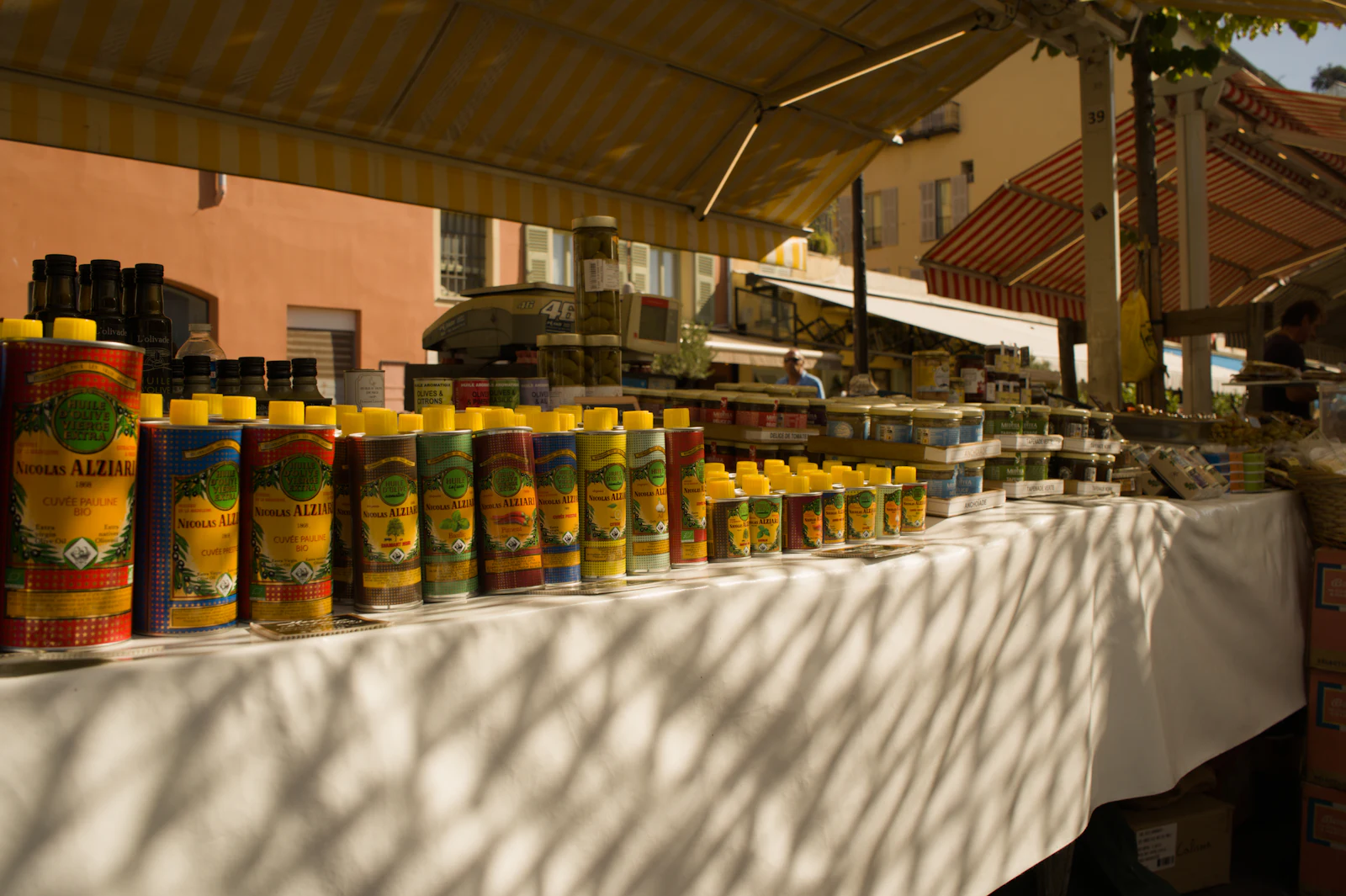
On the shelf they stand side by side: 500 millilitres, 750 millilitres, one litre. The bottle price is printed large, the unit price per litre small – and the two tell different stories. Compare bottle prices and you reach for the small bottle. Compare prices per litre and you reach for the big one.
Price per litre: almost a factor of three on the same shelf
The honest answer to the question of which size pays off has two halves, and they contradict each other. The price per litre punishes small formats hard. But the litre you buy is not the litre you use: oil a household fails to finish in time turns rancid, and then the saving per litre is a loss. Both halves have to be added up – and at the end of this piece there is a rule, not an “it depends”.
We record the shelf prices of the entry-level and mid-range oils at the big chains ourselves. These six positions are as of 16 September 2026, sorted here by container size rather than by chain:
| Size | Chain and oil | Bottle price | Per litre |
|---|---|---|---|
| 0.5 l | Migros Bio, Greece | CHF 11.40 | CHF 22.80 |
| 0.75 l | Aldi Suisse Bio, EU blend | CHF 9.95 | CHF 13.27 |
| 0.75 l | Lidl Primadonna | CHF 8.95 | CHF 11.93 |
| 1 l | Migros, Monini Classico | CHF 16.00 | CHF 16.00 |
| 1 l | Denner, Divella Classico | CHF 11.95 | CHF 11.95 |
| 1 l | Migros M-Budget, “vergine” only | CHF 7.95 | CHF 7.95 |
The pattern is clear, but it is not monotonic. The most expensive litre in this selection sits in the smallest container and the cheapest in the largest, and between the two lies almost a factor of three. It would be monotonic only if every larger bottle automatically had the better price per litre – and the Monini litre at CHF 16.00 is dearer than the 750-millilitre bottle from Aldi. Container size and price per litre therefore move in the same direction, but not in step: only the unit price per litre is comparable, never the price on the bottle.
The case that raises the question: organic in 500 ml against organic by the litre
It gets sharpest with organic oil. The Greek organic olive oil from Migros costs CHF 11.40 for 500 millilitres – CHF 22.80 per litre, the highest price per litre in our survey (as of 16 September 2026). Kassensturz and K-Tipp rated it “good” in 2025. It is a solid oil at a price per litre that hardly anyone would pay if it were printed on the bottle.

Migros Bio Greek extra virgin olive oil, 500 ml
Greece · Organic
CHF 11.400.5 L · CHF 22.80 per litre
Kassensturz / K-Tipp 2025: good Check priceThe comparison that separates the container from the contents leads to Manor. The organic olive oil from Manor was the 2025 test winner at Kassensturz and cost CHF 21.50 for the whole litre bottle – a price per litre below that of the half bottle from Migros. One thing matters here: that figure dates from 2 September 2025 and we are re-recording it, because Manor does not carry the oil online, only in its food departments – which sizes you can actually have delivered is in buying olive oil online in Switzerland. As a current price comparison it is therefore no use. As evidence that a whole litre of organic oil with a test-winning verdict need not cost more than half a litre of standard organic, it is telling enough.
Manor Bio Extra virgin olive oil, 1 l
Italy · Organic
CHF 21.501 L · CHF 21.50 per litre
Kassensturz / K-Tipp 2025: very good Check priceIt also works without changing brand. Migros carries Monini Classico on the shelf in two sizes: the litre at CHF 16.00, the 500-millilitre bottle at CHF 8.50, which is CHF 17.00 per litre (both as of 16 September 2026). Identical oil, identical chain, one franc more per litre – paid for the smaller glass alone.
Why the small bottle ends up in the basket anyway
That the price per litre is on the shelf edge at all is not a kindness of the retail trade but a legal requirement. The Swiss Price Indication Ordinance (PBV) requires that pre-packaged goods sold by measure show the unit price – the price per litre or per kilogram – alongside the retail price. It is just that this unit price is printed small, sometimes per 100 millilitres instead of per litre – and then you have to multiply by ten in your head while blocking the aisle with your trolley.
Two further reasons have nothing to do with arithmetic. First, the range cannot be combined freely. In our survey the organic oil from Migros comes in 500 millilitres and the one from Aldi in 750; the whole litre is found in the standard and budget lines and at Manor. Anyone who reaches for organic in the supermarket often picks the small container along with it, whether they want to or not. Second, many people buy small on purpose – because they suspect what the next section says.
The litre you buy is not the litre you use
Olive oil does not get better, it only gets older. From pressing onwards it breaks down aroma, polyphenols and vitamin E. Light and heat drive that process hardest; oxygen works more slowly, but without interruption: every pour enlarges the headspace in the bottle, and a half-empty bottle ages faster than a full one. How much the packaging has to do with it was measured by Pristouri, Badeka and Kontominas in 2010 – the same oil kept for six months in clear glass in the dark, and not three in clear PET in the light. The ranking of the packaging types is in Dark Glass or Plastic.
For the household, a single number follows from this: an opened bottle gives its full flavour for one to three months, depending on how well it is kept and how full it still is. The oil stays edible considerably longer, but the fruitiness and the peppery bite in the finish fade, and the polyphenols with them. Everything about temperature, storage spot and decanting is in How to store olive oil. What the printed best-before date has to do with that is in Olive oil past its best-before date.
Large containers have a logic of their own. For end consumers, no more than five litres per pack is permitted in the EU, and the greater part of the oil sold in Switzerland is bottled in the EU. Tinplate protects against light better than any glass – so the tin itself is not the problem. The problem is the time a household needs to empty it, and the fact that it is aerated afresh at every meal if you pour straight from it.
How fast a Swiss household empties a bottle
Here it is possible to calculate rather than guess. The food balance sheet of the Federal Food Safety and Veterinary Office puts olive oil at five grams per person per day for 2020/21, 14 per cent more than in 2014/15. That is around 1.8 kilograms, or just under two litres, per person per year. And the households this is spread over are small: at the end of 2022 the Federal Statistical Office counted around four million private households with an average of 2.18 people; 37 per cent of them are single-person and 33 per cent two-person households.
At just under two litres per person per year, these are the resulting ranges. They are calculated, not measured – anyone who cooks Mediterranean food is well above them, anyone who needs olive oil only for salad clearly below:
| Household | Use per year | 0.5 l | 0.75 l | 1 l | 3 l |
|---|---|---|---|---|---|
| 1 person | approx. 2 l | 3 months | 4–5 months | 6 months | 1.5 years |
| 2 people | approx. 4 l | 6 weeks | 2 months | 3 months | 9 months |
| 4 people | approx. 8 l | 3 weeks | 5 weeks | 6 weeks | 4–5 months |
That resolves the contradiction. For a two-person household the litre bottle falls exactly into the window of one to three months: it is the cheaper and the right container at the same time, and the question does not even arise. For a single-person household, by contrast, a litre lasts half a year – far beyond the window. And a household of four empties even three litres in a good four months, and pays a surcharge every week if it buys small bottles.
The decisive point: the clock starts when the bottle is opened
The obvious conclusion for the small household would now be the 500-millilitre bottle. It is wrong. The one to three months apply to the opened bottle. Unopened and kept dark and cool, oil lasts until its best-before date, which as a rule falls 18 to 24 months after bottling.
From that follows the move that gets round the surcharge without buying the risk: take two litre bottles, open one, leave the second sealed in the cupboard. The single-person household then pays the price per litre of the large container and carries the ageing risk of a small one. With a large tin the same applies one step up: decant into a small dark bottle and leave the rest sealed, instead of opening the tin every time you cook.
So the rule that “a small bottle that gets emptied beats a large one that stands around” still holds. It can simply be met more cheaply than the shelf suggests. And the small container keeps exactly two sensible uses: trying out an expensive oil you do not know yet, and running a second, better oil alongside the everyday one – raw over salad, vegetables and soup, where the difference actually registers.
The decision rule
- Single-person household: buy one litre, not 500 millilitres – but open only one bottle at a time. If you need oil rarely, take 750 millilitres: a format that suits the small household and stays clearly below the half bottle per litre.
- Two-person household: one litre. Here the low price per litre and the rate of use coincide.
- Three people and more: one litre in use, a second sealed as a reserve. A large tin only if you decant consistently.
- Bulk tin, three to five litres: pays off only if the household empties it in around nine months and the oil is decanted into a small dark bottle. Otherwise you are buying a cheap price per litre and an expensive risk.
- 500 millilitres: for the oil you are trying out and for the good oil alongside the everyday one. Not as a standard size, just because the bottle looks cheaper.
A word on the middle size, which the Swiss shelf often skips. The organic oil from Aldi Suisse costs CHF 9.95 for 750 millilitres, which is CHF 13.27 per litre (as of 16 September 2026), and was rated “good” by Kassensturz and K-Tipp in 2025. For a single-person household this is the container that reconciles price per litre and rate of use best: around four months of range, at a price per litre well below that of the half bottle.

Aldi BIO Extra virgin olive oil, European blend, 750 ml
EU blend · Organic
CHF 9.950.75 L · CHF 13.27 per litre
Kassensturz / K-Tipp 2025: good Check priceWhat remains is the check at the shelf that takes two seconds: read the unit price, not the bottle price. The complete, continuously updated table with all prices per litre is on our price overview. And why prices are easing again right now is something we work through in Olive oil prices in 2026: why it is getting cheaper.
Frequently asked questions
Is a five-litre tin of olive oil worth it?
Only for households that empty it in around nine months, and only with decanting. Tinplate protects against light better than glass, which speaks for the tin. Against it: it is aerated every time it is used, and you cannot see the fill level. Anyone who fills a small dark bottle from the tin and leaves the rest sealed gets the better price per litre without sacrificing the reserve.
Why is the 500 ml bottle more expensive per litre than the litre bottle?
Because glass, closure, label, filling and transport are incurred per bottle, not per litre of contents. Two half bottles need two closures and two labels for the same amount of oil. With Monini Classico at Migros that comes to CHF 17.00 per litre in the half bottle against CHF 16.00 in the whole one (as of 16 September 2026).
How long does an opened bottle of olive oil keep?
For the full flavour, one to three months, depending on storage spot, temperature and fill level. The oil stays edible longer, but the fruitiness and the peppery bite in the finish fade noticeably. Unopened and kept dark and cool, it lasts until its best-before date – as a rule 18 to 24 months after bottling.
Two litre bottles or one 500 ml bottle – which is better?
For a small household, the two litre bottles, opened one after the other. The ageing clock starts when the bottle is opened, not when it is bought: the sealed second bottle in the cupboard loses almost nothing in that time, while you pay the lower price per litre.
Which size suits a single-person household?
Calculated at just under two litres per person per year, one litre lasts about half a year, 750 millilitres around four months and half a litre three months. If you cook regularly, take the litre and open only one bottle. If you use olive oil almost only raw, 750 millilitres serves you best.
Sources
- Federal Statistical Office: Households and family forms
- Federal Statistical Office: Private households by household size, 2022
- FSVO: Food balance sheet – overview of approximated consumption (5 g of olive oil per person per day, 2020/21)
- SECO: FAQ on price indication (unit price for pre-packaged goods sold by measure)
- SME Portal of the Swiss Confederation: Price labelling
- Pristouri G, Badeka A, Kontominas MG: Effect of packaging material headspace, oxygen and light transmission, temperature and storage time on quality characteristics of extra virgin olive oil. Food Control 2010;21:412–418
- Sanmartin C et al.: The effects of packaging and storage temperature on the shelf-life of extra virgin olive oil. Heliyon 2018;4(11):e00888
- Delegated Regulation (EU) 2022/2104 on marketing standards for olive oil (containers for end consumers: no more than five litres)
- SRF Kassensturz / K-Tipp: Olive oil in the test – “Extra vergine” or not, that is the question (2025)