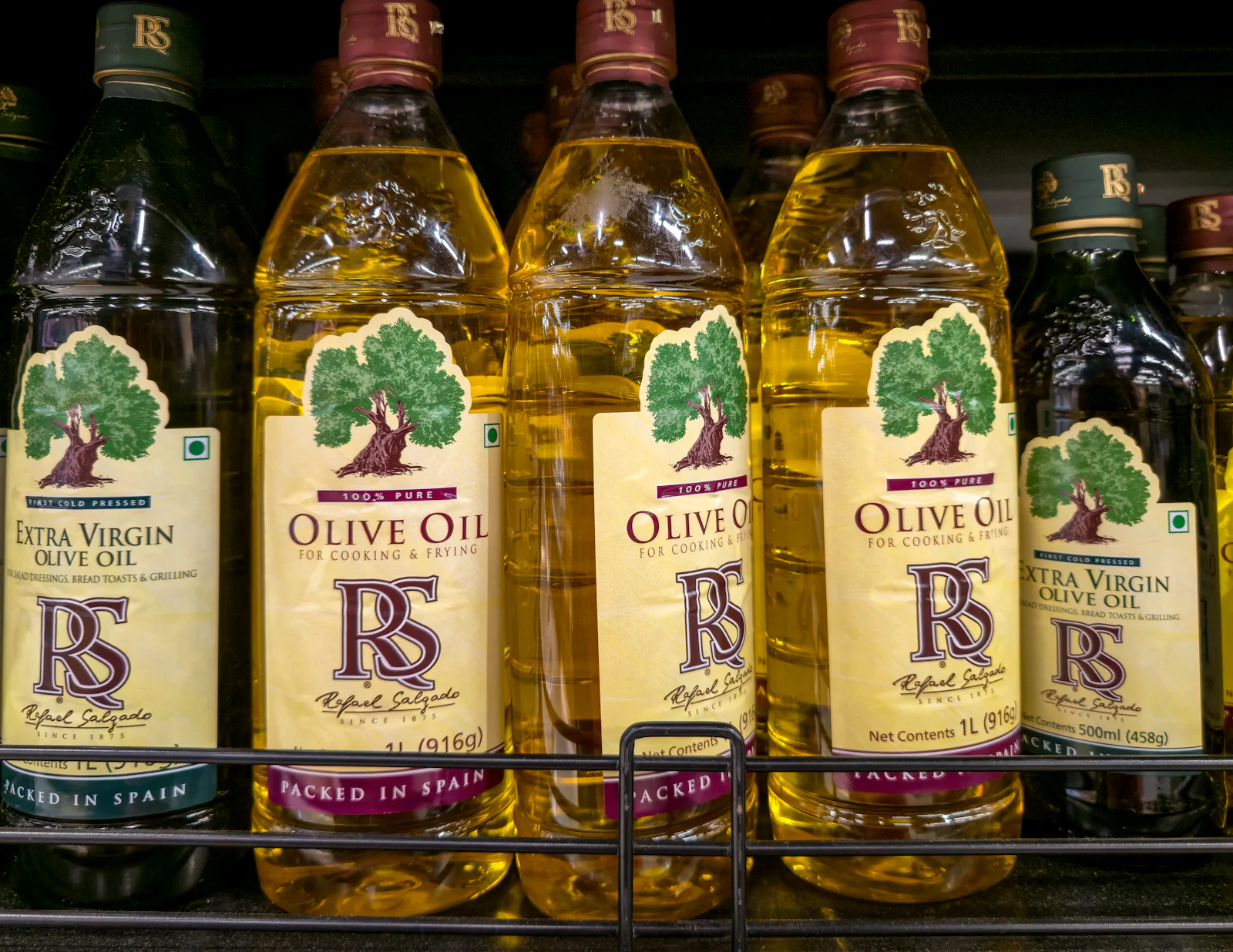
Private labels – “marcas blancas” in Spain, “marques de distributeur” in France – are no longer a second-best choice for olive oil. They sit prominently on the shelf and cost less than well-known brands. But do they live up to the “extra virgin” on the label?
Two major consumer tests give different answers: in Spain every oil passed, in France most failed. This article sums up the results and explains what they mean for shopping in Switzerland and just across the French border.
Spain: own brands on a par with name brands
At the end of December 2024 the Spanish consumer organisation OCU published a test of 23 supermarket extra virgin olive oils. The laboratory checked fruit quality, acidity, shelf life and authenticity, followed by a sensory assessment. The result: for the first time since 2007, OCU found no quality failures at all. All 23 oils were genuinely “virgen extra”.
| Rank | Oil | Type | Price (December 2024) |
|---|---|---|---|
| 1 | Oleoestepa DOP Estepa | brand (cooperative) | €12.44/l |
| 2 | Auchan Bio Ecológico (Alcampo) | private label | €14.26/l |
| 3 | Hacendado (Mercadona) | private label | €8.75/l |
Five of the ten best-rated oils were private labels, costing on average €1.50 per litre less than the brands. Hacendado stands out: Mercadona's oil came third and was considerably cheaper than the two oils ahead of it. OCU also expected prices to fall by up to 25 per cent in 2025.
France: only 5 of 20 oils pass
The picture in France is very different. UFC-Que Choisir had 20 oils sold as “vierge extra” in supermarkets and organic shops analysed physico-chemically and tasted by accredited expert panels; the comparison was updated in June 2025. Only 5 oils kept their grade. 13 were downgraded to “vierge” and 2 even to “lampante”, meaning not fit for direct consumption. Prices ranged from €7.89 to €13.45 per litre.
| Private label | Retailer | UFC-Que Choisir 2025 result |
|---|---|---|
| Bellasan | Aldi | vierge extra (passed) |
| Eco+ | E.Leclerc | vierge extra (passed) |
| Carrefour Extra | Carrefour | downgraded to “vierge” |
| Auchan | Auchan | downgraded to “vierge” |
| Primadonna | Lidl | downgraded to “vierge” |
| Monoprix | Monoprix | downgraded to “vierge” |
| U | Système U | downgraded to “vierge” |
| Bouton d'or | Intermarché | downgraded to “vierge” |
| Bio Village | E.Leclerc | downgraded to “vierge” |
Among the brands, Carapelli Classico, Puget and Monini Classico passed. Lesieur and Tramier were downgraded to “vierge”, while Terra Delyssa from Tunisia and Cauvin fell to “lampante”. Detailed scores are for subscribers only; it is public that Aldi's Bellasan achieved the best score, 12 out of 20.
Contaminants: the 60 Millions de consommateurs test
In April 2025 the French magazine 60 Millions de consommateurs also tested just over twenty extra virgin olive oils for contaminants. According to summaries of the test, every oil contained plasticisers (phthalates) and mineral oil hydrocarbons (MOSH and MOAH), though in very different amounts. Three brand oils came out best: H de Leos Vierge Extra Fruité Vert (15.4 out of 20, €59.20/l), Puget Origine France (14.6, €31.66/l) and Costa d'Oro Bio (14, €20.35/l). Detailed results for individual private labels have not been made public.
Why Spain and France score so differently
The results cannot be compared directly. The tests come from different years, examined different products and used different methods and panels. Still, a few factors help put them in context:
- Freshness: olive oil ages. An oil that was “extra” when bottled may only be “virgin” after months on the shelf, depending on storage, light and temperature.
- Batch, not brand: private labels change suppliers and harvests. A test judges a specific bottle, not the brand forever.
- Origin: Spain is the largest producer, so the route from grove to shelf is short. France produces little itself and imports most of its olive oil.
Swiss tests show how much results vary between batches: Aldi's Bellasan passed Que Choisir's test in France in 2025 but was rated only “vierge” by the FRC in French-speaking Switzerland the same year. Lidl's Primadonna failed in France in 2025; in Switzerland the Swiss Olive Oil Panel also rated Primadonna Bio only “vergine” in 2025. All Swiss results are in our overview Olive oil test Switzerland 2026.
What this means for shoppers in Switzerland
- Don't dismiss private labels: in Spain they are among the best and cheapest oils on the shelf.
- Check the harvest year and best-before date: the fresher the oil, the better the chance it is still “extra”. Be wary of offers with a short best-before date.
- Prefer a specific origin: oils from one country or a PDO region are easier to trace than “EU” blends.
- Shopping in France: if you shop at Leclerc, Carrefour or Auchan across the border, you may bring up to 5 litres of edible oil per person per day into Switzerland duty-free. If the value of all goods exceeds 150 francs, VAT is due.
- Store it properly at home: dark, cool, and use within six to eight weeks of opening. More in How to store olive oil.
Why Spanish oils do so well internationally is explained in Why Spanish olive oil ranks among the world's best.
Frequently asked questions
Are private-label olive oils worse than brands?
Not necessarily. In Spain's OCU test, five of the ten best oils were private labels, and they cost €1.50 per litre less on average. In France many private labels failed Que Choisir's test, but so did well-known brands such as Lesieur and Tramier.
Which private-label olive oil is best in Spain?
In OCU's December 2024 test, Auchan Bio Ecológico from Alcampo (€14.26/l) came second and Hacendado from Mercadona (€8.75/l) third out of 23 oils. The winner was Oleoestepa DOP Estepa.
Which French private labels passed Que Choisir's test?
Of the private labels tested, only Aldi's Bellasan and E.Leclerc's Eco+ remained “vierge extra”. Carrefour Extra, Auchan, Primadonna (Lidl), Monoprix, U, Bouton d'or (Intermarché) and Bio Village (E.Leclerc) were downgraded to “vierge”.
Does supermarket olive oil contain plasticisers?
According to 60 Millions de consommateurs' April 2025 test, all oils tested contained plasticisers and mineral oil hydrocarbons, though in very different amounts. The best oils had far lower residues.
Sources
- OCU: Análisis de aceite de oliva virgen extra – la marca blanca, a la altura de las primeras marcas (27 Dec 2024)
- UFC-Que Choisir: Comparatif huiles d'olive (updated 24 Jun 2025, details for subscribers)
- Cuisine Santé: summary of the 60 Millions de consommateurs olive oil test (24 Apr 2025)
- FOCBS: duty-free allowances for food, alcohol and tobacco