Price comparisons tell you which olive oil is cheapest on the Swiss shelf. They do not tell you whether what is in the bottle is what is on it – and it is precisely at the cheapest end of the shelf that Swiss tasting panels and cantonal laboratories most often strike out the words "extra virgin". Whether a bottle deserves that grade is not decided by the label but by the nose. And yours came with you.
This article explains the three defect notes an "extra virgin" fails on in practice, what each of them reveals about the olive or about the bottle, and how to check in two minutes at the kitchen table what you actually bought.
Why a single defect costs the grade
Olive oil grades are not a matter of taste, they are law. In Switzerland the Federal Department of Home Affairs ordinance on foodstuffs of plant origin, mushrooms and table salt (VLpH, SR 817.022.17) governs which designation an olive oil may carry. Almost the entire Swiss offer comes from the EU, which is why the bottles at Migros, Coop, Denner, Aldi, Lidl and Manor show the EU categories. The marketing standards in force are set out in Delegated Regulation (EU) 2022/2104, the conformity checks and analysis methods in Implementing Regulation (EU) 2022/2105.
Everything turns on one number from Annex I of Regulation 2022/2104: the median of the defects. For extra virgin olive oil it has to be 0.0, and the median of the "fruity" attribute has to be above 0.0. In other words: no perceptible defect, and at the same time a positive fruitiness. If a slight defect is found – a median of the defects of up to 3.5 on the ten-point scale – the oil is only "virgin", that is "vergine". Above 3.5 it is lampante oil and may not be sold as such at all. What else separates the individual grades is set out in What is extra virgin olive oil?.
That threshold is the reason oils are constantly "downgraded" in tests without anything harmful to health having been found. A rancid oil is not toxic. It simply is no longer an "extra virgin" – and you paid for a grade that is no longer in the bottle.
Rancid: the defect that appears after the purchase
The IOC method COI/T.20/Doc. No 15, to which EU Implementing Regulation 2022/2105 refers for the organoleptic assessment, defines "rancid" briefly and unmistakably: the flavour of oils that have undergone intense oxidation. Oxygen, light and heat take the fatty acids apart, and what is left no longer smells of olive.
How you recognise it: old walnuts, wax crayons, glue, damp cardboard; in the mouth flat and greasy, without any fruit at all. Anyone who knows the smell of nuts left too long in the shell knows rancid oil. It does not scratch the throat, it is not bitter, it does nothing at all – and that emptiness is exactly the signal.
Rancid is the only one of the three common defects that can still arise after the purchase. The oil may have been faultless at bottling and is no longer so after eight months on a brightly lit shelf. That is why the cantonal laboratories object above all to old, oxidised stock, and why the harvest year and the bottle material are worth a look. How to slow the process down at home is covered in How to store olive oil. What the date on the label does and does not tell you about this is covered in Olive oil past its best-before date.
The finding is not a theoretical one in Switzerland: in the 2020 Kassensturz test, Denner's Barbera Selezione Unica failed because the panel found it rancid.
Fusty, winey-vinegary, muddy: what went wrong at the mill
The second family of defects arises before the oil is even in the bottle, and it has two related faces.
Fusty/muddy sediment is described by the method as the characteristic flavour of oil from olives that were piled up or stored in such a way that they are in an advanced stage of anaerobic fermentation – or of oil that has been in contact, in vats and barrels, with decanting sediment that has likewise fermented anaerobically. In plain words: the fruit lay too long in a heap or in sacks, without air, and began to ferment. It smells fusty and rotten, of sauerkraut liquid, of silage, sometimes sweetish and muddy.
Winey-vinegary / acid-sour is the aerobic variant: a flavour reminiscent of wine or vinegar, produced first of all by an aerobic fermentation process of the olives or by residues of olive paste in press mats that were not properly washed, in the course of which acetic acid, ethyl acetate and ethanol are formed. Here the smell is sharp and stinging, like red wine vinegar or nail polish remover.
Both notes say the same thing about the production: too much time passed between harvest and mill, or the plant was not clean. You cannot prevent this defect by storing the oil well, and you cannot undo it – it was already there when you bought the bottle.
In the joint test by Kassensturz and K-Tipp of 2 September 2025 it hit exactly this family: the ZHAW's Swiss Olive Oil Panel downgraded Lidl's Primadonna Bio to "vergine" because of a "fusty, muddy" note. According to SRF, Lidl had the same batch assessed by a German panel, which found nothing to object to.
Musty-humid: the olive lay wet for too long
The third note is called musty-humid-earthy in the method; in everyday language people say mouldy. It arises from an infestation of moulds and yeasts on olives that were stored for several days in humid conditions, or from soil and mud still clinging to unwashed fruit.
How to spot it: cellar smell. Damp cellar, an old dishcloth, mushrooms, wet earth. Anyone who has ever opened a cardboard box taken out of a damp basement storeroom has the note in their memory. Of the three defects it is the easiest to recognise, because it has so little to do with food.
A warning about telling things apart: a slightly earthy, "rustic" tone is intended in some traditionally made oils and is happily sold as character. The method does not know that distinction – musty-humid-earthy is a defect, full stop.
The two-minute test in the kitchen
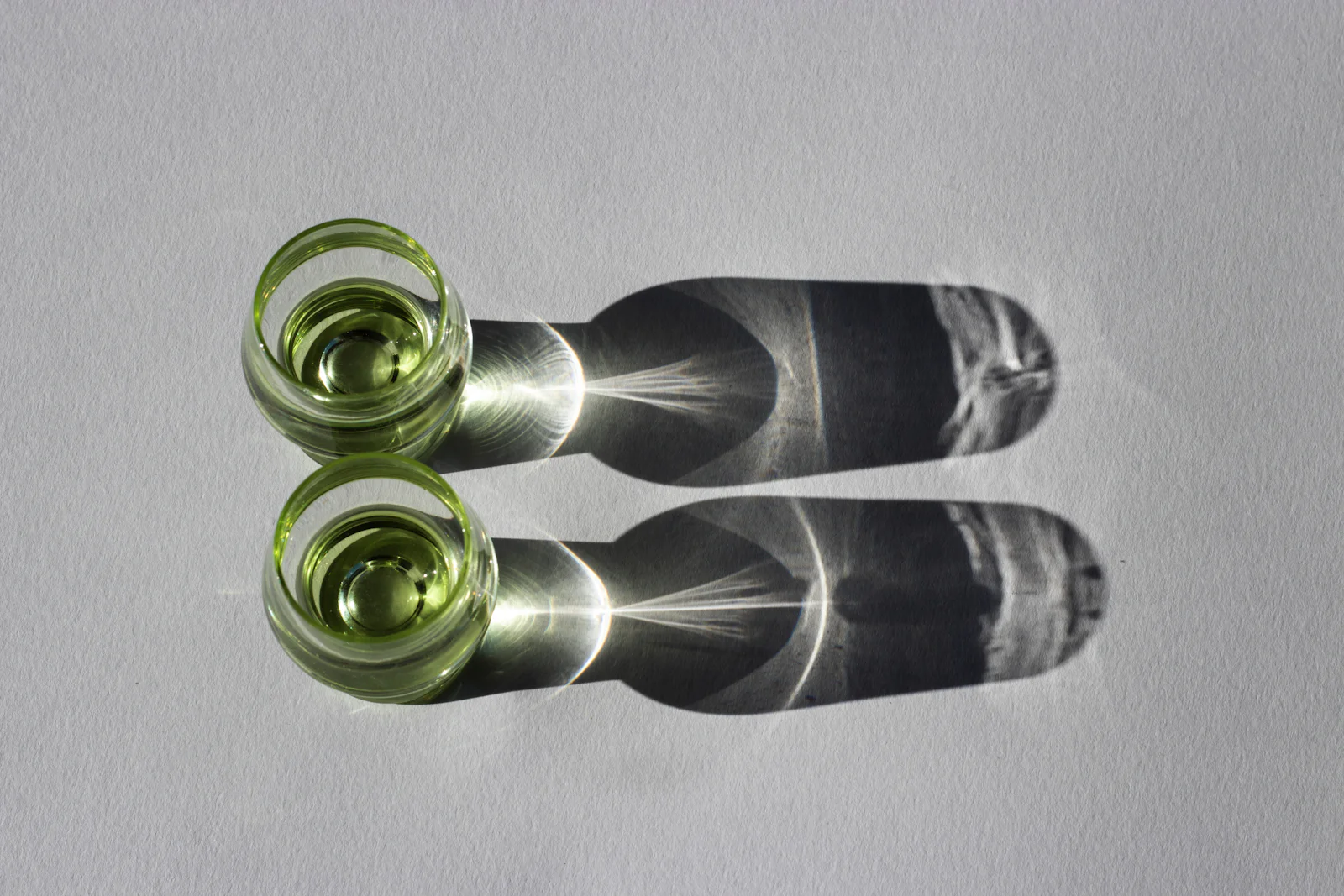
The panel works under laboratory conditions: the oils go into standardised blue glasses so that the colour cannot influence the assessment, each glass holds 14 to 16 millilitres, is covered with a watch glass and is kept at 28 °C ± 2 °C throughout the assessment – at that temperature the aroma compounds come through most clearly. In Wädenswil the assessors sit in individual booths to do it.
At home you can rebuild the procedure with what you have in the house. It really does take only two minutes:
- A glass, not a spoon. A small water glass or shot glass, one to two tablespoons of oil in it. A spoon offers the nose no headspace in which the aromas can gather.
- Warm it in your hand. Glass into the palm, the other hand on top as a lid, swirl gently. Hand warmth is close to the 28 degrees the panel works at.
- Let it stand covered. Keep it closed for half a minute. That is what the watch glass is for: collecting the volatile compounds in the glass instead of letting them escape into the kitchen.
- Smell briefly and several times. Hand away, nose to the glass, two or three short sniffs rather than one long one. The nose tires quickly; the first impression is the most honest.
- Take a small sip and draw air in with it. Spread the oil around your mouth, part your lips slightly and suck in air, as you would when slurping wine. That carries the aromas up into the nose from behind – retronasal perception, which is often what makes a defect obvious in the first place.
- Compare with a second oil. The test only becomes meaningful once you put two bottles side by side. A reference oil you trust replaces every description.
Between two oils, a piece of apple or bread and a sip of water help. And there is one mistake almost everybody makes: bitterness, pungency and the scratch in the throat are not defects. They come from the polyphenols and belong to a fresh, polyphenol-rich oil. Sorting them out means throwing away exactly the good bottles.
There is one limit you need to know: under Implementing Regulation (EU) 2022/2105 the classification of an oil can be assessed sensorially only by an authorised panel whose evaluation is made up of at least 8 and at most 12 trained panellists – not by a single nose. Your kitchen test is no substitute for an expert opinion. But it is entirely enough to decide whether you buy this bottle again.
What Swiss enforcement finds in these bottles
The figures from official enforcement show how often the defects make it onto the shelf. In an inter-cantonal campaign in 2022, fifteen cantons examined 96 oils: in 11 of them the sensory deviations were too large, 5 were flagged chemically, 44 had labelling faults – in total 55 of the 96 samples deviated on one point or another. The Zurich cantonal laboratory tested twelve oils in 2023 and twelve in 2024 and had to downgrade three of them sensorially each time. The consumer protection and veterinary office of the canton of St. Gallen examined four oils declared as "extra virgin olive oil" in 2026; three did not meet the legal requirements, two had to be downgraded to the lower grade, one of them because of a sensory defect.
With the consumer tests the picture is the same, only with names attached. The test by Kassensturz and K-Tipp of 2 September 2025 assessed 13 of the best-selling "extra vergine" oils in Switzerland; two were rated "very good", eight "good", one "sufficient", and for the cheapest oil in the field – Denner's Ybarra, at CHF 7.95 per litre in the SRF test table at the time – the panel noted that "clean and pure" it was not. Every Swiss test from 2010 to 2026, with winner, downgrades and source, is in Olive oil tests in Switzerland 2026.
The low-price segment is not written off across the board. With Lidl's Primadonna the verdict came out differently depending on the line and the test: the organic version, the Primadonna Bio, was downgraded by the Swiss Olive Oil Panel in 2025, while the ordinary Primadonna passed in 2016, 2020 and 2024 and was given the mark "adequate" by Stiftung Warentest in 2026.

Primadonna Extra virgin olive oil, 750 ml
EU
CHF 8.950.75 L · CHF 11.93 per litre
Stiftung Warentest 2026: adequate Check priceThe top mark "very good" went in 2025 to two oils from the middle price band: the Manor Bio and the Greek Iliada from Coop. The amounts in the two cards come from the SRF test table of 2 September 2025 – the collection date is given with each of them, and quite a lot has moved on the shelf since.
Manor Bio Extra virgin olive oil, 1 l
Italy · Organic
CHF 21.501 L · CHF 21.50 per litre
Kassensturz / K-Tipp 2025: very good Check price
Iliada Kalamata PDO extra virgin, 1 l
Greece, Kalamata
CHF 18.501 L · CHF 18.50 per litre
Kassensturz / K-Tipp 2025: very good Check priceWhat the six positions from our own survey cost today, with litre price and collection date, is on the page Olive oil prices in Switzerland.
What to do with a defective bottle
If the oil smells rancid, fusty or musty, the bottle is defective in legal terms – it does not have the quality you paid for. Three sober points on that:
- There is no general right of return in Switzerland. The rule is "bought is bought"; many shops and online stores take goods back voluntarily, but they do not have to. That is what the authorities' portal ch.ch says.
- Where there is a defect, the statutory warranty applies. Under sales law the buyer has three routes open: rescind the purchase, reduce the price, or demand an item free of defects. The condition is that you report the defect to the seller immediately – with food, therefore, not weeks later. For new items the warranty period is two years. In practice that means: take the bottle and the receipt with you, tell the customer service desk what you found, and ask for the refund or the replacement.
- Enforcement of food legislation lies with the cantons. If it is not about your bottle but about the suspicion that a whole batch is wrongly declared, the cantonal food control authority, or the cantonal laboratory, is the competent body – the same offices that run the campaigns mentioned above. Which reporting channels, forms and deadlines apply in detail differs from canton to canton; ask the laboratory of your own canton rather than relying on a general statement.
And the practical advice for the open bottle that has merely gone rancid: it is not dangerous, but it makes every dish worse. Using it for cooking is not a rescue, it is an extension of the problem.
Frequently asked questions
What does rancid olive oil smell like?
Of old walnuts, wax crayons, glue or damp cardboard, and in the mouth flat and greasy without any fruitiness. The IOC assessment method defines "rancid" as the flavour of oils that have undergone intense oxidation. What is typical is not a strong stench but the absence of everything: no grass, no fruit, no scratch.
Is rancid olive oil bad for your health?
A rancid oil is first of all a quality and labelling problem, not an acute safety problem: the cantonal laboratories downgrade such oils to the lower grade rather than judging them a health hazard. The eating pleasure and the polyphenols are gone, though – and that is what you paid for. We give no medical assessment here; for health questions your doctor or your pharmacist is the right address.
Are bitterness and pungency a defect?
No, quite the opposite. Bitterness and the pungency that scratches the throat come from the polyphenols and are wanted in a fresh extra virgin olive oil. The defect notes of the assessment method are others: rancid, fusty/muddy sediment, musty-humid-earthy, winey-vinegary, metallic and several more. Anyone who reads pungency as a fault sorts out the best bottles.
Can I tell with my own nose whether an oil really is "extra virgin"?
A clear defect that you can plainly smell in the warmed glass is solid evidence – the classification itself is not. Under Implementing Regulation (EU) 2022/2105 the sensory classification can be carried out only by an authorised panel whose judgement rests on at least 8 and at most 12 trained panellists. For an everyday buying decision your nose is still enough.
Sources
- Delegated Regulation (EU) 2022/2104 on the marketing standards for olive oil, consolidated version, Annex I (median of the defects)
- Implementing Regulation (EU) 2022/2105 laying down rules on conformity checks and analysis methods for olive oil
- International Olive Council: COI/T.20/Doc. No 15, method for the organoleptic assessment of virgin olive oil (PDF)
- Federal Department of Home Affairs ordinance on foodstuffs of plant origin, mushrooms and table salt (VLpH), SR 817.022.17
- ZHAW Wädenswil: sensory assessment and the Swiss Olive Oil Panel
- SRF Kassensturz: how do I recognise a good olive oil?
- SRF Kassensturz: "extra vergine" olive oil in the test: two with the mark "very good" (2.9.2025)
- SRF Kassensturz: many "extra vergine" olive oils are not extra at all (26.5.2020)
- Canton of Zurich: one in ten "extra vergine" olive oils shows sensory defects (13.4.2022)
- Canton of Zurich: "extra vergine" olive oil not always extra in taste (31.1.2025)
- Canton of St. Gallen, AVSV: olive oil – what the label does not tell you (2026 report)
- ch.ch: returning or exchanging goods
- Confederation, online shopping guide: defects of quality
- Association of Cantonal Chemists of Switzerland