Few countries shape the global olive oil market as much as Spain. The country has been the world's largest olive oil producer for decades — and increasingly stands out not just for quantity, but for top-tier quality as well. And yet surprisingly little of that dominance is visible on the Swiss shelf. The two facts are connected, and this piece explains both.
The numbers speak for themselves
For the 2025/26 season the International Olive Council (IOC) forecasts world production of around 3,440,000 tonnes, some 4 per cent below the previous year. About 2,060,000 tonnes of that comes from the EU — roughly 60 per cent of the world total. And of that EU volume, Spain accounts for more than 65 per cent.
For Spain's own 2025/26 crop the figures diverge: market observers put it at between roughly 1,295,000 and 1,370,000 tonnes. The spread does not change the finding — even the lower figure exceeds the combined output of every other EU producing country. In strong years Spain's share of world production reaches around 45 per cent. Italy and Greece, the next-largest producers, sit well behind at roughly 200,000 to 300,000 tonnes each.
Andalusia and Jaén: the heart of production
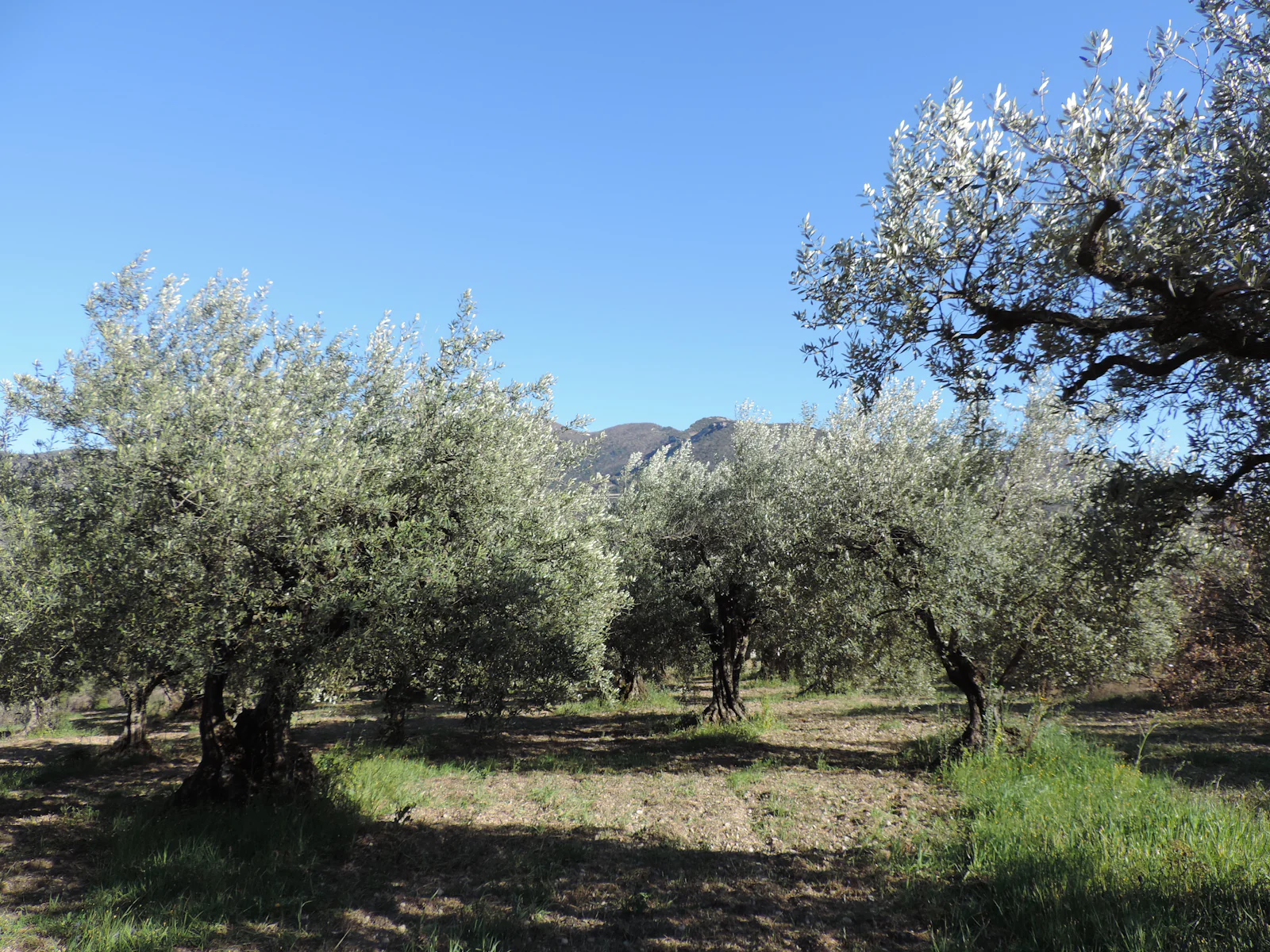
Around 80 per cent of Spain's olive oil production comes from Andalusia, in the south of the country. The province of Jaén alone is considered the largest olive-oil-producing region in the world: across some 550,000 hectares grow more than 66 million olive trees, credited with about 20 per cent of global olive oil production.
How large Jaén's share of Spanish output is depends on the source: figures between roughly 37 and 45 per cent circulate, varying by year and method. The upward comparison is more robust: applying that 20 per cent of world volume to the IOC's 2025/26 forecast, a single Spanish province comes out, by our own calculation, at considerably more oil than Italy produces nationwide in the same year.
Protected designations of origin as a quality guarantee
Spain has numerous Protected Designations of Origin (P.D.O.) that strictly regulate origin, cultivation methods and quality standards. Counts range between 29 and 31 olive oil P.D.O.s — the list grows as new areas are registered. In Jaén province alone there are three separate P.D.O. zones: Sierra de Segura, Sierra de Cazorla and Sierra Mágina. The smaller designations, with their varieties and brands, are covered in Spain's small olive oil PDOs.
These certifications guarantee consumers that the oil genuinely comes from the stated region and meets defined sensory and chemical criteria. What they do not guarantee is excellence: a P.D.O. seal sets a floor, not a peak. Conversely, a missing seal often only means the estate grows a variety the specification does not admit.
Variety as a hallmark of quality
Spain boasts an exceptional diversity of olive varieties — 262 different cultivars are grown nationwide, the great majority of them native — and each produces a different oil. Picual, dominant in Andalusia, yields robust, powerful oils with high oxidative stability and a high polyphenol content. Arbequina, originally from Catalonia, produces milder, fruitier oils with notes of green apple and almond. Other important varieties such as Hojiblanca and Cornicabra add further to the stylistic range of Spanish olive oils.
What the 2025/26 competitions actually say
Spain wins a great deal, but it does not own the podium. Three documented results from the current season put that in perspective:
- Flos Olei 2026: the Italian guide named Istria the world's best olive oil region for the ninth time. That places Istria in the top three alongside Tuscany and Apulia; the guide selects around 500 oils from more than a thousand entries.
- Premis Nacionals, Catalonia, December 2025: the Government of Catalonia recognised 72 extra virgin olive oils, chosen from 186 samples. Among large producers, second, third and fourth place went to the Janiroc oils of PONS of L'Albagés in Les Garrigues — a Spanish success, but from Catalonia rather than Andalusia.
- World's Best Olive Oils 2023/2024: best organic mill in the world went to Aceite Artajo of Fontellas in Navarre, the northernmost olive oil area in Europe. That too is Spain — but a Spain with nothing to do with the clichés of Jaén and large-scale production.
The pattern behind the titles matters more than the titles: Spain's top placings increasingly go to small estates with their own mill and an early harvest, often far from the Andalusian heartland.
Which Spanish oil is actually on the Swiss shelf?
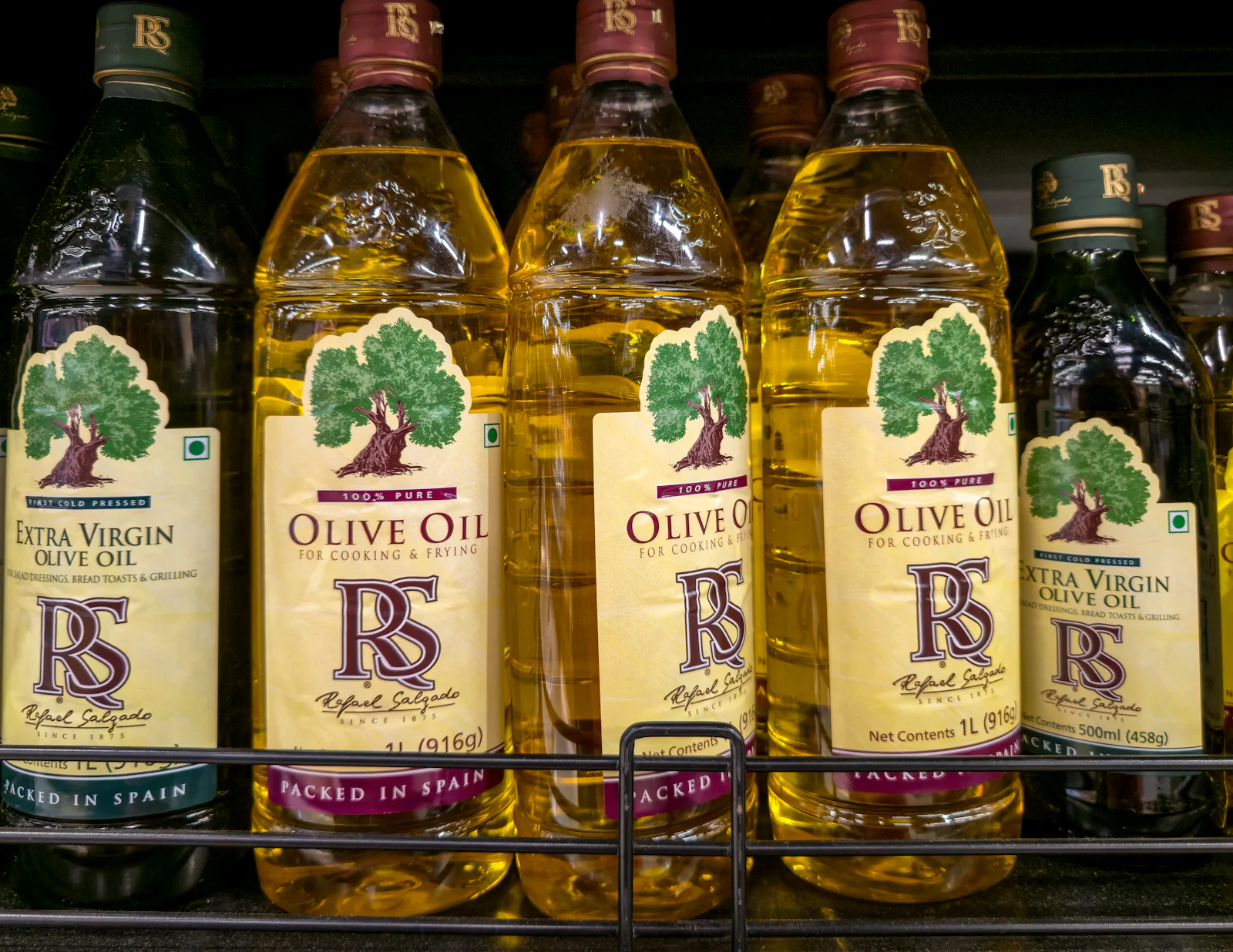
The answer has become more precise. When our price overview covered eight bottles, not one named Spain as its origin. We now track 24 bottles across six chains — and three of them put Spain on the label:
- Migros Bio Spanish olive oil, 500 ml: CHF 21.90 per litre (price recorded 30 Sep 2026) — declared as extra virgin organic olive oil from Spain, certification ES-ECO-001-AN
- Don Felipe at Coop, 1 l: CHF 12.50 per litre (30 Sep 2026) — produced in Spain, packed in Italy
- Primadonna Spanish at Lidl, 1 l: CHF 7.95 per litre (30 Sep 2026)
The spread is the instructive part: the same declared origin carries per-litre prices from CHF 7.95 to 21.90 on the Swiss shelf, close to a threefold difference. "Spain" on the label therefore says nothing about quality — the world's largest producing country supplies both ends of the shelf. None of the three bottles yet carries a Swiss test verdict.
The larger part of the range sticks to the old descriptions. The seven bottles we have tracked longest:
- Migros Bio, Greece: CHF 22.80 per litre (price recorded 30 Sep 2026)
- Iliada Kalamata PDO at Coop, Greece: CHF 18.50 per litre (30 Sep 2026)
- Manor Bio, Italy: CHF 21.50 per litre (2 Sep 2025)
- Monini Classico at Migros, EU blend, bottled in Italy: CHF 16.00 per litre (30 Sep 2026)
- Aldi BIO, EU blend: CHF 13.27 per litre (30 Sep 2026)
- Divella at Denner, bottled in Italy: CHF 11.95 per litre (16 Sep 2026)
- Primadonna at Lidl, EU: CHF 11.93 per litre (30 Sep 2026)
That is not coincidence but the market's old division of labour: a substantial share of Spanish oil is bottled abroad — above all in Italy — and resold there. Anyone buying an "EU blend" is very likely holding Spanish oil, without seeing it on the label.
The one Spanish brand Swiss tests have examined at all did badly: Ybarra at Denner, then CHF 7.95 per litre, was rated "insufficient" in the 2025 Kassensturz and K-Tipp tasting. The full chronology of every verdict is in our Swiss olive oil test 2026, and the per-litre prices we track are in the price overview.
The buying conclusion: Spain appearing on three labels does not change the fact that Spain's best oils are not a supermarket purchase in Switzerland. The award winners arrive through specialist import, direct order or delicatessens. Standing at the shelf, you are not choosing between Spanish and Italian, but between an oil with traceable origin and an anonymous blend — and "Spain" on the label is at least a traceable statement.
From volume to top-tier quality
For a long time, Spain was mostly known for large volumes and a significant share of oil bottled and resold abroad. In recent years this picture has shifted noticeably: more and more small and medium Spanish producers, often harvesting and pressing on the same estate, are winning international awards. Regions outside Andalusia — Catalonia, Navarre, Castile and León — show that smaller, more northerly growing areas can also produce world-class oils.
- World's largest producer, with roughly a third to nearly half of global output and more than 65 per cent of EU production
- 262 different olive varieties grown nationwide, the great majority of them native
- Around 30 Protected Designations of Origin (P.D.O.) with strict quality requirements
- A growing number of award-winning small producers alongside large-scale industrial production
- Named under its own origin on three of the 24 bottles we track in Switzerland — but very much present inside the "EU blends"
It therefore pays for consumers to look at the origin label: a Spanish olive oil bearing a P.D.O. seal or from a named family estate today often stands for a quality far beyond what the reputation of "the world's largest producer" alone would suggest.
Spain is no longer just the volume powerhouse of the olive oil world — increasingly, it is a quality powerhouse too.
Frequently asked questions
How much olive oil does Spain produce?
For 2025/26, market observers give figures between roughly 1,295,000 and 1,370,000 tonnes. That is more than 65 per cent of EU production and, in strong years, around 45 per cent of the world total — more than all other EU producing countries combined.
Is Spanish olive oil better than Italian?
As a question about countries it cannot be settled, and the competitions hand no country the podium: Flos Olei 2026 puts Istria ahead of Tuscany and Apulia. What decides the matter is variety, harvest date, processing and storage — not the national border.
Why do so few bottles on the Swiss shelf say "Spain"?
Because a large share of Spanish oil is bottled abroad and sold as branded goods or as an "EU blend". Of the eight bottles in our price survey, none names Spain as its origin, even though Spain supplies more than 65 per cent of the EU's volume.
How do I recognise a good Spanish olive oil?
By the variety on the label (Picual, Arbequina, Hojiblanca for example), by a stated harvest year, by a dark bottle, and by the producer's name rather than the bottler's. A P.D.O. seal is an additional indicator, but not a sufficient one.
Sources
- International Olive Council: Olive sector statistics – December 2025 and forecasts
- eComercio Agrario: olive oil production in Spain, 2025/26 campaign
- ASOLIVA (Spanish olive oil exporters' association): list of designations of origin
- Province of Jaén: area, tree count and share of world production
- Michelin Guide: Jaén – From the World's Largest Olive Grove to a New Gastronomic Destination
- Croatia Week: Istria named world's best olive oil region for ninth time (Flos Olei 2026)
- Istra.hr: Flos Olei 2026 – Istria breaks record with olive growers
- Generalitat de Catalunya: El Govern reconeix 72 olis d'oliva verge extra (14 Dec 2025)
- World's Best Olive Oils 2023/2024 – ranking
- SRF Kassensturz: Olivenöl "Extra vergine" im Test (2 Sep 2025)