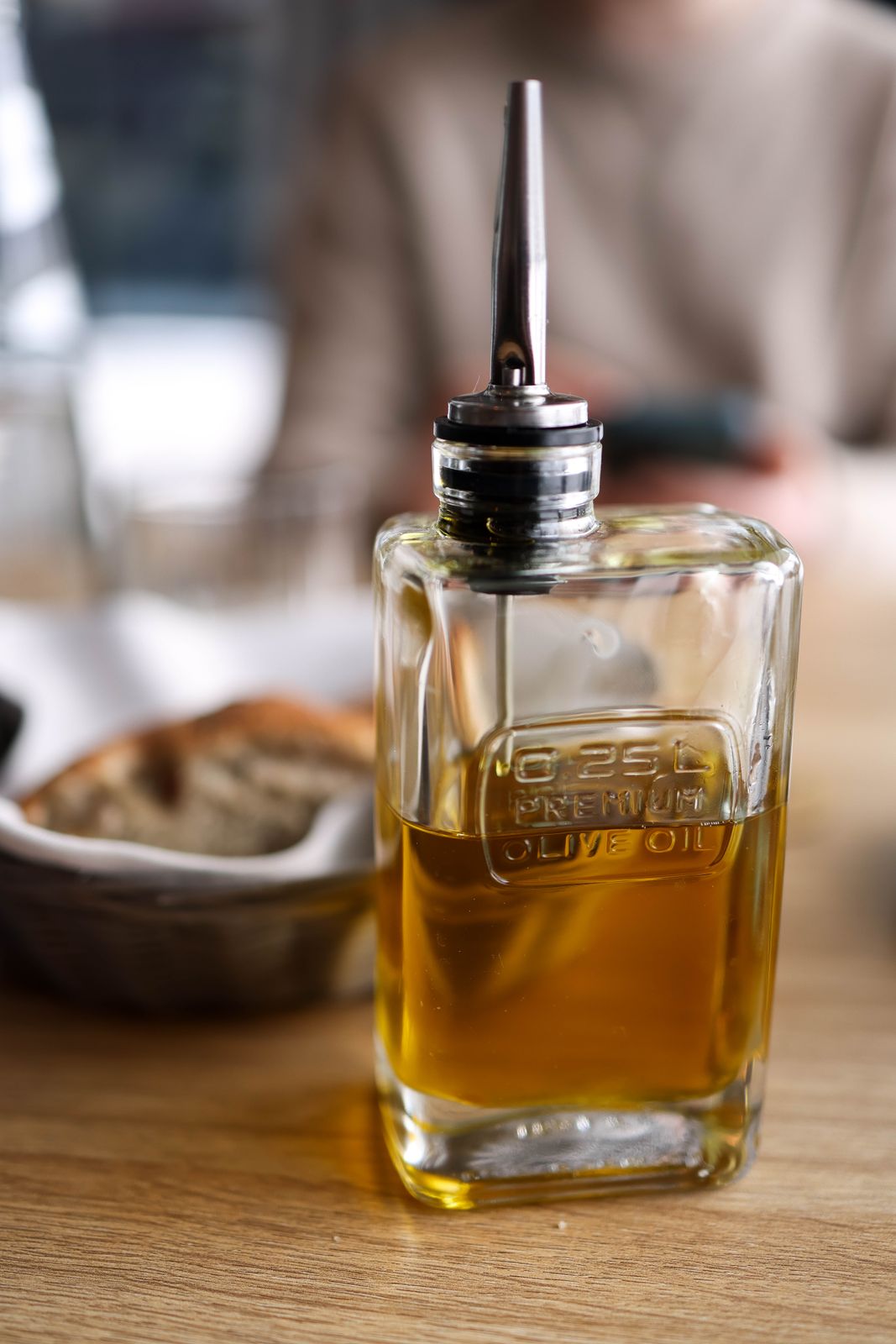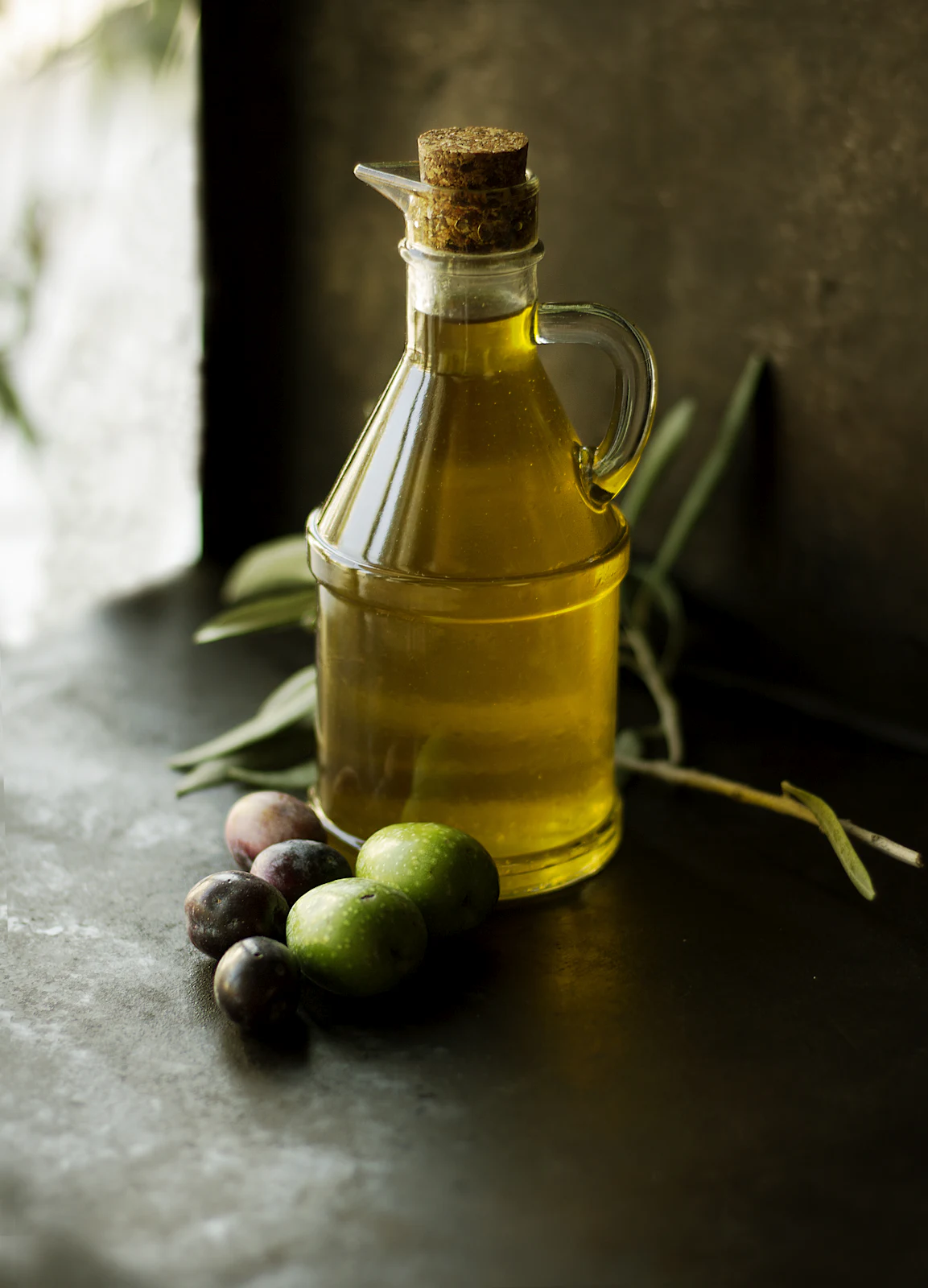
In the supermarket, olive oil usually stands in the brightest light in the shop: LED spots overhead, white-painted walls, glass bottles with no protection at all. That is exactly where the loss of quality begins – long before the bottle is opened at home. Which packaging protects an oil and which does not is one of the few quality questions you can answer with the naked eye while shopping.
What light does to olive oil
Extra virgin olive oil contains chlorophyll, which gives it part of its green colour. Under light, chlorophyll acts as a photosensitiser: it transfers light energy to dissolved oxygen and creates singlet oxygen, which attacks the oil's fatty acids. This process, photo-oxidation, runs many times faster than ordinary autoxidation in the dark.
The consequences are measurable and tasteable:
- The peroxide value rises and the oil turns rancid.
- Tocopherols (vitamin E), carotenoids and chlorophyll degrade.
- Polyphenols – the compounds behind the only health claim authorised in the EU – decline markedly.
- The typical green aromas disappear and the oil tastes flat.
What polyphenols do and why losing them matters is explained in Polyphenols and antioxidants in olive oil.
What the studies show
A Greek study (Pristouri, Badeka and Kontominas, Food Control 2010) stored the same extra virgin olive oil in clear glass, clear PET, PET with a UV blocker, PET covered with aluminium foil and polypropylene – in the dark and in the light, at different temperatures. The results:
| Packaging and condition | Shelf life |
|---|---|
| Clear glass, in the dark, up to 22 °C | 6 months |
| Clear PET, in the dark, 22 °C | 3 months |
| Clear polypropylene, in the dark, 22 °C | under 3 months |
| PET with aluminium foil, in the light | 9 months |
| PET with UV blocker, in the light, 22 °C | 3 months |
| Clear PET, in the light, 22 °C | under 3 months |
The authors noted that temperature and light had the strongest effects, while headspace volume and the material's oxygen permeability mattered least. In other words: light-proof packaging in a cool place beats any high-tech material in a shop window.
An Italian study (Sanmartin et al., Heliyon 2018) compared greenish glass and tinplate tins at 6 °C and 26 °C over 125 days. Phenolic content fell by around 10 percent at 6 °C and around 15 percent at 26 °C; perceived bitterness dropped by more than 60 percent in almost every variant – except greenish glass at 6 °C. Here too, temperature was the decisive factor.
The packaging types compared
| Packaging | Light protection | Note |
|---|---|---|
| Tin / canister | complete | Best choice for larger volumes; once opened, use quickly or decant. |
| Dark glass (green, brown, UV glass) | high | The best compromise between protection, neutrality of taste and recyclability. |
| Bag-in-box | complete | No oxygen drawn in while pouring; common in specialist shops, rare in retail. |
| Ceramic / printed glass | high | Protects well, but hides the colour and the level. |
| Clear glass | none | Neutral in taste, but the riskiest option under shop lighting. |
| PET | none to low | Light and unbreakable, but more permeable to oxygen; unsuitable for long storage. |
| Polypropylene | none | Performed worst in the study. |
Why plastic is additionally tricky
PET bottles are approved for food use and unproblematic for quick consumption. Two properties nevertheless argue against them:
- Oxygen permeability: plastic is not an absolute barrier. Over months, oxygen seeps in and the oil ages faster than in glass.
- Aroma binding: plastic walls can absorb volatile aroma compounds – an effect packaging research calls "aroma scalping".
For an oil that will be empty in four weeks this hardly matters. For a five-litre supply, tin is the better choice. Whether the large container pays off at all is worked out in 500 ml, 1 litre or a bulk tin.
What the rules require
The EU recast its marketing standards for olive oil in 2022: Delegated Regulation (EU) 2022/2104 replaced the earlier Regulation (EU) No 29/2012. On packaging it provides:
- Olive oil for the final consumer may be offered in packaging of no more than five litres.
- The packaging must have an opening system that can no longer be sealed after it is first opened – the rule that ended refillable oil jugs on restaurant tables.
- For restaurants, hospitals and canteens, member states may allow larger containers.
Switzerland is not bound by this EU regulation, but most of the olive oil sold here is bottled in the EU and therefore complies anyway.
In practice: what to do with a clear bottle
- In the shop: prefer dark glass or tin. Between two equivalent oils, the packaging decides.
- Not from the front of the shelf: the bottles that have stood longest under the spotlight are usually at the front.
- Decant: at home, transfer oil from clear glass or PET into a dark bottle or a well-sealed tin.
- Store dark and cool: cupboard rather than windowsill, not next to the stove. All the details in How to store olive oil.
- Buy smaller bottles: half a litre emptied in six weeks beats three litres standing for a year.
- Check the harvest date: it says more about freshness than a best-before date, which often just reflects bottling plus 18 to 24 months.
On the Swiss shelf
A look into Migros, Coop, Aldi or Lidl shows both: dark bottles and small tins next to bright, decorative bottles in full light. With mid-priced oils, reaching for the dark version pays off especially, because the polyphenol content there is scarcer to begin with. Which products performed well in Swiss tests is covered in our Swiss olive oil test 2026; which variety has which character, in Olive varieties in Europe.
Frequently asked questions
Is dark glass really better than clear?
Yes. Dark glass filters out much of the light that drives photo-oxidation. In studies, oil exposed to light lost polyphenols, tocopherols and aroma considerably faster.
Is olive oil in PET bottles bad?
Not inherently, but less well protected. In the 2010 study, oil in clear PET kept for about three months in the dark, in clear glass twice as long. For quick use PET is fine, for stockpiling it is not.
Which is better, tin or dark glass?
Tin blocks light completely and is ideal for larger volumes. Dark glass is more practical in the kitchen. More decisive than the material is that the bottle stands cool and dark.
May a restaurant serve olive oil in an open jug?
Not in the EU: packaging must have an opening system that cannot be resealed after first opening, which rules out refillable jugs.
How long does an opened bottle last?
Best used within two to three months. Every pour lets more oxygen into the bottle.
Sources
- Pristouri G, Badeka A, Kontominas MG: Effect of packaging material headspace, oxygen and light transmission, temperature and storage time on quality characteristics of extra virgin olive oil. Food Control 2010;21:412–418
- Sanmartin C et al.: The effects of packaging and storage temperature on the shelf-life of extra virgin olive oil. Heliyon 2018;4(11):e00888
- Kanavouras A, Coutelieris FA: Packaging and Storage of Olive Oil (IntechOpen)
- Delegated Regulation (EU) 2022/2104 on marketing standards for olive oil