In October the question arrives in the same form in every household: the bottle is half empty, olive oil has been getting cheaper for two years, and the promotion season starts in six weeks. Buy now – or wait until oil from the new crop reaches the shelf?
The honest answer has three parts, and all three have just changed for the first time in months: the crop estimate, the stock levels, and whatever of that arrives on the Swiss shelf.
New since 1 October: the official crop estimate
Until the end of September the official figure for Spain as a whole was missing. On 1 October 2026, the first day of the new season, the Spanish agriculture ministry published the first aforo for 2026/27: 1,602,596 tonnes of olive oil, around 23 per cent more than in the previous season. The ministry calls the harvest “medium to high”.
| Region | Estimate 2026/27 | Change on previous season |
|---|---|---|
| Andalusia | 1,261,200 tonnes | +29 per cent |
| Castile-La Mancha | 152,555 tonnes | +10 per cent |
| Extremadura | 97,300 tonnes | +24 per cent |
| Spain, total | 1,602,596 tonnes | +23 per cent |
Andalusia therefore accounts for 78.7 per cent of Spanish production, Jaén alone for roughly 36 per cent. Catalonia, Aragon, the Balearics, Madrid, Murcia and Navarre come in below last year. That “almost 24 per cent” can also be read in the press for Andalusia comes down to a different comparison base – an indication of how solid figures are at this stage.
Added to that is the ministry's own caveat: this is a provisional estimate, and its outcome depends on how the weather develops over the coming weeks – the oil content of the olives only forms in the weeks before pressing. A figure from early October is not a price, it is an expectation.
The second number: the tanks are full
A big harvest only pushes the price down if it meets full tanks. The Spanish market agency AICA reported total stocks of 475,434 tonnes as at 31 August 2026: 264,799 tonnes at mills and cooperatives, 206,615 tonnes at bottlers, 4,020 tonnes at the Patrimonio Comunal Olivarero. Outflows from the mills came to 68,831 tonnes in August, and the sector's total stocks fell over the month by around 93,900 tonnes – a pace the trade reports call slow. A month before the new harvest, the warehouse was well filled.
How much of that crossed into the new season as a carry-over is open. The government puts it at around 289,000 tonnes. Álvaro Olavarría, managing director of the Oleoestepa cooperative, estimates 375,000 tonnes plus imports of 215,000 to 225,000 tonnes, which would put total availability at about 2.2 million tonnes. Two figures for the same stock, 86,000 tonnes apart.
The oils and fats market report of July 2026 – the most recent available edition – calls supplies sufficient until the new harvest and the price tendency stable to slightly falling. A report with the October figures is not yet out.
The price at origin: four sources, four numbers
This is where things turn awkward for any forecast. For late September and early October 2026 several quotations for Spanish extra virgin olive oil are available – a long way apart:
| Source | Period | Price per kilo |
|---|---|---|
| POOLred | 3 to 9 October 2026 | 3.20 euros (−2.6 per cent) |
| POOLred | 26 September to 2 October | 3.56 euros |
| Agriculture ministry | 21 to 27 September | 3.44 euros |
| Observatory of the Junta de Andalucía | 8 September to 4 October | 3.57 euros |
The reason for the spread is not disagreement but emptiness: the season has begun, but there is hardly any trading. In the POOLred data for 29 September to 5 October, ASAJA Jaén counted 43 deals, averaging 3.34 euros. A drop from 3.56 to 3.20 euros in seven days therefore describes not the trend but the thinness of the trading.
Nothing is moving on the Swiss shelf
This is the part that counts for your shopping – and the news is: no news. Coop said at the end of September 2026 that no price changes were apparent for olive oil at present; how the price develops over the coming year would only become visible after the harvest, between October and January. A producer in the same piece expects a slight increase as a “tendency”. Nobody is talking about cuts.
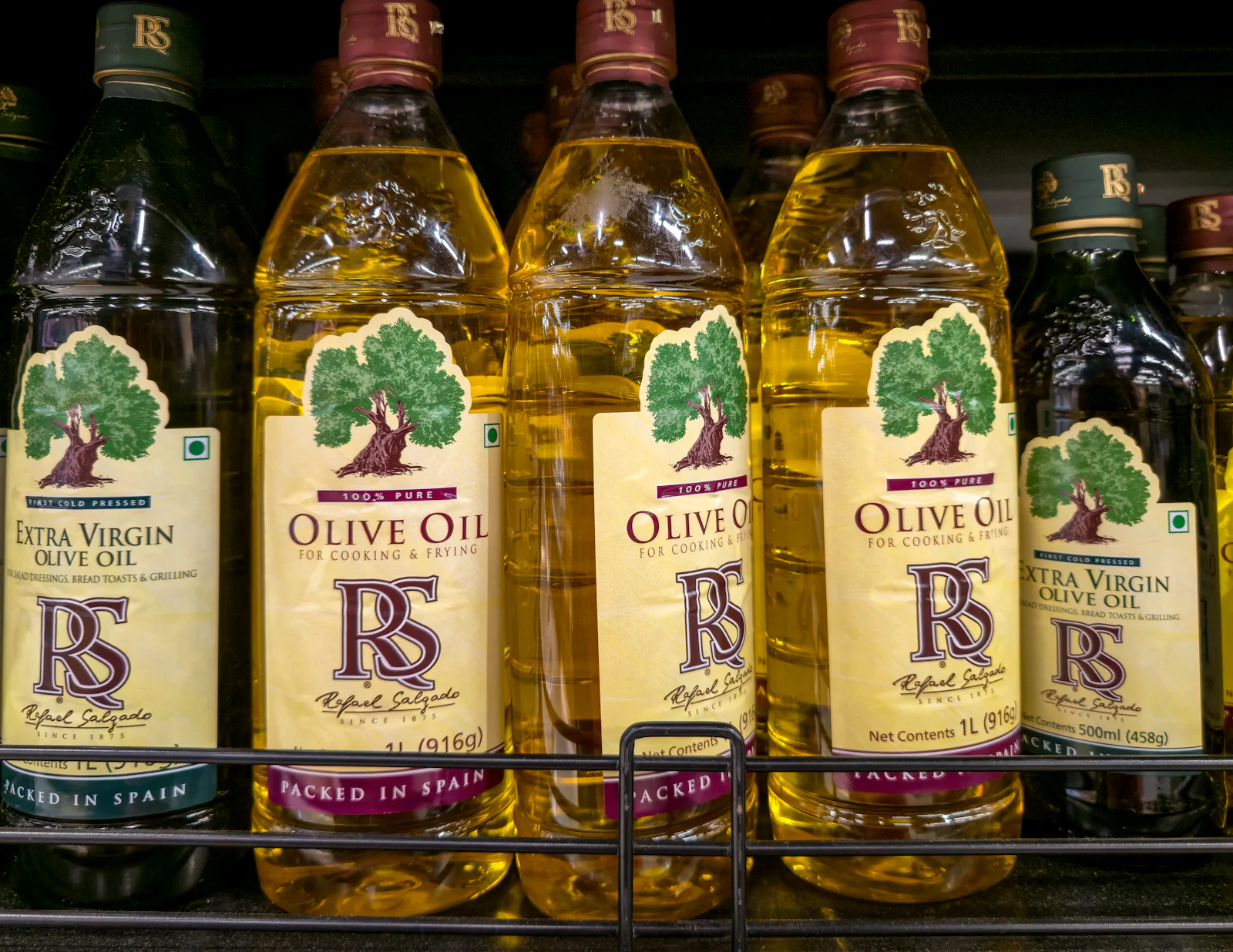
Our survey of the chains on 30 September 2026 confirms it: the floor is still an own brand in a one-litre bottle. That bottle has a history, though – the French-speaking Swiss consumer organisation FRC downgraded it to “virgin” in 2025 over sensory defects, while chemically it was unremarkable. The cheapest litre is a price reference, not a recommendation.
Prix Garantie Extra virgin olive oil, 1 l
EU, bottled in Italy
CHF 7.951 L · CHF 7.95 per litre
FRC 2025: only “virgin” (downgraded) Check priceThat the shelf reacts more slowly than the mill is no accident: glass, bottling, transport and the retail margin are paid in francs, and purchasing contracts run for months. We took that mechanism apart in our piece on the olive oil price in 2026 – at the time with the argument that the decline would continue. That needs correcting: it has not reversed, but it has flattened out, and the risk lies on the upside.
The unknown: a 20 per cent withdrawal
The Spanish agriculture ministry put the draft of a marketing standard for 2026/27 out to public consultation; the deadline ran to 13 August 2026. If opening stocks and estimated production together exceed 120 per cent of the average of the last six seasons, up to 20 per cent can be temporarily withdrawn from the market; that oil stays in store until the following season.
Minister Luis Planas called the instrument an extraordinary measure that has never been applied, and said on 1 October that the government was examining “rigorously” whether it applies. The decision is due in the first half of November 2026; COAG Andalusia and others are calling for activation. Whether it comes, we do not know – what it would mean, we do: an instrument that takes oil out of the market is meant to support prices, not lower them.
The only calculation without risk: two litres
Three uncertain numbers will not build a price forecast, but they will build a buying rule: two litres. One open in the kitchen, one sealed, dark and cool in the cupboard. No pallet.
The reason is chemistry, not thrift: olive oil is not a tinned good but a fresh juice that loses polyphenols and aroma from the moment it is bottled – faster once opened. What the best-before date says about that is in our piece on olive oil past its best-before date; which container is cheaper per litre we worked through for 500 ml, one litre and the bulk tin.
In the worst case two litres cost a few francs more than the same purchase made in three months, in the best case less. That spread is smaller than the difference in quality between freshly pressed oil and one that has spent two harvest years on the shelf. If you are buying to stock up, look at the harvest date rather than the price – a tested organic oil in the middle of the per-litre range is the unexcitable compromise:

Aldi BIO Extra virgin olive oil, European blend, 750 ml
EU blend · Organic
CHF 9.950.75 L · CHF 13.27 per litre
Kassensturz / K-Tipp 2025: good Check priceThe continuously updated table of current per-litre prices at the Swiss chains is on our prices page. Two minutes there will tell you whether the floor is still where it was on 30 September.
What this page cannot do
Nobody can say today what olive oil will cost in January 2027. For that, the harvest would have to be finished, the decision on the withdrawal taken, and the purchasing contracts of the Swiss chains known. In October none of those three things is the case. Anyone naming a concrete figure for 2027 – a retailer, a producer, a website, this one included – is naming a guess.
Frequently asked questions
Should I stock up on olive oil now or wait for 2027?
Buy the quantity you will use in six to nine months – for most households that is around two litres. The possible price differences between today and the spring run to a few francs per litre, while the quality lost by an oil stored too long is greater. A genuine multi-year stockpile never pays off with olive oil.
Will olive oil be cheaper in 2027?
That cannot be answered in October. The Spanish crop estimate of 1 October 2026 gives 1,602,596 tonnes, 23 per cent more than the previous season – which keeps the downward pressure on. At the same time the Spanish government is examining whether to take up to 20 per cent of production temporarily off the market, and quotations at origin are swinging markedly from one week to the next. We deliberately name no figure.
Why do the price figures for Spanish olive oil contradict each other?
Because they cover different periods and different deals. POOLred reported 3.20 euros per kilo for the week of 3 to 9 October 2026, while the observatory of the Junta de Andalucía gave 3.57 euros for 8 September to 4 October. On top of that, almost no deals are closed at the start of the harvest: in one week there were 43. The fewer the transactions, the more the average swings.
Have Swiss shelf prices already gone up?
On the current evidence, no. Coop said at the end of September 2026 that no price changes were apparent for olive oil at present, and that the trend would only become visible after the harvest, between October and January. Our survey of 30 September 2026 shows the same picture. Raw-material movements reach the Swiss shelf with a delay and in weakened form in any case.
How do I recognise a fresh oil when buying to stock up?
By the harvest date, not the best-before date. Good oils carry the harvest year on the back label; where it is missing, the bottling date is the approximation left. Add to that dark glass or tin, cool storage, and your own smell test on opening. Oil from the 2026/27 harvest is pressed from late October and reaches Swiss shelves in the weeks after that.
Sources
- MAPA: Primeras estimaciones del aforo 2026/27 (1 October 2026)
- Agrodigital: El aforo del aceite de oliva prevé 1,6 Mt, un 23 % más
- Junta de Andalucía: El aforo del olivar estima 1.261.200 toneladas
- Moncloa: La próxima campaña será media-alta – the government's carry-over estimate
- Agrodigital: AICA data for August 2026
- El Pespunte: Oleoestepa's carry-over and import estimate (5 October 2026)
- AgroCLM: Precios medios en origen (9 October 2026)
- ASAJA Jaén: Precio del aceite – weekly values from POOLred
- MAPA: Audiencia pública de la norma de comercialización 2026/27
- Última Hora: El Gobierno estudia «con rigor» la autorregulación (1 October 2026)
- Nau.ch: Hersteller rechnet mit leicht teurerem Olivenöl (25 September 2026)
- Millennium Trading: Marktbericht Öle und Fette, July 2026