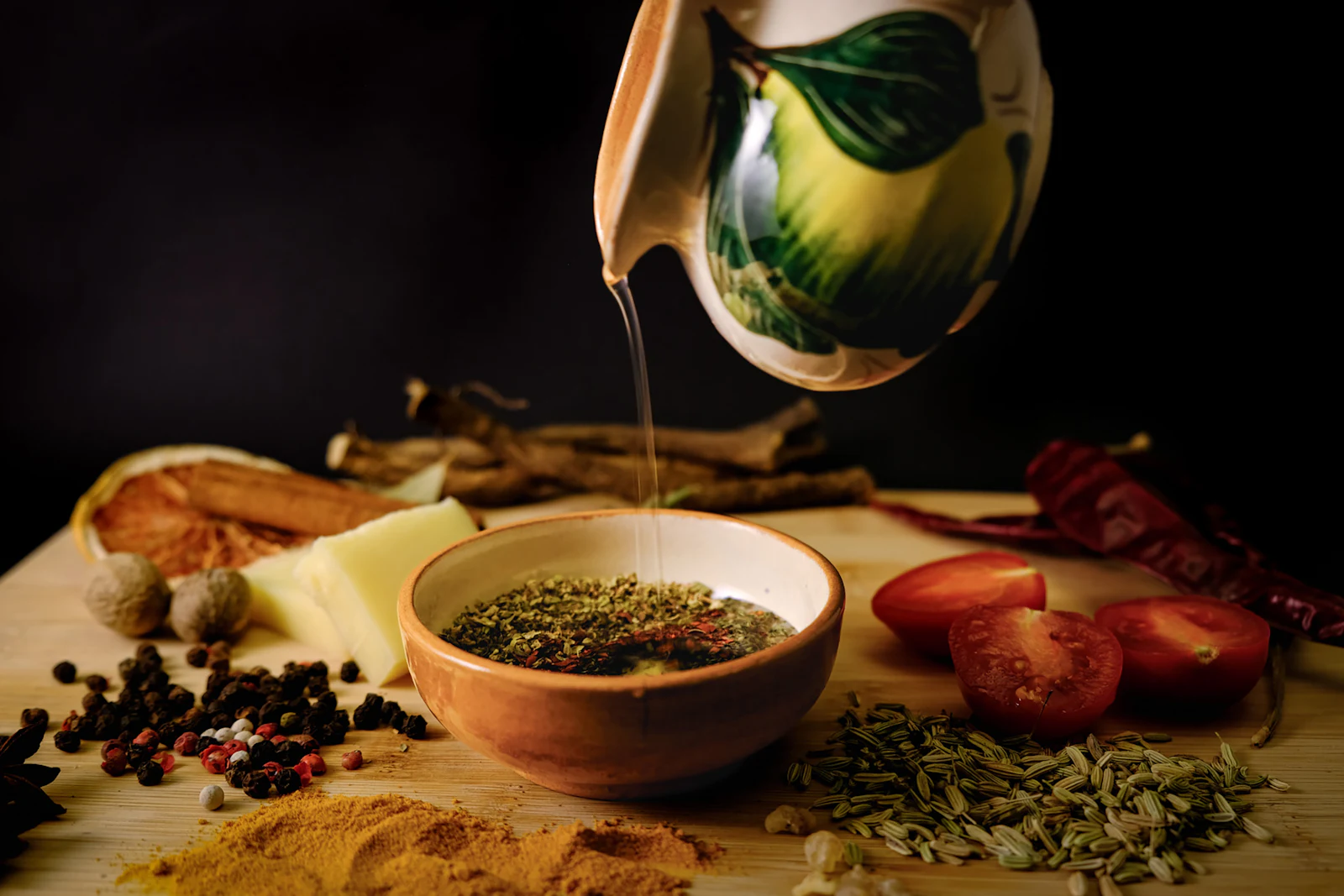
With wine the machinery is in place: a vocabulary, professionals, a culture of putting things together. With olive oil the analogy runs further than most people think — and breaks off somewhere else than most people think. The intensity of an oil is not a matter of opinion: it is defined by a testing standard and backed by numbers in an EU regulation. Which oil goes with which dish, by contrast, is standardised nowhere. This article keeps the two apart, because advertising constantly runs them together.
The three positive attributes, and what they actually mean
Tasting extra virgin olive oil follows a method of the International Olive Council (IOC), most recently in the version COI/T.20/Doc. No 15/Rev. 11 of June 2024. It recognises three positive attributes, with definitions far more precise than any marketing adjective:
- Fruity — the set of olfactory sensations characteristic of the oil, which depends on the variety and comes from sound, fresh olives, either ripe or unripe. It is perceived directly and/or through the back of the nose.
- Bitter — the characteristic primary taste of oil obtained from green olives or olives turning colour. It is perceived in the circumvallate papillae on the «V» region of the tongue.
- Pungent — the biting tactile sensation characteristic of oils produced at the start of the crop year, primarily from olives that are still unripe. It can be perceived throughout the whole mouth cavity, particularly in the throat.
What matters is how it is measured. Each taster marks the intensity of every attribute on a 10-centimetre scale; the panel result is the median of those marks, to one decimal place. Not an average, not a majority vote. And for grading: extra virgin olive oil has a median of defects of 0.0 and a median of the fruity attribute above 0.0 — a single perceptible defect costs the grade. What «extra virgin» means in the first place is set out in What Is Extra Virgin Olive Oil?.
The intensity grades are in law — with numbers
This is where it becomes concrete for shopping. There is an optional terminology for the label, and it is not arbitrary. The IOC defines it by the median of the attribute in question, and the EU has adopted exactly that scale:
| Term | Median of the attribute |
|---|---|
| robust | more than 6.0 |
| medium | more than 3.0 up to and including 6.0 |
| delicate | 3.0 or less |
The grades apply per attribute, not to the oil as a whole: «robust bitterness», «medium pungency», «delicate fruitiness». The legal basis today is Commission Delegated Regulation (EU) 2022/2104 (OJ L 284, 4.11.2022). Its Article 10(c) allows indications referring to taste or smell only for virgin and extra virgin oils, and only where they are based on an assessment carried out following the prescribed method; Annex II contains the definitions and the median bands.
Important for anything older you find online: Article 13 of that regulation repealed Regulation (EEC) No 2568/91 and Implementing Regulation (EU) No 29/2012. Anyone still citing «Annex XII of Regulation 2568/91» as current law is citing a repealed text. The numbers stayed the same; the legal basis did not.
Two further terms are defined and useful in a shop:
- «Well balanced» — an oil in which the median of the bitter attribute and the median of the pungent attribute are not more than 2.0 points above the median of the fruitiness.
- «Mild oil» — an oil in which the median of the bitter attribute and the median of the pungent attribute are 2.0 or less.
There is also a second axis that often gets lost: the kind of fruitiness. The IOC distinguishes green fruitiness (reminiscent of green fruit, from green, sound, fresh olives), ripe fruitiness (reminiscent of ripe fruit) and plain fruitiness, where neither predominates. Two oils can share an intensity median and taste entirely different because one is green and one is ripe.
Where the intensity comes from: variety and harvest date
Paul Vossen of the University of California Cooperative Extension puts it briefly: «The variety essentially determines the quality of the fruit and oil.» The second half of the explanation is ripeness — and here lies the practically most important rule: the greener the fruit, the more bitter and pungent the ultimate product and the longer its shelf life. Green oils carry the green, herbaceous note; riper fruit brings more olive fruitiness; oil from very ripe fruit is often buttery, less fruity to flat, and does not keep as well. The ideal harvest window for a variety, Vossen writes, is probably no more than two to three weeks.
Chemically, the bitterness sits with the phenols. A paper in «Molecules» (2019), co-authored by researchers at the ZHAW in Wädenswil, attributes bitterness to oleacein and the dialdehydic form of decarboxymethylligstroside aglycone; p-HPEA-EA and oleuropein correlated most strongly with bitterness (r = 0.46 and 0.57) and also with pungency (r = 0.37 and 0.40). The same paper reports bands for total phenolic content: below 220 mg/kg non-bitter, 220–340 lightly bitter, 340–410 bitter, above 410 very bitter. More on these compounds in Olive Oil Polyphenols.
Variety profiles: what each olive delivers
The descriptions below come from Vossen's variety overview for the University of California Agriculture and Natural Resources. They are his wordings, not ours:
| Variety | Profile according to Vossen | Tendency |
|---|---|---|
| Arbequina | recognised for its aromatic ripe fruitiness, low bitterness, pungency and stability | delicate |
| Taggiasca | mildly fruity; low bitterness, pungency and stability | delicate |
| Hojiblanca | fruity, aromatic, mildly pungent, low bitterness and stability | delicate to medium |
| Leccino | medium fruitiness and stability; low bitterness and pungency | medium |
| Cornicabra | very fruity and aromatic with medium bitterness, pungency and stability | medium |
| Koroneiki | strongly fruity, herbaceous and very stable; mild bitterness and pungency | medium |
| Frantoio | very fruity, aromatic and herbaceous; medium bitterness and stability; strongly pungent | medium to robust |
| Moraiolo | very strongly fruity, herbaceous and stable; medium bitterness and pungency | robust |
| Coratina | strongly green herbaceous, bitter, pungent and stable | robust |
| Picual | when harvested early, a nicely aromatic fruity oil with medium bitterness and very high stability | strongly harvest-dependent |
Picual deserves a caveat. In his overview Vossen writes of medium bitterness; in his paper in «HortScience» (2007), discussing the oils of Andalusia, he writes that Picual oils are high in polyphenols, strongly bitter, very pungent and keep well. Same author, two descriptions — the plausible reason is harvest date. There is no single «Picual intensity». Portraits in Picual and Arbequina, the overview in Olive Varieties in Europe.
And now the pairing — where the standard stops
This is the point where we have to be blunt: there is no scientific or regulatory authority for matching oil styles to dishes. The International Olive Council publishes no pairing guidance. We found no university source on it. What exists is recommendations from trade associations without citations, plus two individual findings in peer-reviewed journals.
The best-known scheme comes from the North American Olive Oil Association, a trade body whose page cites no sources at all. It describes delicate oils as buttery or floral with a slight peppery finish, medium oils as fruity with a spicy or peppery finish, and robust oils as intense and bold with a prominent peppery finish — and assigns dishes to each. Its guiding principle: «what grows together tastes good together». The Olive Wellness Institute, an industry-funded science repository, places light oils with baking and butter substitution, medium oils with everyday cooking and vegetables, and robust oils with casseroles, roasts, dressings, marinades and drizzling over finished dishes.
From peer-reviewed work, exactly two things can be contributed. First, a genuine regional observation: Vossen writes of the Ligurian Taggiasca that it is commonly harvested late to produce a very light, fruity oil «that goes well with the typical seafood diet of the region» — evidence for the «what grows together» principle from a better source than a trade text. Second, a measurement: a sensory team led by Jean-Xavier Guinard had a trained panel describe four dishes in which butter was replaced with extra virgin olive oil, and found considerably more significant differences for the pasta and green beans (14 attributes each) than for the fish (9) and the cake (5).
The table below is therefore labelled as what it is: an editorial convention, built on the regulation's intensity grades and on trade recommendations, not on studies.
| Intensity | Typical varieties | What it is usually recommended for |
|---|---|---|
| delicate | Arbequina, Taggiasca, late-harvested oils | fish and seafood, mild salad leaves, mild cheese, eggs, mayonnaise and aioli, pesto, baked goods |
| medium | Cornicabra, Koroneiki, Leccino, Hojiblanca | bread, chicken, pork, roasted vegetables, pasta, pizza, soups, pulses |
| robust | Coratina, Moraiolo, Frantoio, early-harvest Picual | beef and lamb, stews, tomato sauce, bold cheese, bitter leaves such as radicchio, drizzling at the end |
The one rule that really does follow from sensory science is not a matching rule but an ordering: a robust oil covers a delicate dish, and conversely a delicate oil disappears beside a strong one. The regulation's term «well balanced» describes exactly that problem inside the bottle — bitterness and pungency must not exceed fruitiness by more than two points. On the plate the same logic applies, only unmeasured.
How to find out for yourself, in twenty minutes
- Three oils, not two and not six. One delicate, one medium, one robust. More overwhelms the nose.
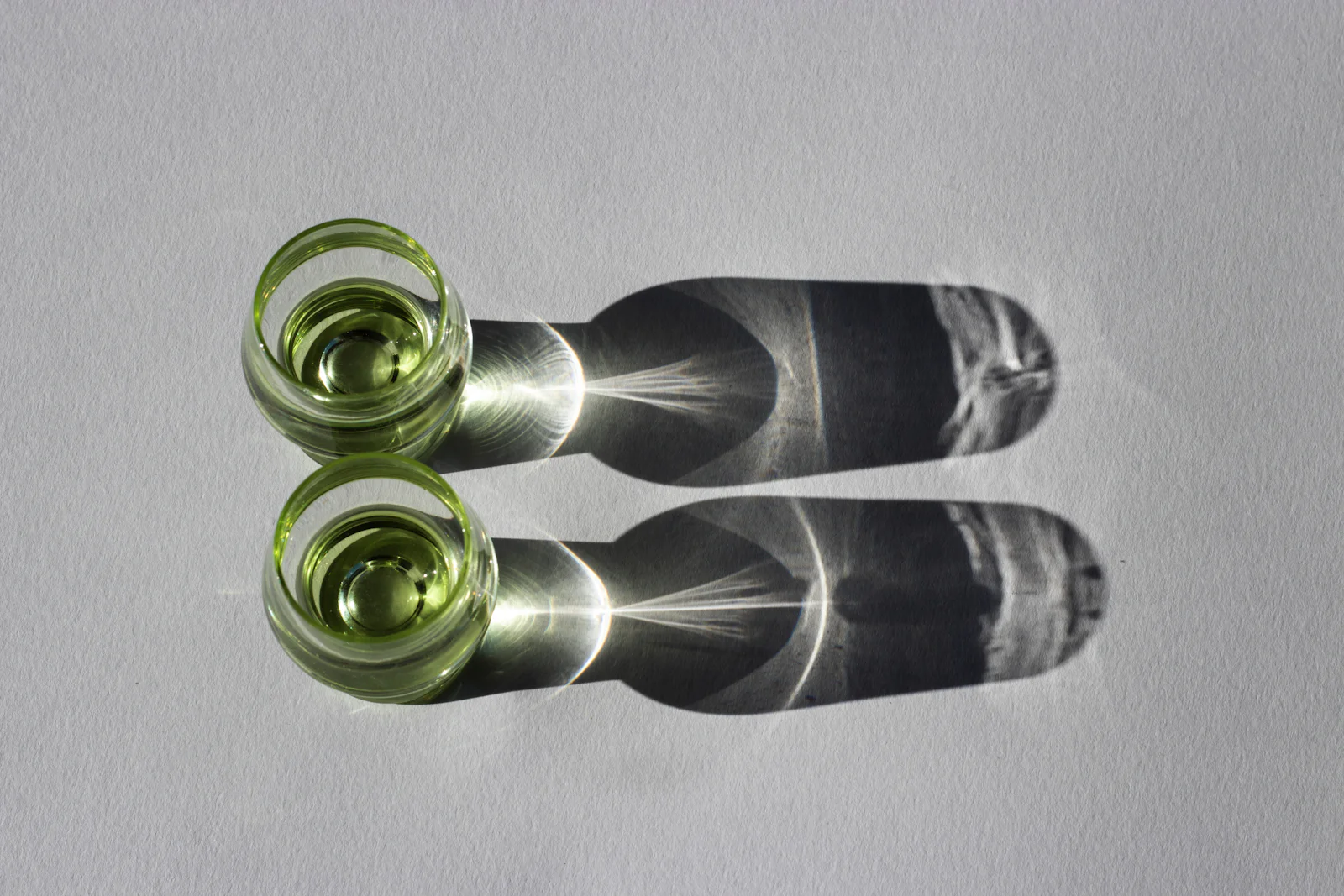
- A tablespoon each in a small glass, covered with your hand and warmed in your palm — the way panels do it, because warmth releases the volatiles.
- Smell, then take a small sip, spread it around your mouth and draw air through your teeth. Bitterness comes first, pungency follows in the throat, often with a cough. Both are quality markers, not faults.
- Only then add the food. A piece of bread, a tomato, a radicchio leaf, a spoonful of lentils. This is where your own convention gets built instead of the advertiser's.
- Write it down. Two words per oil is enough. After three rounds you have a preference that does not come from a label.
Frequently asked questions
What do «robust», «medium» and «delicate» mean on a bottle?
They are legally defined terms. Under Annex II of Commission Delegated Regulation (EU) 2022/2104, «robust» means the median of the attribute is more than 6.0, «medium» more than 3.0 up to 6.0, and «delicate» 3.0 or less — as measured by a tasting panel on a 10-centimetre scale. They may only appear on a label with a corresponding assessment certificate.
May any olive oil carry taste descriptors?
No. Under Article 10 of the same regulation, indications referring to taste and smell are permitted only for extra virgin and virgin olive oil, and only on the basis of an assessment following the prescribed method.
Is there an official pairing table for olive oil?
No. The International Olive Council standardises the tasting and the intensity terms, but not the matching of oils to dishes. Every pairing table — including ours — is convention and experience, not standard.
Is a bitter oil a bad oil?
On the contrary: bitterness and pungency are positive attributes in the testing standard. They depend on phenol content and therefore on variety and harvest date. An oil with no bitterness at all is usually a late-harvested one, or an old one.
Why does the same variety taste different every year?
Because the harvest date decides. The greener the fruit, the more bitter and pungent the oil and the longer it keeps; very ripe fruit gives a more buttery, flatter oil. The ideal harvest window for a variety, according to Vossen, lasts only two to three weeks.
What exactly does «mild oil» mean?
It is a defined term: the median of the bitter attribute and the median of the pungent attribute are each 2.0 or less. It is a statement about intensity, not about quality.
Sources
- International Olive Council: Sensory analysis of olive oil – Method for the organoleptic assessment of virgin olive oil, COI/T.20/Doc. No 15/Rev. 11, June 2024 (PDF)
- Commission Delegated Regulation (EU) 2022/2104 supplementing Regulation (EU) No 1308/2013 as regards marketing standards for olive oil (consolidated text; Article 10, Article 13, Annex II)
- Vossen P.: Variety and Maturity – The Two Largest Influences on Olive Oil Quality. University of California Agriculture and Natural Resources (PDF)
- Vossen P.: Olive Oil – History, Production, and Characteristics of the World's Classic Oils. HortScience 2007;42(5):1093–1100
- Pedan V, Popp M, Rohn S, Nyfeler M, Bongartz A: Characterization of Phenolic Compounds and Their Contribution to Sensory Properties of Olive Oil. Molecules 2019;24(11):2041
- Guinard J-X et al.: The Fat Flip – Sensory profiles of four dishes in which butter was replaced with extra virgin olive oil. International Journal of Gastronomy and Food Science 2020;22:100250
- North American Olive Oil Association: How Do You Pair Olive Oil With Food? (trade association, no sources cited)
- Olive Wellness Institute: Virtual Sensory Kit