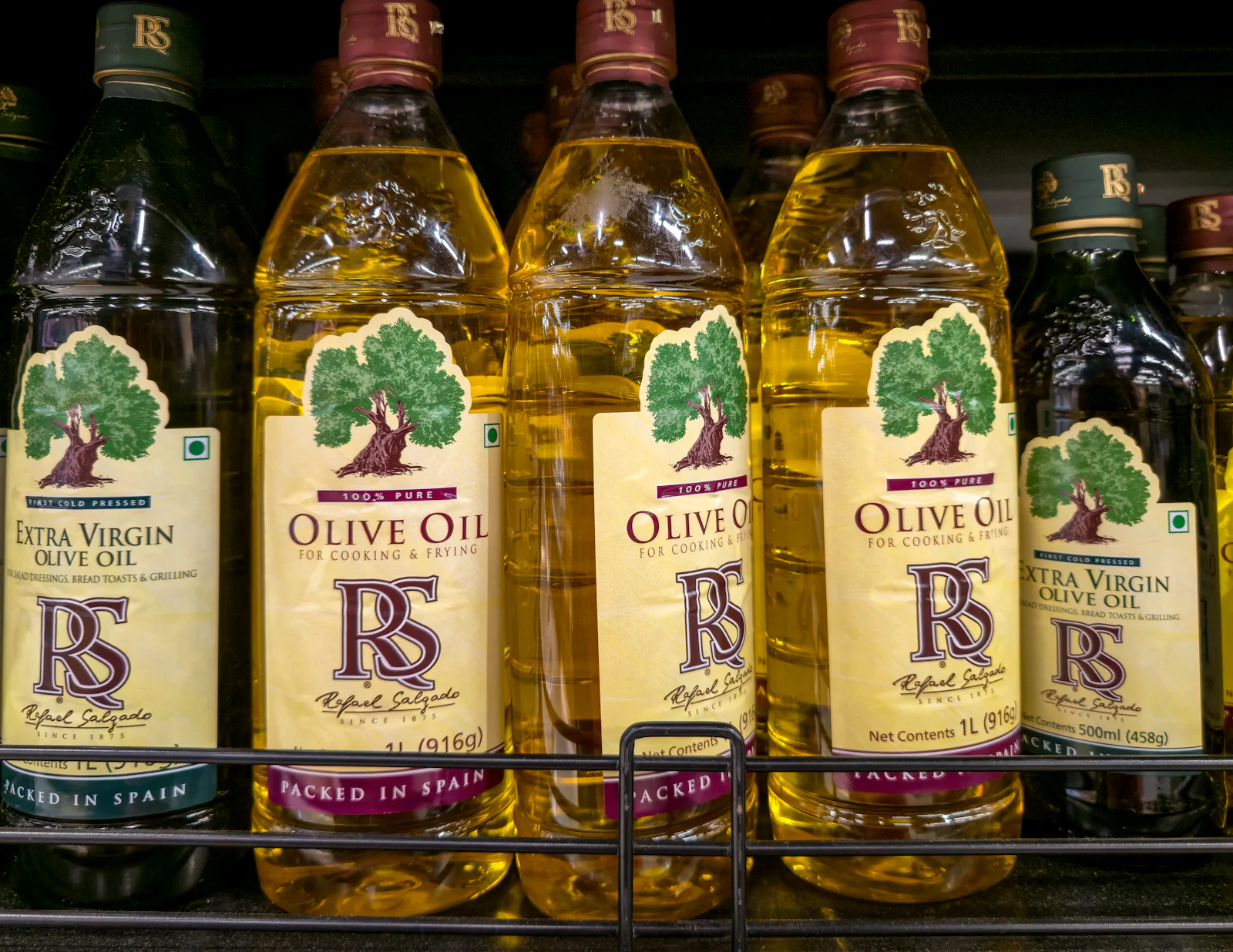
A bottle of olive oil on a Swiss shelf can carry five or six marks at once: a red-and-yellow PDO logo, a blue-and-yellow PGI logo, a green leaf of stars, a Knospe bud, a gold medal from a competition, and somewhere in small print a combination of letters and numbers. They all look equally important. They promise entirely different things, and two of them are not a judgement of quality at all.
This article sorts them out: what each mark guarantees in law, what it expressly does not guarantee, which of them even applies in Switzerland — and how to tell an official attestation from a paid tasting.
PDO and PGI: the difference sits in half a sentence
First the abbreviations, because they are the same thing in different languages. PDO (protected designation of origin) is the Italian, Spanish and Portuguese DOP, the French AOP and the German g.U. PGI (protected geographical indication) is IGP and g.g.A. Anyone who can keep DOP and IGP apart can keep all six apart.
The legal basis has recently changed, and that matters because the old number is still quoted everywhere. Since 13 May 2024 the governing text is Regulation (EU) 2024/1143 of 11 April 2024 on geographical indications for wine, spirit drinks and agricultural products; a few provisions have applied since 1 January 2025. Its Article 94 is terse: «Regulation (EU) No 1151/2012 is repealed.»
Article 46 contains the entire difference. A designation of origin identifies a product «originating in a specific place, region or, in exceptional cases, a country», «whose quality or characteristics are essentially or exclusively due to a particular geographical environment with its inherent natural and human factors», and «the production steps of which all take place in the defined geographical area». A geographical indication identifies a product originating in a specific place, region or country, «whose given quality, reputation or other characteristic is essentially attributable to its geographical origin», and «at least one of the production steps of which takes place in the defined geographical area».
All of them against at least one of them: that is it. With a PDO olive oil the olives grow in the area, are harvested there and milled there. With a PGI oil one step may be inside the area and another outside — the olives can come from further away if the specification allows it. That is why PDO is the stricter claim for olive oil, and why the register holds far more PDOs than PGIs.
What a PDO guarantees – and what it does not
A common misunderstanding is that PDO is a quality grade. It is not. A PDO guarantees that an oil comes from the named area and was made according to the specification in force there. It guarantees no score and no sensory assessment by a neutral jury.
From which follows the genuinely useful sentence: a PDO is as good as its specification — and the specification is a public document. Anyone who wants to know what a particular seal is worth reads the disciplinare or the pliego de condiciones rather than the marketing copy. Those documents often contain requirements well beyond the law:
- The specification of the PDO Olio Extravergine di Oliva del Chianti Classico requires the olives to be detached directly from the tree and harvested before 31 December, limits interim storage to cool, ventilated rooms and at most three days, requires processing within 24 hours of delivery to the mill, and caps the extraction plant at 27 °C.
- The specification of the Spanish PDO Priego de Córdoba requires ground fruit and tree fruit to be kept apart at harvest, admits only healthy olives picked directly from the tree for the protected oil, and sets the milling deadline at two days from picking.
Those deadlines are exactly the levers on which the quality of an oil actually turns. A PDO with a strict specification is therefore a strong signal — but the signal comes from the specification, not from the logo. Which small Spanish areas are worth seeking out, and the varieties behind them, we set out in Spain's small olive oil PDOs; the wider variety landscape is in olive varieties in Europe.
How many there are
The European Commission keeps the registered names in its public register, eAmbrosia. Under chapter 15 of the Combined Nomenclature — fats and oils — it held 159 registered geographical indications as of October 2026. That figure also covers butter and seed-oil names such as Beurre d'Isigny or Steirisches Kürbiskernöl; on our own review, roughly 145 to 150 of those entries are olive oil, the large majority of them PDOs.
The distribution is lopsided, and it explains the shelf: Italy leads with around fifty olive oil names, followed by Spain and Greece with a good thirty each, then at a distance France, Portugal, Croatia and Slovenia — Istria is shared between Croatia and Slovenia in a single joint PDO. Turkey, as a non-EU country, has also had names protected in the EU. Anyone looking for a PDO oil is, in practice, almost always looking in Italy, Spain or Greece.
Does a PDO mean anything in Switzerland?
Yes, but not automatically for every one. Here lies a point almost nobody knows.
The first route is the agricultural agreement between Switzerland and the EU. Its Annex 12 (SR 0.916.026.81), in force since 1 December 2011, governs the mutual protection of designations of origin and geographical indications. The decisive wording is in Article 4: each party protects the geographical indications of the other party as listed in Appendix 1. It is a list, not a general clause. And because the list is only updated periodically, it lags behind the EU register: in the version currently published, the fats category holds around 137 names, of which roughly 128 are olive oils. There are therefore olive oil PDOs registered in the EU that are not yet protected in Switzerland through the agreement.
The second route is Swiss law itself. The GUB/GGA ordinance (SR 910.12) maintains a federal register and draws the same distinction as the EU in its Articles 2 and 3, only in different words: a designation of origin requires the product to have been produced, processed and refined within a defined area, a geographical indication that it was produced, processed or refined there. That «and» against «or» is the Swiss version of «all steps» against «at least one».
For the label, Article 16 is what counts: the marks GUB and GGA may not be used for products whose name is not registered under that ordinance — but foreign designations registered in their own country of origin are expressly reserved. An Italian DOP may therefore appear as a DOP in Switzerland, because it is registered in Italy. In that sense the mark on the bottle is genuine even where the agreement has not yet listed it.
The green leaf: what organic guarantees
The EU organic logo — the leaf of white stars on green — rests on Regulation (EU) 2018/848. And unlike a competition medal it is an official mark: Article 33 describes it expressly as «an official attestation in accordance with Articles 86 and 91 of Regulation (EU) 2017/625».
What it attests is set out in Article 4, which lists the objectives of organic production: contributing to protection of the environment and the climate, maintaining long-term soil fertility, contributing to a high level of biodiversity, substantially contributing to a non-toxic environment, contributing to high animal welfare standards, encouraging short distribution channels and local production, encouraging the preservation of rare and native breeds, contributing to the supply of adapted plant genetic material, diversity of that material, and fostering organic plant breeding.
Ten objectives — and not one of them mentions taste, aroma or sensory quality. That is the sentence that puts the logo in its place: it attests a method of production, not the quality in the glass. An organically grown oil from olives picked too late can be sensorially worse than a conventional early-harvest oil, and the other way round. The two seals answer different questions.
Two companion statements belong to the logo and can be read:
- The control body's code number. Under Article 32, the code number of the control authority or body to which the operator carrying out the last production or preparation operation is subject must appear. The format, per Annex V, is «AB-CDE-999»: two letters of ISO country code for the country where the controls take place, three letters such as «bio», «öko», «org» or «eko», and a reference number of at most three digits.
- The origin statement next to the logo. Where the logo is used, the same visual field must say where the agricultural raw materials were farmed: «EU Agriculture», «non-EU Agriculture» or «EU/non-EU Agriculture». A country name may replace «EU» where all the raw materials were farmed there — which for olive oil is the more interesting version.
One practical point more: for products imported from third countries the EU logo is optional under Article 33(3). Its absence on an imported oil therefore does not necessarily mean the oil is not organic. The regulation's 95 per cent rule — at least 95 per cent of the agricultural ingredients by weight must be organic — is irrelevant for olive oil: it is a single-ingredient product and so either wholly organic or not.
Swiss organic and the Knospe
In Switzerland, labelling is governed by the Organic Ordinance (SR 910.18) of 22 September 1997. It protects the words: under Article 2 the terms «biologisch» and «ökologisch», their translations into all national languages and derived forms such as «Bio-» may be used only where production followed that ordinance, and only where compliance has been certified. Here too: not a word about taste.
Above that sits the Knospe of Bio Suisse (Bourgeon, Gemma), a private label with stricter rules than the law. Bio Suisse names among the differences from EU organic: the whole farm is run organically, whereas EU organic allows partial conversion; at least 7 per cent ecological compensation areas; no air freight; compliance with social requirements and a charter for fair trading relations.
Can an imported olive oil carry the Knospe? Yes, under conditions. Bio Suisse admits to the Knospe only products that are not available, or not sufficiently available, in Switzerland; abroad, the same or equivalent provisions apply as for Swiss Knospe production; the entire supply chain must be certified and the flow of goods documented without gaps; transport must be by land or sea. And expressly: certification of a foreign operation does not on its own entitle its products to the Knospe.
For olive oil, the Knospe guidelines contain a detail hardly anyone knows, and it makes them the strictest of the marks discussed here. The guidelines require olive oil to meet the food-law requirements for cold-pressed or cold-extracted olive oil, by centrifugation only, and they set out expressly that raw materials may not be heated above 50 °C — «for olive oil a maximum of 27 °C» — with the same ceiling for the outlet temperature in mechanical pressing and for centrifuging. Refining, bleaching, deodorising and solvent extraction are not permitted.
Which means that what food law treats as an optional claim becomes a contractual obligation for a Knospe olive oil. Why those 27 °C matter at all, and where the law handles the same figure differently, is in Cold-pressed: what the word means.
Medals are not seals
That leaves the gold stickers. They are not worthless — but they are a categorically different thing, and the difference can be shown from the competitions' own rules.
The Olive Oil Award Zurich run by the ZHAW is the most transparent example. The jury is the Swiss Olive Oil Panel, described in the regulations as an ISO 17025 accredited expert panel recognised by the International Olive Council, in existence since 2002. Samples are blinded and assessed under three-digit random numbers, in several rounds, with classification according to Commission Implementing Regulation (EU) 2022/2105 and additional chemical analysis. Methodologically this is serious work.
And the same regulations show the limits:
- Entry is voluntary and paid. The regulations state a registration fee of CHF 600 for the first oil and CHF 300 for each further one. An oil without a medal may simply not have entered.
- The award covers only the lot submitted. In the regulations' words, any announcement of prizes or labels «may only refer to original containers of the participating lot (production year, production)». A gold medal from two years ago says nothing about the bottle on the shelf.
- There is no appeal. «Appeals are not permitted.» An official objection can be contested; a tasting result cannot.
With other competitions, the organiser itself is informative. The NYIOOC World Olive Oil Competition is, on its own account, organised by Olive Oil Times, «the industry's publication of record» — not by an authority. The Mario Solinas Quality Award comes from the International Olive Council itself and goes to oils with the highest scores for harmony, complexity and balance.
The contrast in one sentence: the EU organic logo is, by the regulation's own words, an official attestation, and official food control in Switzerland rests on the Foodstuffs Act (SR 817.0), which requires self-monitoring by businesses in Article 26 and risk-based official controls at every stage in Article 30. A competition medal is the result of a paid, voluntary tasting of a single lot. Both can be informative. Only one of them is a control.
What finally counts on the label
A short order of priority for the shelf, following from the above:
- The grade. «Extra virgin olive oil» is the legal basis for everything else — what it means is in What is extra virgin olive oil?.
- The harvest year. It may be stated only where the entire contents come from that harvest. More concrete than any seal.
- The origin of the olives, not just the country of bottling — and on organic oil, the statement beside the logo and the control body's code.
- A PDO, if you know which one: as a pointer to a specification you can go and read.
- A medal last, and only with the year and the lot in view.
Frequently asked questions
What is the difference between PDO and PGI?
For a designation of origin (PDO, DOP, AOP), Article 46 of Regulation (EU) 2024/1143 requires that all production steps take place in the defined geographical area. For a geographical indication (PGI, IGP), at least one step suffices. In addition, a designation of origin requires the quality or characteristics to be essentially or exclusively due to the geographical environment, whereas for a geographical indication a given quality, reputation or other characteristic must be essentially attributable to the origin.
Is Regulation (EU) No 1151/2012 still in force?
No. It was repealed by Regulation (EU) 2024/1143 of 11 April 2024, which has applied since 13 May 2024; a few provisions have applied since 1 January 2025. The old number still appears in many texts and on packaging.
Does PDO mean the oil tastes better?
Not directly. A PDO guarantees origin and production under a specification, not a sensory assessment. What matters is what the specification says: the Chianti Classico PDO requires processing within 24 hours of delivery and a maximum of 27 °C in the extraction plant; the Priego de Córdoba PDO sets a two-day milling deadline and the separation of ground and tree fruit. Rules like those act directly on quality.
Does the organic logo guarantee better taste?
No. Article 4 of Regulation (EU) 2018/848 lists ten objectives of organic production — environment and climate, soil fertility, biodiversity, a non-toxic environment, animal welfare, short distribution channels, rare breeds and plant genetics. Taste, aroma and sensory quality appear in none of them. The logo attests a method of production, and the regulation expressly calls it an official attestation.
Can an imported olive oil carry the Bio Suisse Knospe?
Yes, under conditions. Bio Suisse admits to the Knospe only products not available, or not sufficiently available, in Switzerland; abroad the same or equivalent provisions must be met, the whole supply chain must be certified, the flow of goods documented without gaps, and transport by land or sea. For olive oil the guidelines additionally prescribe a maximum of 27 °C in pressing and centrifugation.
Does Swiss olive oil have a PDO?
No. The eAmbrosia register holds no Swiss olive oil name under the chapter for fats and oils. Given the volumes involved in Ticino that is not surprising: a protected name presupposes a collective body to carry a specification and have it inspected.
Is a gold medal an official seal?
No. It is the outcome of a competition that is entered voluntarily and for a fee. At the Olive Oil Award Zurich an ISO 17025 accredited panel does assess blinded samples, but the regulations record that an award covers only the lot submitted and that no appeal is possible. Official control runs through the Foodstuffs Act and the cantonal enforcement authorities.
Sources
- Regulation (EU) 2024/1143 on geographical indications – Article 46 (definitions), Article 94 (repeal), Article 97 (application)
- European Commission: eAmbrosia, the register of geographical indications
- Regulation (EU) 2018/848 on organic production – Articles 4 (objectives), 32 (labelling), 33 (EU logo), Annex V
- Swiss Organic Ordinance (SR 910.18), Article 2: labelling and certification requirement (in German)
- Swiss GUB/GGA Ordinance (SR 910.12), Articles 2, 3 and 16 (in German)
- Switzerland–EU agricultural agreement, Annex 12 on the protection of designations of origin and geographical indications (SR 0.916.026.81)
- Swiss Foodstuffs Act (SR 817.0), Articles 26 (self-monitoring) and 30 (official controls)
- Bio Suisse: how the Knospe differs from EU organic (in German)
- Bio Suisse: conditions for Knospe import products (in German)
- ZHAW: Olive Oil Award Zurich 2026 regulations – jury, fees, scope of the award (PDF)
- NYIOOC World Olive Oil Competition: organiser and self-description
- International Olive Council: Mario Solinas Quality Award 2026, call for participation
- Specification of the PDO Olio Extravergine di Oliva del Chianti Classico (PDF, in Italian)
- Specification of the PDO Priego de Córdoba (MAPA, 2022) (PDF, in Spanish)