"What does a professional footballer eat?" is one of the most searched questions in sport, and one of the worst documented. There is no publicly accessible, citable source for the meal plans of individual players or of Swiss clubs. So we are not going to tell you which oil sits in a Super League kitchen. What does exist is firmer: Swiss sports-nutrition guidance that names olive oil, and a body of research on olive oil polyphenols that is more precise than the bottle's marketing copy suggests, and also narrower.
What Swiss sports nutrition actually says
The reference document is the Food Pyramid for Athletes. It comes from the Swiss Forum for Sport Nutrition and the Swiss Sports Nutrition Society (SSNS), was produced with ETH Zurich and the Federal Office of Sport (BASPO), and builds on the food pyramid of the Swiss Society for Nutrition. The SSNS is Swiss Olympic's recognised partner organisation for sports nutrition.
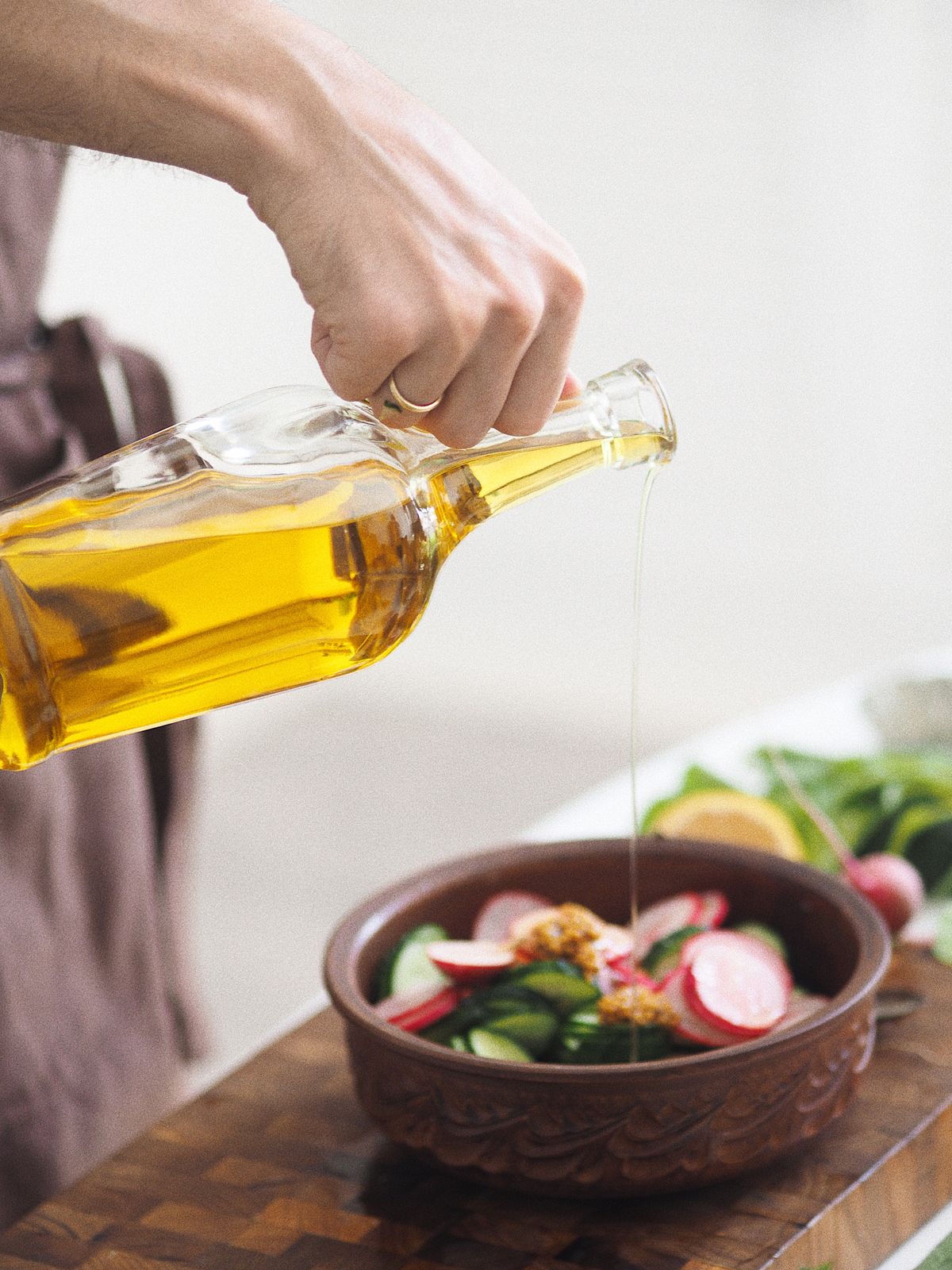
On the "oils, fats, and nuts" level the wording is specific: one portion a day of plant oil for cold dishes, "e.g. canola or olive oil", one portion for cooking, "e.g. olive oil", and, if needed, one portion (10 g = 2 teaspoons) of butter or spread. A portion is 10 to 15 g, or 2 to 3 teaspoons. And the part that concerns training: add half a serving per hour of sport from that same level.
The target group is defined just as precisely: healthy adults exercising at least five hours per week, roughly an hour on most days at moderate intensity or above. Moderate intensity is defined through football itself – the stop-and-go load of an ice hockey match, a soccer game or a tennis match, or a continuous effort of about 8 km/h running. Serving sizes follow body mass, the smallest for 50 kg and the largest for 85 kg.
For an amateur footballer with two training sessions and a match a week, that works out at roughly 20 to 30 g of oil a day as a baseline, and a little more on training days. Olive oil is named – but as one of two options, alongside rapeseed oil. Anyone claiming the pyramid singles out olive oil is over-reading it.
Why the recommendation lands on olive oil at all
Extra virgin olive oil is mostly monounsaturated fat and carries polyphenols that refined oils do not. For hot food, its stability is the argument: how hot you can take an extra virgin oil and where its smoke point really lies is set out in cooking with olive oil. What polyphenols are and how much they vary between oils is covered in polyphenols and antioxidants in olive oil.
Exactly one health claim about those polyphenols is authorised in the EU: that they contribute to the protection of blood lipids from oxidative stress, for oils containing at least 5 mg of hydroxytyrosol and its derivatives per 20 g, at a daily intake of 20 g (Regulation (EU) No 432/2012). That is a narrow statement about blood lipids. It says nothing about performance, muscle mass or recovery.
Exercise stress: what was measured, and with what
This is where the most common confusion sits. The studies that show measurable effects around exercise mostly do not use olive oil. They use concentrated olive extracts.
A group around James D. Roberts tested a phytocomplex drink made from olive fruit water (OliPhenolia) containing 28.8 mg of hydroxytyrosol per 28 ml serving. Twenty-nine recreationally active adults took 2 × 28 ml a day, or a matched placebo, for 16 days. In the first paper (Nutrients 2022), superoxide dismutase activity after exercise was lower on the extract and reduced glutathione higher; malondialdehyde and catalase showed no difference. In the second (Nutrients 2023), oxygen uptake kinetics at exercise onset, running economy at the first lactate threshold and perceived exertion all improved, while time to exhaustion rose similarly in both groups with no significant difference between them.
That is a serious finding, but it applies to a high-dose extract drink, not to two teaspoons of olive oil on a salad. Doing the arithmetic: 57.6 mg of hydroxytyrosol a day is what roughly 230 g of an oil sitting exactly at the EU threshold would supply. Nobody eats that.
Work done with actual oil comes from Sanchez-Rodriguez and colleagues (Nutrients 2019): 51 healthy adults took 30 ml a day of each of three oils differing in phenols and triterpenes (124 to 490 ppm phenols) for three weeks each, double-blind and crossover. The oil additionally enriched with triterpenes lowered the DNA damage marker 8-OHdG in urine and TNF-alpha versus the high-phenol comparator, and interleukin-8 versus the standard oil too. That is biochemistry in healthy adults rather than performance on the pitch – but it was measured with realistic amounts of oil.
The Mediterranean diet and performance: the honest state of play
In sport, olive oil is almost always part of a pattern rather than a single intervention. A systematic review by Bianchi and colleagues (Nutrients 2024) pooled eight intervention trials with 116 participants in total, from professional handball and volleyball players to CrossFit trainees. Plasma total antioxidant capacity rose, markers of oxidative stress and inflammation fell, and the body-composition results were mixed. The authors name small samples and short interventions as a limitation outright.
The single most-cited study is a randomised crossover trial by Baker and colleagues (2019) with eleven active participants: after four days of a Mediterranean diet they ran 5 km on average 6 per cent faster than after four days of a Western diet, with no difference in anaerobic tests. Eleven people are eleven people; no training plan follows from that.
How serious that caveat is was worked through by Massart and colleagues (Journal of Functional Morphology and Kinesiology 2025): only about 40 per cent of the studies reviewed found significant performance gains, and those suffered from heterogeneous groups, uncontrolled carbohydrate intake and poor dietary records. The sober position: plausible, partly supported, not proven.
What we cannot say about footballers
The UEFA expert group statement on nutrition in elite football (Collins et al., British Journal of Sports Medicine 2021) sets out that nutrition plays an integrated role in performance and health across a season, and works through nine topic areas from match day and training day to supplements and rehabilitation. It crowns no oil. And for individual players, club kitchens or Swiss club diets we found no citable source at all. Claims of that kind circulate freely online; none of them checks out.
In practice: olive oil in an athlete's shopping basket
What follows for a Swiss supermarket is unspectacular and cheap:
- Amount: 2 to 3 teaspoons for cold dishes and the same again for cooking, plus half a serving per hour of training – exactly as the pyramid puts it.
- Cost: 30 g of oil is about 33 ml. At CHF 21.50 per litre, the price of the best-rated oil in the 2025 Kassensturz test, that comes to roughly 70 centimes a day by our arithmetic.
- Choosing: "extra virgin", a dark bottle, a harvest date or harvest year on the label. A high-polyphenol oil tastes bitter and catches at the back of the throat: that is a feature, not a fault.
- Not needed: extracts, capsules or "sports" oils. The one authorised claim refers to 20 g of oil a day – a food, not a preparation.
What regular consumption does outside sport, according to the evidence, is summarised in daily olive oil; whether it actually extends life is examined against the mortality studies. And because daily use adds up, the price per litre is worth a look on our overview of Swiss olive oil prices.
Frequently asked questions
How much olive oil should an athlete use per day?
The Food Pyramid for Athletes gives one portion of 10 to 15 g for cold dishes and one for cooking, plus half a serving per hour of sport. Olive oil is one of several named fat sources, not the only one.
Does olive oil improve athletic performance?
That is not established. Effects on exercise-induced oxidative stress were measured mainly with high-dose olive extracts. For the Mediterranean diet as a whole there are signals of better endurance, but the studies are small and methodologically weak.
Does olive oil help recovery?
In the 2023 trial, participants on the extract drink reached 50 per cent of their end-of-exercise oxygen uptake value faster. For olive oil in normal kitchen amounts there is no comparable evidence.
What do professional footballers actually eat?
There is no reliable public source on individual players or Swiss clubs. The UEFA expert group describes general principles for elite football but recommends no brands.
Is a cheap supermarket olive oil good enough?
For fat intake, yes. For polyphenols, quality counts: a harvest date, a dark bottle and a bitter, peppery profile tell you more than the price alone.
Sources
- Swiss Forum for Sport Nutrition / Swiss Sports Nutrition Society: Food Pyramid for Athletes (English, PDF)
- Swiss Sports Nutrition Society: food pyramid for athletes
- Swiss Olympic: sports nutrition (partner organisation SSNS)
- Roberts JD et al.: The Impact of a Natural Olive-Derived Phytocomplex (OliPhenolia) on Exercise-Induced Oxidative Stress in Healthy Adults. Nutrients 2022;14(23):5156
- Roberts JD et al.: The Effect of a Hydroxytyrosol-Rich, Olive-Derived Phytocomplex on Aerobic Exercise and Acute Recovery. Nutrients 2023;15(2):421
- Sanchez-Rodriguez E et al.: Effects of Virgin Olive Oils Differing in Their Bioactive Compound Contents on Biomarkers of Oxidative Stress and Inflammation in Healthy Adults. Nutrients 2019;11(3):561
- Bianchi E et al.: Impact of the Mediterranean Diet on Athletic Performance, Muscle Strength, Body Composition, and Antioxidant Markers. Nutrients 2024;16(20):3454
- Massart A et al.: Why Is the Association Between Mediterranean Diet and Physical Performance in Athletes Inconclusive? J Funct Morphol Kinesiol 2025;10(1):16
- Collins J et al.: UEFA expert group statement on nutrition in elite football. Br J Sports Med 2021;55(8):416
- EUR-Lex: Regulation (EU) No 432/2012 – list of permitted health claims
- SRF Kassensturz: olive oil test – "extra vergine" or not (02.09.2025)
Note: This article is for general information only and does not replace advice from a doctor or dietitian. If you have health questions, please consult a professional.