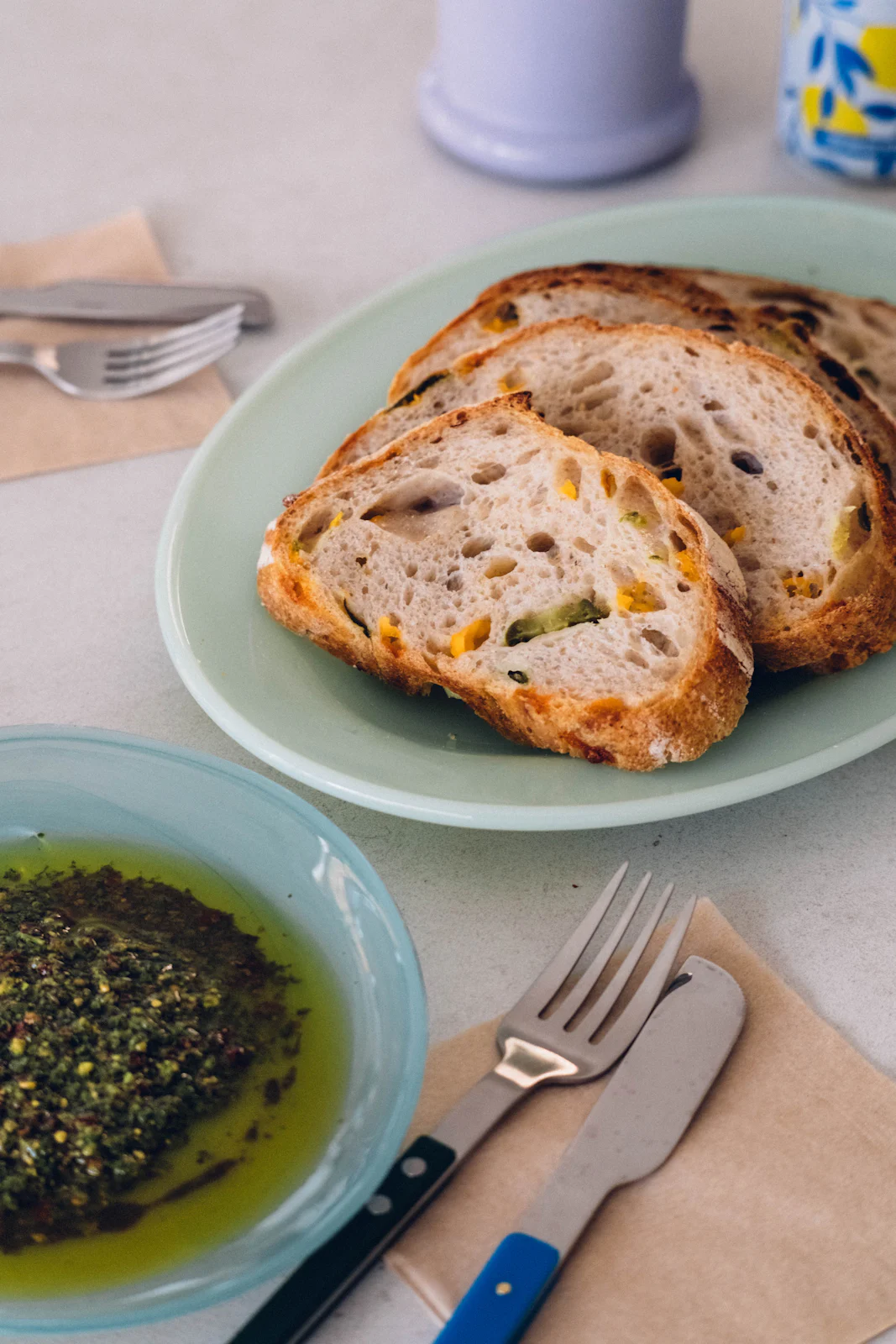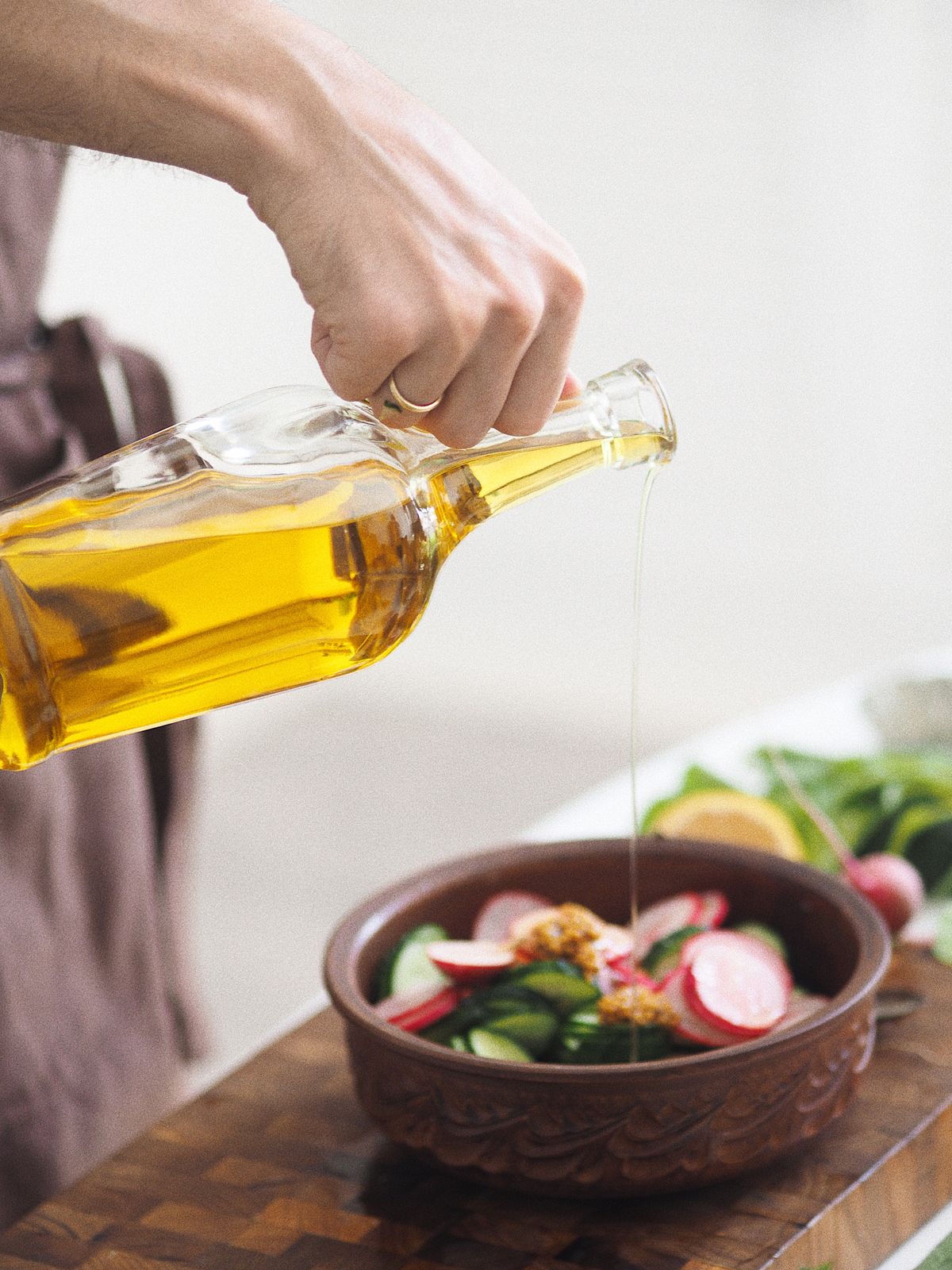
Tomatoes and olive oil have belonged together in Mediterranean cooking for centuries – for pleasure, not out of nutritional calculation. Today we know the combination is more than a matter of taste. The tomato's most valuable pigments are fat-soluble. Without fat on the plate, the body absorbs only a small share of them. A tablespoon of extra virgin olive oil therefore turns a tomato salad not only into a better dish, but into a different package of nutrients.
Why lycopene needs fat
Lycopene is the red pigment of the tomato and belongs to the carotenoids, like beta-carotene in carrots or lutein in spinach. All of them are fat-soluble: they do not dissolve in water but need fat to be packed into tiny transport droplets (micelles) in the gut and carried from there via the lymph into the blood. Without fat, a large part of the carotenoids stays in the digestive tract and leaves the body unused.
Two further factors matter:
- Cell structure: lycopene sits firmly inside the tomato's cell walls. Cutting, crushing, salting and above all heating break that structure open and make the pigment available.
- Isomer form: heating converts part of the lycopene into so-called cis forms, which the body absorbs more easily. That is why a cooked tomato sauce often delivers more usable lycopene than the same amount of raw tomatoes.
What the studies show
The research on this is limited in size but remarkably consistent.
Salad without fat: almost no uptake
A much-cited study at Ohio State University (Brown et al., American Journal of Clinical Nutrition, 2004) had seven participants eat the same salad of spinach, romaine lettuce, cherry tomatoes and carrots with three different dressings: containing 0, 6 and 28 grams of oil. After the fat-free dressing, the amount of alpha-carotene, beta-carotene and lycopene arriving in the blood's transport particles (chylomicrons) was negligible. With reduced-fat dressing it rose measurably, and with full-fat dressing most of all. The salad was identical in all three cases – only the fat decided how much of it the body could actually use.
Tomatoes cooked with olive oil: more lycopene in the blood
An Australian study (Fielding et al., Asia Pacific Journal of Clinical Nutrition, 2005) compared tomatoes cooked with and without olive oil. After eating the tomatoes cooked with olive oil, plasma trans-lycopene rose by around 82 percent and cis-lycopene by 40 percent. Without olive oil there was no meaningful change in trans-lycopene. The authors concluded that adding olive oil during cooking greatly increases lycopene absorption – exactly what Mediterranean cooking has always done.
Sofrito: cooking time and oil quantity count
Spanish work on sofrito, the slow-cooked base of tomato, onion and garlic in olive oil, shows the same pattern: depending on cooking time and the amount of extra virgin olive oil, the carotenoid profile of the sauce changes markedly, and part of the pigments migrate into the oil phase, where they are more available to the body.
Context: these are small studies using blood levels as their measure, not investigations of disease or life expectancy. They show that fat improves absorption – not that tomato salad with olive oil protects against any particular illness. How the other health claims about olive oil rate on the same scale is set out in Olive Oil and Health: What the Evidence Shows.
How much olive oil does a tomato salad need?
A few grams of fat are enough for carotenoid uptake, but more works better – in the salad study, absorption was highest with full-fat dressing. In practice:
- One to one and a half tablespoons of extra virgin olive oil per person and portion of salad (roughly 10 to 15 grams) is a good rule of thumb.
- No "light" dressing: reduced-fat supermarket dressings save calories but cost precisely the effect described here.
- Add the oil last and toss so that it coats every piece. Salting the tomatoes ten minutes earlier draws out juice that combines with the oil into a natural sauce.
- Keep an eye on calories: olive oil provides around 90 kilocalories per tablespoon. It should replace other fats, not be added on top of them.
Which olive oil suits tomatoes?
Both styles work; it is a matter of taste:
- Mild and almondy (Arbequina, Taggiasca, Empeltre, Tanche): keeps the sweetness of ripe tomatoes in the foreground.
- Robust and green (Picual, Koroneiki, Hojiblanca, Coratina): adds pepper and bitterness that go superbly with tomato, basil and salt – the classic southern choice.
For the character of each variety, see our overview Olive varieties in Europe. An oil rich in polyphenols also brings its own antioxidants; more in Polyphenols and antioxidants in olive oil.
Choosing the right tomato
- Buy ripe, eat ripe: lycopene content rises with ripeness. Pale, early-picked tomatoes contain considerably less.
- Not in the fridge: below 12 degrees tomatoes lose aroma. They belong on the counter at room temperature.
- Salt first: salt the slices, let them stand briefly, then add the oil – the sauce makes itself.
- Go easy on acid: a good vinegar or lemon juice at a ratio of one part to three parts oil is enough; too much acid buries both tomato and oil.
Five salads where olive oil makes the difference
1. Spanish tomato salad
Cut ripe beef tomatoes into thick slices, sprinkle with coarse salt, add fine rings of sweet onion, a generous pour of extra virgin olive oil, a splash of sherry vinegar and a little oregano. Let stand for ten minutes and mop up the sauce with bread.
2. Greek village salad (horiatiki)
Tomato wedges, cucumber, green pepper, red onion, Kalamon olives, a slab of feta on top, oregano, no lettuce. Dressing: robust Greek olive oil and salt, nothing else – the fat of the feta and the oil together carry the carotenoids.
3. Panzanella
Soak cubes of stale bread briefly in water, squeeze them out, mix with tomato pieces, cucumber, onion and basil. Dress with three parts olive oil to one part red wine vinegar, salt and pepper. Leave half an hour – the bread soaks up tomato juice and oil.
4. Caprese
Alternating slices of tomato and mozzarella, basil, salt, olive oil. The better the oil, the less else it needs. Balsamic is optional and rather unusual in Italy.
5. Tomato and lentil salad
Mix cooked beluga lentils with diced tomatoes, spring onions, parsley and a vinaigrette of olive oil, lemon, mustard and salt. Filling, high in protein – and the oil carries both lycopene and the fat-soluble vitamins.
More ideas: Swiss recipes with olive oil, including the beetroot salad, where the same principle applies.
What may legally be claimed
Health claims are strictly regulated in the EU and Switzerland. For olive oil, the authorised statement is that olive oil polyphenols contribute to the protection of blood lipids from oxidative stress – permitted for oils containing at least 5 mg of hydroxytyrosol and its derivatives per 20 grams (Regulation (EU) No 432/2012). For lycopene itself there is no authorised health claim. That fat improves the absorption of carotenoids, by contrast, is undisputed nutritional physiology and not a health claim.
Frequently asked questions
Why does tomato salad need olive oil?
Because lycopene and the other carotenoids are fat-soluble. Without fat the body absorbs only a fraction of them; in studies, uptake after a fat-free dressing was negligible.
How much olive oil is enough?
One to one and a half tablespoons per portion. More fat means more absorption in studies, but also more calories – olive oil should replace other fats.
Are cooked tomatoes better than raw ones?
For lycopene uptake, yes: heat breaks the cell structure open and creates more usable cis forms. Raw tomato salad with olive oil still makes sense – it also provides heat-sensitive vitamin C.
Does every fat work equally well?
For carotenoid absorption, what counts above all is that some fat is present. Extra virgin olive oil additionally brings polyphenols and vitamin E, and it suits the tomato in flavour.
Doesn't olive oil make the salad too fatty?
A tablespoon has around 90 kilocalories. If it replaces ready-made creamy dressings, you usually end up eating less fat overall – and getting more of what is in the tomato.
Sources
- Brown MJ et al.: Carotenoid bioavailability is higher from salads ingested with full-fat than with fat-reduced salad dressings. Am J Clin Nutr 2004;80(2):396–403
- Fielding JM et al.: Increases in plasma lycopene concentration after consumption of tomatoes cooked with olive oil. Asia Pac J Clin Nutr 2005;14(2):131–136
- Vallverdú-Queralt A et al.: Carotenoid profile of tomato sauces – effect of cooking time and content of extra virgin olive oil
- Regulation (EU) No 432/2012 on permitted health claims
Note: This article is for general information only and does not replace advice from a doctor or dietitian. If you have health questions, please consult a professional.