Search for the world's most expensive olive oil and you will find figures between 50 and 15,000 francs for the same bottle. That is not a volatile market; it is copying without checking. So we worked differently. Every price in this article comes from the producer's own shop or from a Swiss retailer, was collected on 28 September 2026, and is shown with its bottle size and source. What could not be verified is not in the table – it is in a chapter of its own explaining why.
Why the figures online do not add up
Four sources of error explain nearly every discrepancy. First, bottle size: 100 ml, 50 cl, 75 cl and 1.75 litres sit side by side in rankings with nobody converting to a price per litre. Second, resale: between the estate and a delicatessen importer sit transport, duty and retail margin, often doubling the price. Third, gift packaging: the same bottle costs a multiple once a wooden case, an engraving or a gold-plated plaque is added – the oil inside is identical. Fourth, the age of the claim: some record figures have circulated unchanged since 2010.
We convert euros at the European Central Bank reference rate of 25 September 2026 (1 euro = 0.9445 francs). That conversion is an approximation: your card, the shipping and the import charges all push the effective price up.
The verified top prices, as of 28 September 2026
| Oil | Size | Price | Per litre | Approx. CHF per litre | Source |
|---|---|---|---|---|---|
| Santa Tea Gonnelli «Profumo d'Olivia» (Tuscany) | 50 cl | CHF 123.10 | CHF 246.20 | CHF 246.20 | ThunGourmet (CH), currently sold out |
| Château d'Estoublon «Flacon Couture» (Provence) | 75 cl | EUR 190.00 | EUR 253.33 | approx. CHF 239 | Producer's own shop |
| Château d'Estoublon PDO Vallée des Baux-de-Provence | 50 cl | EUR 46.00 | EUR 92.00 | approx. CHF 87 | Producer's own shop |
| Ardoino «Fructus» (Liguria) | 50 cl | CHF 27.75 | CHF 55.50 | CHF 55.50 | ThunGourmet (CH) |
| Manolakis Groves, Koroneiki (Crete) | 75 cl | CHF 39.70 | CHF 52.93 | CHF 52.93 | ThunGourmet (CH) |
| Château d'Estoublon single varieties (Picholine, Bouteillan, Salonenque) | 50 cl | EUR 43.00 | EUR 86.00 | approx. CHF 81 | Producer's own shop |
| Frantoi Cutrera «Primo DOP», Tonda Iblea (Sicily) | 75 cl | CHF 31.50 | CHF 42.00 | CHF 42.00 | ThunGourmet (CH) |
| Castillo de Canena «First Day of Picual Harvest» (Jaén) | 1 kg | EUR 25.50 | – | approx. CHF 24 a bottle | Producer's own shop |
Two numbers from the same estate show the pattern especially clearly. Château d'Estoublon sells its PDO oil in a 50 cl bottle for EUR 46.00 and the same house style in the «Flacon Couture» at 75 cl for EUR 190.00 – the price per litre rises from roughly CHF 87 to roughly CHF 239. In the 1.75 litre format the estate's oil costs EUR 105.00, about CHF 57 a litre. It is largely the same Provence in three price brackets.
The Lambda case: the most expensive oil nobody puts a price on
No name appears in these rankings more often than Lambda, made by the Greek company Speiron – marketed as the world's first luxury olive oil, from Koroneiki olives, with acidity below 0.3 per cent, in 100 ml and 500 ml bottles, and sold through Harrods in London since 2011. The «Bespoke» version was announced in 2010 as the most expensive olive oil in the world.
Speiron publishes no price for it on its own sales page. What circulates are third-party figures, and they contradict one another: around EUR 11,000, EUR 12,375, USD 13,045 and USD 14,500 to 15,200 for the same bottle. As long as none of them can be checked at source, none belongs in a table – we quote them only to show how wide the spread on an apparently hard number can be.
What the price actually buys
Early harvest: less oil from the same fruit
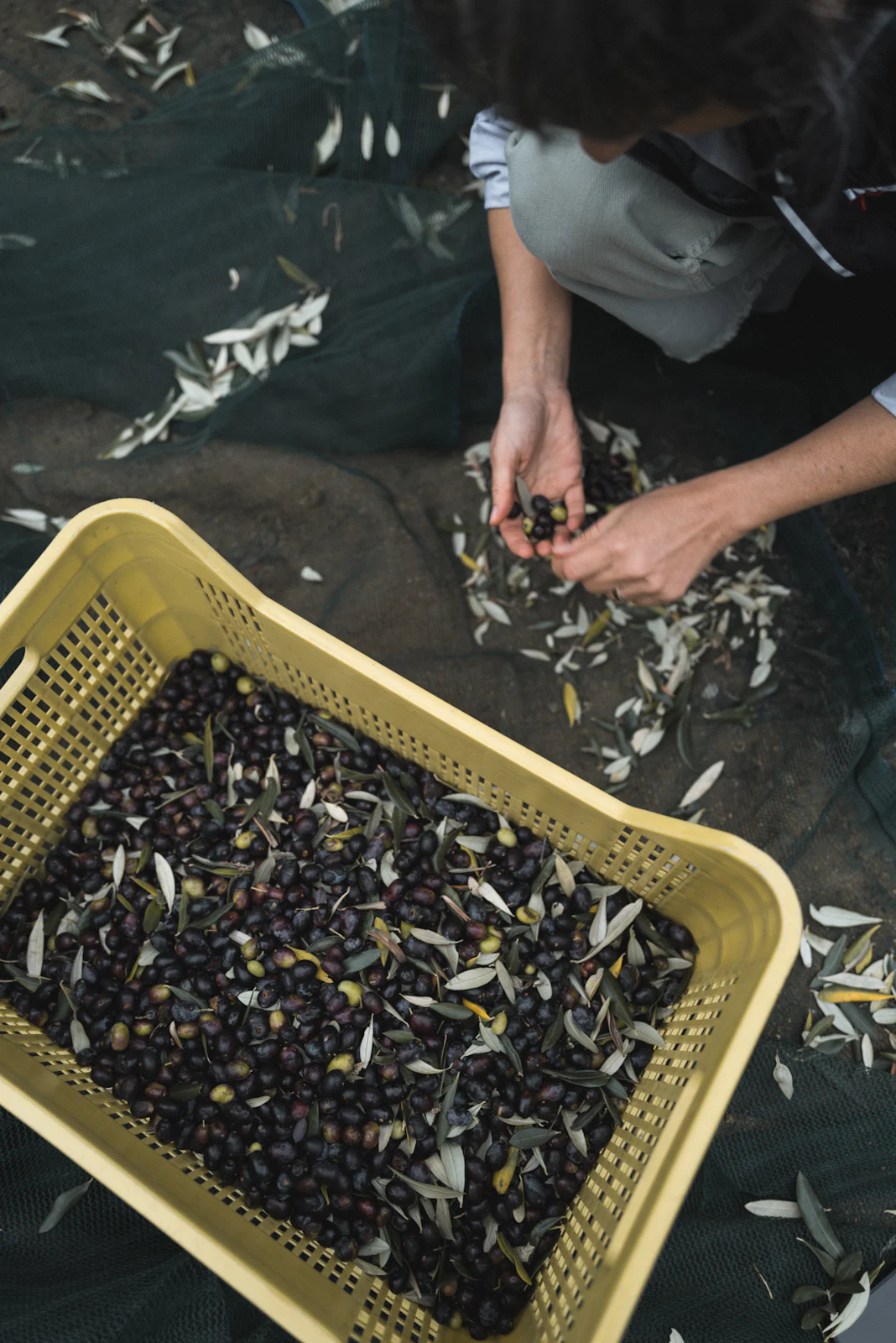
The biggest genuine cost driver is the harvest date. Green olives contain less oil. In an industrial comparison using fruit from the same grove, the oil yield was 11.37 per cent for the early harvest on 4 October and 13.67 per cent for the normal harvest on 8 December. Harvesting early therefore takes considerably more fruit per bottle – in exchange for the grassy, bitter, throat-catching profile that tasting panels count as quality. Why bitterness is not a fault is explained in what is extra virgin olive oil.
Variety, hand work and time to the mill
Single-variety oils from Picual, Koroneiki, Tonda Iblea, Taggiasca or Frantoio cost more to make than a blend: the varieties ripen differently and have to be picked and milled separately. Hand picking, small batches and milling within a few hours cost wages and mill time. Which variety gives which profile is set out in our guide to olive varieties in Europe.
Yield per hectare: the structural difference
A traditional grove holds 80 to 140 trees per hectare. A modern hedgerow planting puts more than 1,600 plants on the same ground and, from the third or fourth year, up to 12,000 kilos of olives per hectare; an intensive rain-fed planting yields about 6,200 kilos, of which roughly 1,200 kilos is oil. Old, widely spaced, often hand-picked groves produce a fraction of that per hectare. That difference sits inside every premium price – and it is justified.
Bottle, box and engraving
From roughly CHF 90 a litre upwards you increasingly pay for the object: designer flasks, wooden cases, engraved names, precious metal. The «Flacon Couture» can be personalised with a pendant of up to five letters. That is a legitimate gift – but it is not a sensory property, and it turns rancid over a year exactly like oil in a tin.
Medals and brand positioning
International competitions such as the NYIOOC World Olive Oil Competition judge sensory quality seriously – but entry is paid, per oil submitted. A medal therefore evidences quality and a marketing budget; small producers without that budget sell equally good oil with no award. The rest is positioning: «the world's first luxury olive oil» is a story, not a laboratory value.
What is available in Switzerland
The top segment is not on supermarket shelves. Three routes are realistic: Swiss fine-food online shops such as ThunGourmet, which carries Tuscan, Ligurian, Sicilian and Cretan oils between CHF 42 and CHF 246 a litre, priced in francs and with no customs trouble; the delicatessen floors of Globus, which lists Château d'Estoublon, and of Manor Food, both with availability changing seasonally; and direct import from the producer's own shop.
If you import directly, budget for the charges: edible oils, fats and margarine together are duty free up to 5 kilos or litres per person per day, and each further litre costs 2 francs. Once the value of all goods you bring in exceeds 150 francs, VAT is due as well – at the reduced rate of 2.6 per cent for foodstuffs. A single bottle at EUR 190 breaks that value threshold on its own.
The comparison: what CHF 20 to 25 already delivers
The question that matters is not what the world's most expensive oil costs, but at what price the gain stops. On the Swiss shelf the interesting zone is CHF 20 to 25 a litre: extra virgin grade, clear origin, dark glass, organic certification and good to very good marks in the Swiss consumer tests. Above that you buy terroir, single varieties, early harvest and craft; far above that you buy a bottle.

Migros Bio Greek extra virgin olive oil, 500 ml
Greece · Organic
CHF 11.400.5 L · CHF 22.80 per litre
Kassensturz / K-Tipp 2025: good Check priceTo see the full range, our overview of olive oil prices in Switzerland lists every price per litre from Migros to Lidl, and the Swiss olive oil test 2026 collects the verdicts of Kassensturz, K-Tipp, Saldo and FRC. Our advice: buy the everyday oil at around 20 francs and add a small bottle of early harvest oil for raw uses. That combination beats any single oil at CHF 240 a litre on taste – and costs less together. Which of the two belongs with which dish is sorted out in our guide to pairing olive oil with food by intensity.
Frequently asked questions
Which is the world's most expensive olive oil?
The «Bespoke» version of Lambda (Speiron, Greece) is generally named, but the producer publishes no price for it; circulating figures range from about EUR 11,000 to USD 15,200. What can be verified at source is Château d'Estoublon's «Flacon Couture»: 75 cl for EUR 190.00, about CHF 239 a litre.
Is expensive olive oil better?
Up to a point, yes. Early harvest, hand picking, single varieties and fast milling genuinely cost more and are measurable in tasting. Beyond roughly CHF 90 a litre you increasingly pay for the bottle, the box and the brand.
Why do online price claims differ so wildly?
Because bottle sizes are mixed up, reseller prices are taken for producer prices, gift packaging is counted in, and old claims are passed on unchecked. Only a price with a size, a date and a source is reliable.
Where do I buy high-end olive oil in Switzerland?
At the delicatessen counters of Globus and Manor Food, in Swiss fine-food online shops, or directly from the producer. If you import it yourself, 5 litres per person per day are duty free, each further litre costs 2 francs, and VAT applies above CHF 150 in goods.
Does an expensive bottle keep longer?
No. Oil at CHF 240 a litre should still be used within six to eight weeks of opening and kept cool, dark and tightly closed. Leaving the bottle on display in the light is the most expensive way to spoil oil.
Sources
- Château d'Estoublon: Flacon Couture, 75 cl, EUR 190.00 (producer's own shop, accessed 28 Sept 2026)
- Château d'Estoublon: olive oil range with prices (accessed 28 Sept 2026)
- ThunGourmet: olive oil range with prices in Swiss francs (accessed 28 Sept 2026)
- Castillo de Canena: First Day of Picual Harvest, 1 kg, EUR 25.50 (accessed 28 Sept 2026)
- Speiron: Lambda sales page (no price shown, accessed 28 Sept 2026)
- Wikipedia: Lambda (olive oil) – variety, bottle sizes, Harrods, 2010 announcement of the Bespoke edition
- European Central Bank: euro reference rates, 25 Sept 2026 (1 EUR = 0.9445 CHF)
- Yilmaz E, Aydin S: Production of Early and Normal Harvest Olive Oils Under Industrial Conditions. Eur J Lipid Sci Technol 2025 (oil yield 11.37 vs 13.67 per cent)
- La Comunal: Sistemas de cultivo en el olivar (planting densities and yields per hectare)
- Swiss Federal Office for Customs and Border Security: duty-free allowances for food
- Swiss Federal Tax Administration: VAT rates (reduced rate of 2.6 per cent on foodstuffs)
- NYIOOC World Olive Oil Competition: how to register and pay the entry fee